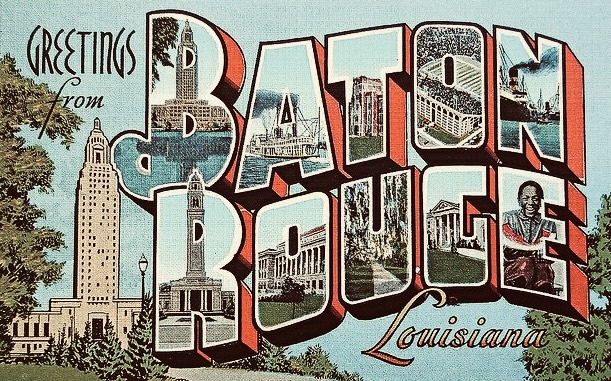
What was happening in Baton Rouge on this date?
January 1, 1722
One of the first land grant in the Baton Rouge area was made to Diron d’Artuguette by the king of France. d’Artuguette had built a house near where the State Capitol stands today by the end of 1721. D’Artuguette had also built a chapel on his farm (in picture), which was the first place of worship in Baton Rouge. The first mass was said in Baton Rouge on January 1, 1722, when Father Pierre de Charlevoix, best known for paddling around the Great Lakes stopped at d’Artuguette’s farm while canoeing down the Mississippi River to New Orleans. We do not know if d’Artuguette’s twenty-five slaves attended the service.
January 2, 1860
Today was the first day of classes at Louisiana State Seminary and Military Academy in Pineville in 1860. The faculty included superintendent William T. Sherman. The Seminary offered classes in engineering, chemistry, Latin, Greek, English, and mathematics. Cadets submitted to military-style discipline and were required to stand inspections, drill, stand guard, and attend classes. They were awakened by a bugler sounding reveille and went to bed at taps. The school would close after the onset of the Civil War and reopen in 1865. In 1869, fire ravaged the campus and the school was forced to move “temporarily” to Baton Rouge.
January 3, 2003
The third time was the charm as Kip Holden, Baton Rouge’s first African American Mayor-President was elected on his third attempt at the office and inaugurated today in 2005. in 20 The 2004 race was Holden’s third attempt to win the mayor-presidency. Holden’s election was fostered through the support of his urban black base but also with substantial support from suburban whites including many Republicans. Prior to being elected, Holden had served two years as a state senator, fourteen years as a state representative, four years on the Metro Council and Public Information Officer for the Baton Rouge Police Department.
January 4, 2004
LSU defeated Oklahoma, 21-14, today in 2004 to win the school’s first BCS National Championship in football. LSU had defeated Georgia in the National Championship game in December, and at the end of the season, three major conference teams had finished the regular season with one loss. The BCS put the Tigers and Oklahoma in the championship game at the Sugar Bowl, while Southern California, which had finished Number One in the Associated Press poll played Michigan in the Rose Bowl. LSU’s top-ranked held the country’s most prolific offense to just one touchdown until midway through the fourth quarter.
January 5, 1973
Louisiana’s eleventh and most recent constitutional convention was called to order by Governor Edwin Edwards today in 1973. The state had gone a record fifty-two years since the last constitution had been enacted in 1921. During 1973 and early 1974, 132 elected and appointed delegates met to work out the language. The new constitution was adopted by the voters on April 20, 1974 and became effective at midnight on December 31, 1974. The convention was chaired by Louisiana House Speaker E. L. “Bubba” Henry, and met at Independence Hall on North Third Street, just north of the State Capitol.
January 6, 2005
Legendary architect and Baton Rouge resident A. Hays Town died in Baton Rouge today at the age of 101. He designed commercial and governmental buildings in the style of modern architecture for the first forty years of his career, but he became best known for his residential architecture, which was heavily influenced by the Spanish, French, and Creole history of Louisiana. His work was featured in Time, Life, Southern Living and other magazines. There are approximately a thousand homes that were designed and built by Town, and his distinct style continues to exert an influence on modern southern architecture.
January 7, 1975
In the general election held in November of 1974, Republican Henson Moore defeated Democrat Jeff Lacaze by 14 votes in a race to become the U.S. Representative from the Sixth Congressional District. When malfunctioning voting machine cast the recount of the vote into doubt, a judge ordered a rematch election, which was held today in 1975. Moore won with a large majority and went on to represent Sixth District until 1986, when he ran unsuccessfully for the U. S. Senate. Later he would serve as U.S. Secretary of Energy and Deputy Director of the White House staff under President George Bush.
January 8, 1850
In 1850, the Jesuit order established a school for boys on North Street, between what are now Fifth and Seventh Streets. In those anti-Catholic times, the Baton Rouge City Council approved a new street through the middle of the campus to be called St. Hippolyte Street. Tellingly, St. Hippolyte led an anti-papal schism in fourth century Rome before being burned alive. The school adjusted its plans and opened this week in 1850 as the College of Sts. Peter and Paul. It would remain open until 1853, when two faculty members succumbed during a yellow fever epidemic. St. Hippolyte Street would eventually be called North Sixth Street.
January 9, 1940
Joe Delpit was born in Baton Rouge today in 1940, the son of Edmae Butler and the late Thomas H. Delpit. He married to the former Precious Robinson in 1959 and they have five children and eleven grandchildren. He attended St. Francis Xavier Elementary School and McKinley Senior High School before attending Southern University. He was the first African-American to be elected to the Baton Rouge Metro Council and he served briefly as Mayor Pro Tempore. In November 1975, he was elected State Representative of District 67 in the first primary and served his district until his retirement in 1992.
January 10, 1947
Today in 1947, the State Board of Education approved establishing a law school at Southern University. Now known as the Southern University Law Center, the school opened for instruction the following September. Its concept was born out of a response of a lawsuit by an African American resident, Charles J. Hatfield, III, seeking to attend law school at a state institution. In recent years, the school has received a number of favorable rankings, including “Best Law Schools for Public Service” in 2012, and ranking first among law schools awarding “Law Degrees With Most Financial Value at Graduation” in 2011 by U.S. News & World Report.
January 11, 1924
James “Slim Harpo” Moore was born in Lobdell today in 1922. on January 11, 1922. He was a self-taught harmonica player and was forced to quit school in the 10th grade after losing both parents. Supporting himself and his family with manual labor, he began to pick up musical gigs and in 1957, he recorded “I’m a King Bee” under the name “Slim Harpo.” “King Bee” was a moderate hit, followed by an even bigger hit “Raining in my Heart”. After Slim’s next two albums bombed, he recorded “Scratch my Back” which turned into his biggest hit. He died at the Baton Rouge General Hospital on January 31, 1970.
January 12, 1937
Today in 1937, the Works Progress Administration approved funding for the Capitol Annex across Third Street from the Capitol. The Annex now serves as the Office of the Lieutenant Governor and other state agencies and was designed by Edward F. Neild. It features exterior granite panels inter spersed with a floral design and a Conrad Albrizio fresco in the lobby which illustrates the state’s industry, public construction, and social welfare. Construction was completed in 1938 at a cost of $1.1 million. Throughout the 1930’s, WPA funds were used to build dozens of structures in Baton Rouge, including the old Mississippi River Bridge and Tiger Stadium.
January 13, 1978
Former U. S. Vice President Hubert Humprey died in Waverly, Minnesota today in 1978. As a young graduate of the University of Minnesota, he came to Baton Rouge to work toward a master’s degree in political science from Louisiana State University in 1939. Humphrey would later say that his experience shaped his views on civil rights. “Everything you did in Louisiana — study or work — was, in a sense, conditioned by that environment of often corrupt, usually bizarre, southern politics and race relations. Louisiana,” he wrote. “It taught me something about American life that I barely knew in fact or in theory.”
January 14, 1977
One of the most controversial murder trials in Baton Rouge history concluded today as Mister Donahue (that was his real name) was convicted of the robbery and second degree murder of Zachary Council Marshall Bond in August of 1973. No arrests in the case had been made in the fifteen months after the murder, and in the week before Donahue’s trial, a second man, Kenneth Wayne Whitmore, was also convicted of the crimes. During the trial, the central piece of evidence was a rusted bucket belonging to the victim found in a field near Port Hudson. No murder weapon—suspected to have been a screwdriver—was produced.
January 15, 1793
First official legal act of marriage in Baton Rouge was recorded today 1793 as Don Antonio de Gras wed Genevieve Duler of St. John the Baptist Parish. Don Antonio was a native of Majorca, Spain who settled in Baton Rouge in the late 1700s. He was a merchant, shipper, philanthropist, and surveyor. In addition, he amassed significant landholdings in and around the new town. The couple married Baton Rouge’s St. Joseph Catholic Church, which was only fair as he had donated the land on which the church was built. The original name of the church was the Church of the Virgin of Sorrows and later the Church of Our Virgin of Sorrows.
January 16, 1817
Over the years, Baton Rougeans have accepted January 16, 1817, as the day that Baton Rouge was incorporated by the State of Louisiana. The truth is that the act passed by the Louisiana Legislature on this day in 1817 did not instruct Governor Jacques Villere or the secretary of state to issue a charter to the town. Instead, it described the method by which Baton Rouge would become an incorporated town—which happened the following year in 1818. Over the years, the act was deemed to be as good as a charter, and the rest was just paperwork. So Happy Birthday, Baton Rouge!
January 17, 1945
What happened to the ducks? Today in 1945, Major James Brown of the Wildlife and Fisheries Commission called in the Navy and Coast Guard to help look for 35 million missing ducks that had left Canada in October and November and were expected to stop off in Louisiana, to the delight of shooting enthusiasts. According to Brown, “Not five percent remained in Louisiana long enough for the hunter to oil is gun, no one knows where they went. Later, it would be suspected that drought conditions the previous summer and fall had dried up marshes to the extent that the ducks got to Louisiana and just kept going.
January 18, 1962
On January 17, 1962, about 1,000 Southern University students marched to the residence of President F. G. Clark to demand an explanation for why seven students had been expelled in the aftermath of a December protest at the Baton Rouge Courthouse. At the time, he had promised that no expulsions would be forthcoming. At a special convocation the following day, he announced dismissal of the seven student leaders whom he characterized as “vandals and anarchists.” He also announced that the university was closing that same day, that each student would have to apply for re-admission and that none would be allowed to return to class until accepted by the university.
January 19, 1939
In January, 1939, the East Baton Rouge Parish Library was established with a collection of second-hand donated books. During its first three years, eight additional branches opened to service the Baton Rouge area. Today, the library is comprised of a Main Library and 13 community or regional branch libraries, and several bookmobiles. With a staff of more than 540 employees, the Library is open a cumulative total of 958 hours weekly. Additional outreach service is provided on a regular basis to area schools, day care centers, retirement centers, and various community centers. The Library’s collection numbers almost 2 million items.
January 20, 1968
Today in 1968, Judy in Disguise (with Glasses) by John Fred and the Playboy Band began the first of its two-week stay in the Number 1 slot of the Billboard Top 40 chart. John Fred Gourrier of Baton Rouge formed the band in 1956 when he was 15. Their first hit single was in March 1959’s Shirley. He appeared on Alan Freed’s show, but when Dick Clark asked him to sing on American Bandstand, Fred, who played basketball and baseball at LSU and Southeastern Louisiana University, had to turn him down. He had a game. Fred died in April, 2005.
January 21, 1964
Today in 1964, two candidates for the Louisiana House of Representatives sued each other and the parish Democratic Executive Committee over the results of an election held on November 6th 1963. First returns showed Joe Keogh the winner by 65 votes. Later a 100-vote error gave the victory to I. P. “Pat” Collier by 35 votes. Then it was discovered that one of the four voting machines at Prescott High School failed to show that any votes had been cast in the race. Collier and Keogh both filed suit demanding to be certified as the winner of the race. Keogh eventually prevailed as was seated.
January 22, 1935
This week in 1935, Auld Lang Syne was in the air as Guy Lombardo and the Royal Canadians performed at the Paramount Theater on Third Street. Lombardo and his orchestra had already popularized the Scottish folk song, playing it for the first time at on New Year’s Eve 1929 at the Roosevelt Hotel in New York. The program for the Paramount Concert was sponsored by Esso and featured Lombardo, who was then at the height of his popularity, comedians Crosse and Dunne, blues singer Joan Abbott, the Embassy Trio, the Viking Quartette and the O’Flynn Choristers. One of Lombardo’s biggests hits in the 1930’s had been “Lazy Lou’siana Moon”.
January 23, 1849
Today in 1849, Baton Rougeans gathered at the home of Baton Rouge Garrison commander Zachary Taylor to wish him well before he left for Washington the next day to assume his duties as President of the United States on March 20th. Elected in November, 1848, Taylor had not campaigned for the job and was the first person to be elected to the office without ever holding another elected office. Born in Virginia, “Old Rough and Ready” thought of Baton Rouge as his home during most of his adult life. He had come to national prominence during the Mexican-American War and died in office a year after his inauguration.
January 24, 2004
It was a celebration that could only happen in Baton Rouge. Today in 2004, ecstatic LSU and Southern football fans rallied downtown to celebrate LSU’s first BCS Championship over Oklahoma in the Sugar Bowl and Southern’s winning the black national championship with a 20-9 victory of Alabama State in the SWAC Championship Game. Marching bands from both schools performed on the State Capitol steps, coaches and players were presented to the roaring crowd, and coaches Nick Saban and Pete Richardson showed off their trophies. Mayor Bobby Simpson said that 70,000 to 100,000 attended the parade and rally at the ally at Capitol, making it the largest in the city’s history.
January 25, 1834
The Methodist Episcopal Church of Baton Rouge was incorporated by legislative act today in 1834. Methodist preachers, known as “circuit riders”, began ministering in the Baton Rouge area in the 1820’s, and one of them, Reverend Charles K. Marshall, served as the congregation’s first pastor. Later, the name of the church was changed to First Methodist Chruch and the first church was built near the corner of Laurel and Fourth Streets. The 1850 census shows that of the 306 churches in Louisiana, 125 of them were Methodist. The church moved to a new $250,000 home at the corner of North and East Boulevards in 1926.
January 26, 1861
Following the election of Abraham Lincoln in 1860, a convention of representatives met in Baton Rouge voted 113 to 17 to adopt the Ordinance of Secession, taking Louisiana out of the union. Judge James G. Taliaferro of Catahoula Parish was the most outspoken opponent, correctly warning that secession would bring war, ruin, and decline. Baton Rougeans rushed to the abandoned U. S. Army Garrison on Third Street to run up the Lone Star Flag (see drawing) and the governor called for homes and businesses to put lights in their windows to show their support. On February 4, 1861, the State of Louisiana joined the Confederate States of America.
January 27, 1991
Today in 1991, Presidential candidate Bill Clinton visited Louisiana Governor Edwin Edwards at the Governor’s Mansion in Baton Rouge on a campaign trip through the state. Earlier that day, an Arkansas woman named Gennifer Flowers had told the New York Times that she’d had a torrid 12-year relationship with Clinton. Edwards later said that Clinton asked him what he should say, and his response was “a man and a woman can have a torrid 12-day or 12-week relationship, but nobody has a torrid 12-year relationship. Married people will understand.” Clinton replied that he wouldn’t say that. Edwards’ response was, “I didn’t think you would.”
January 28, 1982
Liggett’s Drug Store at the corner of Riverside Mall (once and now Third Street) and Florida Street closed its doors this week in 1982. Owner Riggs P. Willis estimated that more than 12 million people had passed through the store since it first opened as Liggett’s Rexall Drug Store in November, 1951. Baton Rougeans had never seen a drug store where they could roam the aisles at their leisure and examine the products. It was also Louisiana’s largest drug store. A neon rooftop Coca-Cola sign, added in 1960 and renovated in 2012, welcomed Third Street customers to the store’s well-patronized soda fountain.
January 29, 1929
The well-intentioned but ill-considered Prohibition Era began today with the ratification of the 18th Amendment to the Constitution, banning the manufacture, transportation, and sale of alcoholic beverages within the United States. Prohibition would become the law of the land the following January 1920. The law led to interesting consequences in Baton Rouge. During the thirteen years of Prohibition, octogenarian ladies and teenagers would be arrested for running liquor establishments in the city. The law was tottering toward its eventually repeal in 1933 when Senator Huey Long responded to a question about what was being done to enforce the law. Huey’s reply? “Not a damn thing!”
January 30, 1946
Tonight in 1946, a banquet with the theme “A Farewell to Arms” was held on the roof of the Heidelberg Hotel (now the Capital Hilton) as the last eleven members of the Foreign Service Wives Club of Baton Rouge disbanded the club at the end of World War II. More than one hundred women who had been members of the club since its founding in July of 1943 were honored. The club was one of dozens of informal organizations formed during World War II to assemble care packages, roll bandages, write holiday cards and perform other services for soldiers serving overseas.
January 31, 1964
Tonight in 1964, Fats Domino and his band played at a dance at the Catholic Youth Organization Center at 2245 Florida Street. The first CYO was initiated by prison chaplain and auxiliary bishop Bernard J. Sheil in Chicago in 1930 during the time of the Great Depression. The first CYO was conceptualized as an athletic association to offer young males a community and constructive leisure activity in the hope to dissuade them from taking part in criminal activities. Archbishop Joseph Francis Rummel brought the CYO to Louisiana in late 1936.
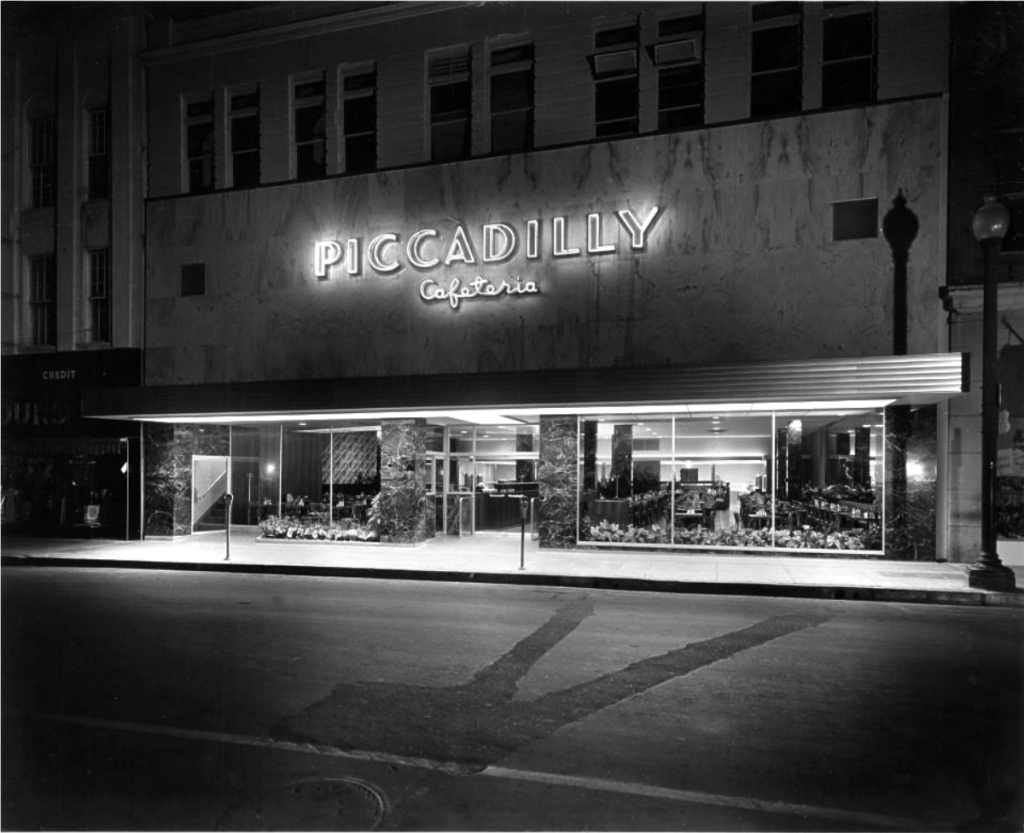
February 1, 1944
Today in 1944, Tandy Hannibal Hamilton purchased the small Piccadilly Cafeteria on Third Street in downtown Baton Rouge from the original owner, Thomas J. Costas, for $65,000. Before coming to Baton Rouge, Hamilton and his wife Julia had been living in Kansas City, where he was serving as general manager of a cafeteria chain. Hamilton began building the business immediately, despite the wartime difficulties imposed by food rationing and equipment shortages. He contacted several friends and associates, some still in the service, encouraging them to join the operation. Over the course of the next fifty years, Piccadilly Cafeterias, LLC would grow to more than sixty cafeterias in twelve states.
February 2, 1952
On this Saturday morning in 1952, the kool kats and kittens-250 of them anyway-were flocking to the BREC recreation center on St. Louis Street for the weekly radio broadcast of Teen Town Rally on WIBR radio. Teens were encouraged to take part in the talent portion of the broadcast by either singing or playing an instrument. The rally also featured “five instrumental recordings by popular orchestras with an explanation of the techniques involved” and a special appearance by the Istrouma High School Pepsters. From its founding in 1948 until the 1990’s, pop music found a home at WIBR, the “Shack by the Track in Baton Rouge.”
February 3, 1990
Today in 1990, the high-scoring Loyola Marymount Lions from Malibu came to Baton Rouge to take on Shaquille O’Neal, Chris Jackson and the LSU Tigers. Seven LSU players were in double figures as LSU played to the Lions’ tempo. Jackson had 34, Vernel Singleton 22 and O’Neal posted 20 points, 24 rebounds and 12 blocks. Despite several blocks, the late Hank Gathers kept forcing his way to the goal and would finish with 48 points of his own. The final was LSU 148, Loyola Marymount 141 in overtime, and many think it remains the greatest game ever played in the history of the Maravich Center.
February 4, 2012
This weekend in 2012, Madonna was the headliner of the half-time show at Super Bowl XLVI in Indianapolis, but the real entertainers on stage were the Fabulous Dancing Dolls of Southern University who performed with her. The Dancing Dolls have been a mainstay of performances for the Southern University Human Jukebox since 1969, when Isaac Greggs was named band director at Southern. He was adamant that he wanted “a lot of pageantry, excitement and precision maneuvers.” He also wanted some pretty young women to add pizzazz to his all-male band. He brought in Gracie Perkins, who was doing her practice teaching at the Lab School, to organize the Dancing Dolls.
February 5, 1940
Today in 1940, Jimmie Davis recorded You Are My Sunshine for the Decca record label. The song had been first recorded in August of 1939 by the Pine Ridge Boys of Georgia and would serve as Davis’s campaign songs for his successful gubernatorial campaigns in 1944 and 1960. It’s one of the most commercially programmed numbers in American popular music and has been covered by so many different types of musicians that it’s lost its original country music identity. In 1941 alone, the song was recorded by Gene Autry, Bing Crosby, Mississippi John Hurt, Wayne King and Lawrence Welk. In 1977, it would be named Louisiana’s official state song.
February 6, 1973
Before there was Tigerland, there was Tigertown. Before real estate, traffic and parking patterns lured students to the retail areas south of the LSU campus in the 1980’s, the area north of campus was the place to go for students, faculty and staff. One of the most popular destinations was the White Horse Tavern at 2353 Highland Road which opened today in 1973. The White Horse caused a sensation later in 1973 when Metro Councilman Stanley Gross suggested that the bar was owned by a company with suspected ties to the Mafia. Owners Allen Boudreaux and Frederick Pou denied the charge.
February 7, 1970
On this Saturday afternoon in 1970, Pete Maravich set an NCAA Division I record with 69 points in a 106-104 loss to Alabama at Memorial Coliseum in Tuscaloosa. Pistol Pete, who would be named the Associated Press Player of the Year at the end of the season, connected on 26 of 57 field-goal attempts and went 17 of 21 from the free-throw line. He’s still the all-time leading NCAA Division I scorer with 3,667 points scored, and his accomplishments were achieved before the three-point line and shot clock were introduced to NCAA basketball and despite being unable to play varsity as a freshman under then-NCAA rules.
February 8, 1993
Louisiana State University presented Lady Margaret Thatcher with an honorary degree Monday, almost three years after her ally Ronald Reagan received the same honor. At a special convocation in the Assembly Center attended by about twenty-five hundred people, LSU awarded an honorary doctorate of humane letters to Thatcher, the former prime minister of Great Britain. Thatcher told the crowd that despite the recent fall of communism, the United States, England and other democratic countries cannot relax their guard. “We must not fall into the trap of thinking because communism has collapsed, we’re automatically going to get a successive democracy and successive enterprising economy.”
February 9, 1923
Inventor and botanist George Washington Carver made his fourth and last appearance at Southern University today in 1923, when he spoke to a large group of students and others about new uses for cabbages and beans. Carver’s prominence as a scientific expert in the late 19th century had made him one of the best-known African-American intellectuals of his time. President Theodore Roosevelt admired his work and sought his advice on agricultural matters. Carver used his celebrity to promote scientific causes for the remainder of his life. He was a frequent visitor to Southern University, and from 1923 to 1933, Carver toured white Southern colleges for the Commission on Interracial Cooperation.
February 10, 1763
Sixty-four years of French possession of Baton Rouge came to an end today in 1763, when the Treaty of Paris ended the French and Indian War between Great Britain and France. France gave up all its territories in mainland North America, effectively ending any foreign military threat to the British colonies. Britain would gain all French territory east of the Mississippi, while Spain would retain Cuba in exchange for handing Florida over to Great Britain. New Orleans and French territories west of the Mississippi would become Spanish. The British would remain in Baton Rouge only sixteen years, as Spanish troops seized the British fort here during the American Revolution.
February 11, 1861
Today in 1861, the legislature of the recently seceded state and new Republic of Louisiana adopted their national flag while in session in Baton Rouge, and it was something to see. Its thirteen stripes alternated red and blue stripes with white stripes, and the upper left hand corner featured a pale yellow star on a red background. Officially, the flag would remain in use until the end of the Civil War, but by the end of 1861, the familiar blue flag with pelican and state motto of “Union, Justice, Confidence” was already put into unofficial use. It would named the official state flag in 1912.
February 12, 1955
After a disappointing record 5-5 record in 1954, LSU Head Coach Gaynell Tinsley stepped down and the search was on for this replacement. Most of the conversation centered around Frank Broyles and Ray Graves who were assistants at Georgia Tech and Coach Don Faurot at Missouri. Then a dark horse entered the race, and today in 1955, Paul Dietzel, a native of Ohio and an assistant coach at Army interviewed for the job. Dietzel would eventually be hired and coach the Tigers for eight years, highlighted by a national championship in 1958. In 1962, he would leave LSU to return to West Point as head coach.
February 13, 1899
The coldest day in Baton Rouge in history was recorded on February 13, 1899, when the the thermometer plunged to 2 degrees above zero. During the Great Blizzard of 1899, record low temperatures were recorded across the South. The port was completely iced over by February 13, with ice floes reportedly floating out of the Mississippi River into the Gulf of Mexico. On February 14, the New Orleans experienced its coldest-ever Mardi Gras reading of 7 degrees. The Krewe of Rex Parade was delayed while snow was removed from the route. The second coldest was recorded during winter freeze of 1989, when 8° was recorded. (It “only” got down to 14 degrees in January 2018.)
February 14, 1928
Worst Valentine Day Gift Ever. The first five electric traffic signals in Baton Rouge were switched on today in 1928. Four signals along Third Street at North Blvd., Convention, Florida and Main Street and another at the intersection of Florida and Church Street, which we now call Fourth Street, were the first four to be erected. Setting a really bad precedent for future generations of drivers, motorists were advised to disregard the signals if they didn’t think they were working properly. The next two signals would be placed on Church Street at Convention, and on North Blvd. at St. Ferdinand Street.
February 15, 1910
The Boy Scouts of America were formed this week in 1910, and the first Boy Scout troop west of the Mississippi was founded in 1912 in Lake Charles. Later in 1912, Rev. T. M. Hunter of the First Presbyterian Church of Baton Rouge established the first troop here and affiliated it with Boy Scouts of America two years later. The Istrouma Area Council, serving the Baton Rouge area was established in 1919. In the days of segregation, the Istrouma maintained a separate summer camp for African-American scouts at Camp Chenier. By 1967, Camp Chenier had been closed and the regular councils camps were integrated.
Febrary 16, 1932
96,000 Americans entered the “Why I Like to Buy Groceries at the Piggly-Wiggly” letter-writing contest, but today in 1932, Mr. and Mrs. F. C. Stoops of Park Boulevard in Baton Rouge brought home the bacon and a gift certificate for free groceries with the winning entry. The Stoopses had been residents of Baton Rouge for three years after Mr. Stoops had come to town to take a position at Standard Oil. After opening its first store in 1916, 1932 would be the company’s best year ever, operating 2,660 stores. Five of those stores were in Baton Rouge, including the 1209 North Blvd. location favored by Mr. and Mrs. Stoops.
February 17, 1921
Today in 1921, G. W. Sitman, chairman of the Baton Rouge Board of Health announced that due to overcrowding and lack of maintenance, burials would be discontinued at Sweet Oliver Cemetery on 22nd Street. Sweet Olive Cemetery is Baton Rouge’s oldest African American cemetery, and the only one in the city until the Greenwell Springs Cemetery opened in 1925. There would continue to be above-ground burials in vaults at Sweet Olive well into the 21st century, but it was clear that the cemetery was in dire need of repair and maintenance. To address this need, the Sweet Olive Association was formed in the 1970’s and incorporated in 1998.
February 18, 1944
Today in 1944, the Baton Rouge Lions Club announced the kick-off of its big rat-extermination campaign in the city. Campaign leaders said that a lot of poisoned horsemeat would be needed to rid the city of its rat population, and that they were raising $16,000 to pay for the campaign. B. L. Dodwell, the chairman of the drive, noted that the poison would not be lethal to cats and dogs. David E. Brown, the state health officer, said that ten to twelve state inspectors would be assigned to Baton Rouge to supervise the forty Lions Club volunteers. The Lion’s Club would continue to sponsor eradication campaigns over the next decade.
February 19, 1986
Adler Berriman “Barry” Seal was an American smuggler of drugs and arms, aircraft pilot, dealer, and money launderer who flew flights for the Medellín Cartel. Seal was employed by the Medellín Cartel as a pilot and drug smuggler and transported numerous shipments of cocaine from Colombia and Panama to the United States. He was eventually arrested and after he was sentence in 1984 and offered to cooperate with the government as an informant. Seal was sentenced to work in public service at the Salvation Army facility on Airline Highway and in revenge for turning on the cartel, he gunned down by a Medellin drug cartel hit squad today in 1986.
February 20, 1811
It’s hard to believe today, but Baton Rouge almost wasn’t part of Louisiana. Today in 1811, President Madison signed an enabling act to authorize a constitutional convention for Territory of Orleans, which would include land secured in the Louisiana Purchase and would become the State of Louisiana. As Baton Rouge was not part of the Purchase and therefore not yet part of the United States, but outraged Baton Rougeans protested the oversight and demanded that the Republic of West Florida be included in the new state. When the constitution was completed in 1812, it included a request that the new state should include West Florida.
February 21, 1988
Today in 1988, Reverend Jimmy Swaggart gave his now-infamous “I have sinned” speech. He tearfully spoke to his family, congregation, TV audience, and finally said “I have sinned against You, my Lord, and I would ask that Your Precious Blood would wash and cleanse every stain until it is in the seas of God’s forgetfulness, not to be remembered against me anymore.” The Louisiana presbytery of the Assemblies of God had initially suspended Swaggart for three months, but the hierarchy of the Assemblies of God national presbytery did not believe that he was genuinely repentant in submitting to their authority and defrocked him, removing his credentials and ministerial license.
February 22, 1932
As part of the George Washington Bicentennial Tree Planting Program this week in 1932, Baton Rouge school children and students of forestry and horticulture began planting a thousand trees along Dalrymple Drive between City Park and Highland Road, and along Plank Road in North Baton Rouge. The program also inaugurated the state highway beautification program. The work was supervised by J. R. Wendt, maintenance superintendant of the Louisiana Highway Commission. The trees were furnished by the LSU Forestry nursery at Woodworth. Planted as part of the same program were the “George Washington Oak” and the “Martha Washington Oak” near the Arsenal
Museum on the grounds of the State Capitol.
February 23, 1971
The Cotton Club had been a feature of the 2300 block of Tigertown since the 1930’s, so when Mardi Gras was observed today in 1971, the ten or twelve patrons watching the festivities in New Orleans on television and asked themselves why they weren’t having more fun. “They decided to have their own Mardi Gras,” said owner Glenn Constantino. “They put my brother Frank in a wagon and stuck a meatball and a crawfish on a cooking fork for scepter.” The Krewe of Grease had been born. By the mid-1980’s, it had become an annual ritual attracting hundreds to the bar until it closed in the early 2000’s.
February 24, 1875
Today was Mardi Gras in 1875, and Governor Henry C. Warmoth signed the Mardi Gras Act, making Fat Tuesday an official state holiday. But Carnival was slow to come to Baton Rouge. The first parade in the city was sponsored by two African American clubs, the Purple Circle Social Club and the “Esso Boosters.” It took place in 1941, and the King and his parade followers rolled down South Blvd., on to East Blvd., North Blvd. and ending on Government Street where the revelers attended a ball at the Club’s headquarters. An estimated 20,000 people showed up to watch the festivities.
February 25, 1963
The department store on the southwest corner of Third and Main that was originally called the S. I. Reymond Co., Ltd., or Reymond’s Department Store, was the showplace of the city. In 1929, it was sold and became Dalton’s, and in 1955, it was sold once again and became a branch of the D. H. Holmes Department Store of New Orleans. But downtown retail was dying, and “Holmes’s” closed this week in 1963. The store was torn down and was the site of a paved parking lot until recently, when it was sold once again as the site of a new hotel.
February 26, 1953
“Million Dollar Mermaid” with Esther Williams and Walter Pigeon was the first feature shown at the newly remodeled 300-seat Ann Theater at 6704 Scenic Highway at Airline which re-opened today in 1953. It was originally built in the 1940’s, and was one of the several movie houses that thrived in North Baton Rouge in the years after World War II. Others included the Gem on Main Street, the Regina on Scenic Highway, and the Rex on Plank Road. In the 1970’s, The Ann was the one of the prime showcases for African-American films. The theater closed in the early 1980’s.
February 27, 1859
Today in 1859, the Steamboat “Princess”, one of the great floating palaces of its day, blew up moments after pulling away from dock at Baton Rouge. A large crowd that had gathered on the levee to watch the boat’s departure witnessed the explosion in horror. Seventy of the Princess’s 250 passengers, including several prominent Baton Rouge attorneys on their way to a meeting in New Orleans, were blown to bits. Passengers with third degree burns who could get to shore were treated at Cottage Plantation. Slaves wrapped the injured in sheets and spread flour over them, which was the conventional treatment for burns at the time.
February 28, 1981
On the Saturday before Fat Tuesday in 1981, the Mystic Krewe for the Preservation of Lagniappe was on the move as the first Spanish Town Mardi Gras Parade began to roll down Spanish Town Road. The few people who actually saw it reported that fewer than ten people lined the streets. Children were the marchers, and they banged on fruit cartons and threw a few beads. Then, the spectators would run to the next corner and throw the beads back to the marchers, so that the parade could continue. Over the years, the parade would outgrow Spanish Town and sprawl over all of downtown.
February 29, 2016
On this Leap Day in 2016, a statue of LSU basketball great Bob Pettit was unveiled at the university’s basketball facility. Pettit’s basketball career had humble beginnings. At Baton Rouge High School, he was cut from the varsity basketball team as both a freshman and sophomore, but he would go on to stardom, and in 1954, his number 50 was retired at LSU–the first Tiger athlete in any sport to receive this distinction. At the end of his remarkable NBA career in 1965, he was the league’s all-time leading scorer and second leading rebounder with career averages of 26.4 points and 16.2 rebounds.
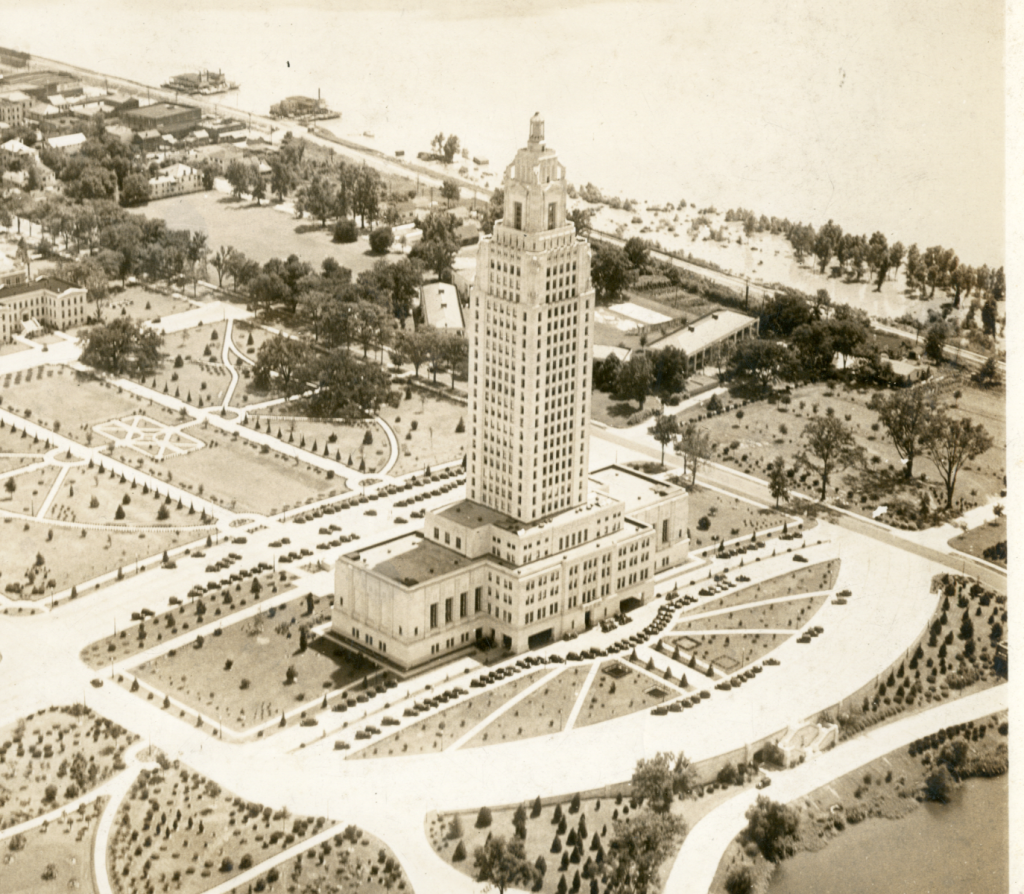
March 1, 1932
The first concrete had been poured in December of 1930, the cornerstone had been set in May of 1931, and today on March 1, 1932, the new State Capitol was completed. The legislature had appropriated $5 million to construct the 27-story skyscraper and it visitors could see where every penny went. Built in the beaux arts style that told the story of Louisiana and her people in stone, bronze, wood and even bagasse, it would become the jewel of the Baton Rouge skyline. It would contain statues and the first fresco murals by Conrad Albrizio that would be the first in a public building south of the Mason Dixon line.
March 2, 3000 BC
Five thousand years ago-or maybe eight thousand, the people that anthropologists call the Archaic people lived in the Baton Rouge area and were hard at work on the construction of the oldest human-built structure in Baton Rouge, the ceremonial mound near the Arsenal Museum. Older than the Pyramids of Egypt, the Arsenal Mound is at least a thousand years older than the other two large mounds in Baton Rouge -one on the LSU campus and the second on the site of Town Square on North Boulevard that was leveled in the 1800’s. Unlike the other two, the Arsenal mound was never used as a burial mound.
March 3, 1881
In 1880, Southern University opened its doors for the first time this week (3/7) in New Orleans. Senator P.B.S. Pinchback and other black leaders petitioned the state to establish the university came into existence on April 10, 1880, with by the passage of Act 87 of 1880. The college would initially open Calliope Street and later move to Magazine and Soniat Street Square in 1883. The university provided academic studies in the primary grades and extend through high school, along with some college-level work. It also offered training in agriculture, home economics, printing, carpentry, and tin-smithing. The college would struggle in New Orleans and move to Baton Rouge in 1914.
March 4, 1927
The Island Queen, said to be the largest inland river steamer that ever called at Baton Rouge this weekend in 1927, en route from New Orleans to Cincinnati. The Island Queen was a steel hull sidewheeler built in Midland, Pennsylvania, in 1923. She was christened in Cincinnati on April 18, 1925, and used for tramping between New Orleans and Pittsburgh. She was considered to be the largest river pleasure boat in the world, accommodating four thousand passengers. In 1947, a welding accident detonated the boat’s fuel tank causing a massive explosion at the Pittsburgh dock. No passengers were aboard at the time of the fire, but 19 crew members were killed.
March 5, 1968
One hour and twenty minutes after the new Earl K. Long Hospital opened its doors on Airline Highway today in 1968, seven pound Vera Louis was the first baby to be born there. Labor diputes, equipment delays and staffing problems had delayed the hospital’s opening by twenty-one months. While all hospital services would not be available for several months, Earl K. was able to open 31 of its 250 beds on its first day with the help of more than one hundred volunteers who had been recruited by the American Red Cross . The hospital would close in 2010 and be demolished on June 12th, 2015.
March 6, 2005
The Grand Opening of the Shaw Center in downtown Baton Rouge was held this weekend in 2005. After a ceremony attended by Governor Kathleen Blanco and Mayor-President Kip Holden, hundreds of people filed into the $65 million project. Within the maze-like building’s six floors Saturday was live music, acting classes and demonstrations of the different types of art the center will display, as well as the opening of the Tsunami sushi restaurant later that evening. Most of the funding for the project came from four partners: the State of Louisiana, LSU, the Baton Rouge Area Foundation, and the City-Parish. Private donors provided about $15 million.
March 7, 1847
St. Mary’s Select and Free School, the first Catholic school in the city, was founded by the Sisters of Charity this month in 1847. It met for a time at the home of Thomas Gibbes Morgan, the father of Civil War diarist Sarah Morgan on Church Street, which later became Fourth Street. Despite the reasonable six dollar per month tuition for elementary students and nine dollars per month for students in advance grades, the school would fail by 1851. St. Mary’s School would be replaced that year by St. Mary’s Academy, run by the Jesuit order, which in turn would close in 1853 during a yellow fever outbreak.
March 8, 1852
Today in 1852, construction completed on what we now call the Old State Capitol. New York native James H. Dakin was hired to design the Baton Rouge capitol building. Dakin had been a colonel of a militia regiment called the Louisiana Volunteers and went to the Mexican War in 1845. Dakin referred to his turreted design, built 1847-52, as “Castellated Gothic” due to its decoration with cast iron, which was both cheaper and more durable than other building materials used at the time. Mark Twain, however, as a steamboat pilot in the 1850s, loathed the sight of it, calling it pathetic and perhaps the ugliest public building in America.
March 9, 1914
Today is Founders Day at Southern University, marking the day when Southern opened its Scotlandville campus in 1914. After floundering in New Orleans for more than thirty years, the university made the commitment to be ore accessible to students from throughout the state and started looking for an appropriate site. The eventual winner was the former Scotland Farm, five miles north of Baton Rouge. Dr. Joseph Samuel Clark was the first president at the Scotlandville campus, and under Clark Southern began its evolution into a major black institution of higher learning, growing from fewer than 75 students in 1914 to more than 500 at the end of his tenure.
March 10, 1980
David Conner Treen was inaugurated as Louisiana’s first Republican governor since Reconstruction today in 1980. Treen had been born in Baton Rouge in 1928 and grew up in Metairie, where in 1972, he had become the first Republican in modern times to be elected to the U.S. House of Representatives from Louisiana. Treen’s oath of office as governor was administered by Judicial Court Judge Doug Gonzales, a Republican from Baton Rouge, who gave Treen a Bible inscribed, “Dave, Upon this good book, you took your oath of office. Please keep it close so it can serve as a constant reminder of your solemn commitment to the people of this great state …”
March 11, 1976
Baton Rougeans learned a new expression—fern bar—today in 1976 when P.O.E.T.S. opened on College Drive. It was located roughly where the food section at the College Drive Wal-Mart is now. P.O.E.T.S was the epitome of the genre of adult watering holes that catered to singles and were usually decorated with ferns or other greenery, as well as such decor as fake Tiffany lamps. T.G.I. Friday’s on 63rd Street in New York is considered to be the first of th type. Food prices at P.O.E.T.S. ran the gamut from the 1.70 cheese omelet to the filet mignon for $9.75. All dinners included the free salad bar.
March 12, 1943
On this night in the middle of World War II, the fifteen thousand Baton Rougeans who flocked to Tiger Stadium were thinking of anything but “Action Overhead”, sponsored by the Baton Rouge Civilian Defense organization, was a demonstration of what actually happens during an air raid. A miniature town was erected on the field and attacked with aerial bombs of different types. The “cast” then demonstrated the work of firemen, rescue squads, air-raid wardens, medical crews and other civilian defense groups. It was designed to provide a new understanding of what an air raid means, how they can be guarded against and what precautions should be taken.
March 13, 1813
George Garig who owned the plantation where the LSU campus is now located allowed the use of a high point on the bluff to be used as a community burial ground. The first known burial was that of John James Neilson on March 13, 1813. We use his death date as the birth date of Highland Cemetery. The cemetery was mostly abandoned after the Civil War, and some of the families reinterred their dead in the larger St. Joseph Cemetery in Baton Rouge. In the 1970’s, Evelyn Thom spearheaded an extensive restoration in conjunction with the American Bicentennial of 1976.
March 14, 2010
Today in 2010, LSU star Lolo Jones won the gold medal in the 60-meter hurdles at the Indoor World Championship at Doha in Qatar. Lolo was born Lori Susan Jones in Iowa in 1982, and attended ran track at LSU where she won three NCAA titles and garnered 11 All-American honors at LSU, and indoor national titles in 2007, 2008, and 2009 in the 60 meter hurdles, with gold medals at the World Indoor Championship in 2008 and 2010 in Doha. Lolo was favored to win the 100-meter hurdles at the 2008 Beijing Olympics, but tripped on the penultimate hurdle, finishing in seventh place.
March 15, 1961
Today in 1961, Sears Roebuck and Company purchased land for a new store at the intersection of Florida Blvd. and Ardenwood from Miss Mary Bird Perkins. The store, one of the largest in the Southeast would open in February, 1963, but competition from the nearby Bon Marche spelled the writing on the wall for the store. When Sears closed and moved to a new store at Cortana Mall in 1976, the old building would house the Louisiana Department of Revenue for almost twenty years. In 2003, developer Milton Womack donated the property to Recreation and Park Commission, and after an extensive renovation, it became BREC’s Administration Center.
March 16, 1992
After casino gaming came to Louisiana in 1991, Louisiana Casino Cruises, Inc., of Baton Rouge, “won” one of the eight casino licenses for the state today in 1992. LCCI would open Baton Rouge’s first casino, Casino Rouge in 1994. The enterprise would be rebranded as “Hollywood Casino Baton Rouge” and joined on the riverfront by the Argosy Casino (later rebranded as the Belle of Baton Rouge) and L’Auberge Baton Rouge. By law, casinos were required on actual boats that actually cruised on lakes or rivers. Often, this requirement was disregarded or ignored, and eventually the law was changed to allow casino boats to remain in port.
March 17, 1699
On this St. Patrick’s Day in 1699, Pierre LeMoyne d’Iberville was leading a French flotilla up the Mississippi River and came to the first high grounds he’d seen since entering the delta. At a place where a small stream entered the river, he found a settlement of Native Americans of the Bayougoula and Houma tribes. The outstanding feature of the village was a tall red pole or cypress tree that may or may not have been festooned with dead fish and animals that the Native Americans called Isse Trouma or Istrouma. The French would translate the word to “Baton Rouge” or red pole or red stick. The name stuck.
March 18, 1972
In 1959, Tony Pizzolato began boiling crawfish and selling shrimp at his open-air fruit and vegetable stand on Plank Road. As he boiled and sold, he realized that the demand for seafood in Baton Rouge was practically unlimited. The store was enclosed and Tony’s Seafood Market was born. Today in 1972, the Pizzolatos moved to their new location in an abandoned service station next to Delmont Village Shopping Center. According to the company brochure, the store has been known to sell as much as 50,000 pounds of live and boiled crawfish in one day. Today, Tony’s Seafood occupies most of the block at 5215 Plank Road and is the largest seafood market in the Gulf South.
March 19, 1993
History was made today in 1993, as the Southern University Jaguars won their first NCAA Tournament game with a 93-87 win over Georgia Tech in Tucson, Arizona. After the Jaguars missed their first seven shots from the field, the Yellow Jackets raced to a ten-point lead. Then the Southern University Human Jukebox started playing, and half-interested Arizona fans liked the sound so much, they began to cheer for a team they hardly knew. With the crowd now behind them (and counting the seconds until the next time-out when the band would start playing again), the Jaguars cut the deficit to five points at the half, then took control down the stretch. The Jaguars scored 32 of the final 49 points to win going away.
March 20, 1945
In the early 1900’s, the sale of alcohol within a one-mile radius of LSU was prohibited. Just outside that perimeter lay Alesce’s Grocery store, which had opened in the 1920’s on the Corner of South Blvd and a gravel road that later became Nicholson Drive. The grocery store grew into a bar and restaurant, and in 1945 changed its name to The Pastime. Due to its proximity to LSU and the Mississippi River Bridge, which would be built overhead in 1968, success was assured, and the Pastime became a familiar and popular hangout. Today, it is Baton Rouge’s oldest bar and restaurant—as well as one of its most popular.
March 21, 1963
Today in 1963, Zachary was honored as an “All American Town”. An article in the Louisiana Municipal Review gave the history of the town, and praised it as an ideal place for industrial workers in Baton Rouge. One tragic—yet oddly hilarious—milestone in the city’s early history was a fire that devastated the city in 1903, supposedly caused by a grocer trying to flame-ripen his bananas. The historic village at the center of town is composed of buildings which either survived the fire, or were built shortly after it. Zachary was the first city in Louisiana since the Reconstruction Era to elect a Republican as mayor, Jack Louis Breaux.
March 22, 1988
Kurt Vonnegut’s “Slaughterhouse Five” came under scrutiny by the East Baton Rouge School Board’s Instructional Material Reevaluation Committee in the spring of 1988. Brenda Forrest, the mother of a student at Central High School submitted a formal complaint to the board, stating that the book was tasteless and vulgar. The book had already been banned in a number of places, including the public schools in Oakland County, Michigan, for being “depraved, immoral, psychotic, vulgar and anti-Christian.” Today in 1988, about fifty parents, school librarians and students listened to an extended and sometimes bitter discussion before the committee voted 11-0 to keep the book on the shelves.
March 23, 1971
After nine years of being one of the top shows on television, the last episode of The Beverly Hillbillies, featuring Baton Rouge’s own Donna Douglas as Elly May Clampett, aired tonight in 1971. She was born Doris Ione Smith in 1932, and attended St. Gerard Catholic School. In 1957, she pulled off the interesting feat of being selected as both “Miss Baton Rouge” and “Miss New Orleans” before moving to New York to pursue a career in show business. Following her acting career, Douglas became a real estate agent, gospel singer, inspirational speaker, and author of books for children and adults. She passed away on New Year’s Day of 2015.
March 24, 1969
When author John Kennedy Toole died this week in 1969, he left behind a literary legacy that would become the all-time biggest seller for Baton Rouge’s LSU Press. A Confederacy of Dunces would be published in 1980 and win the Pulitzer Prize in 1981. The LSU Press was founded in 1935 and publishes works of scholarship as well as general interest. The Press publishes approximately seventy new books each year and has a backlist of over two thousand titles in the fields of southern history, southern literary studies, the American Civil War and military history. A Confederacy of Dunces alone has sold over two million copies in 18 languages.
March 25, 2001
Today in 2001, Baton Rougean Steven Soderbergh won Academy Award for Best Director for Traffic, a film that also won best picture. Soderbergh’s father had been dean of education at LSU and Steven discovered film-makking as a teenager, directing short Super 8 mm films with equipment borrowed from LSU students. His first major film, sex, Lies and videotape, was shot in Baton Rouge and won the Palme d’Or at the 1989 Cannes Film Festival. It was influential in revolutionizing the independent film movement of the early 1990’s, and Soderbergh would go on to direct such hits as Erin Brockovich and the Ocean’s 11 films.
March 26, 1884
Isaac Campbell Kidd was born in Cleveland today in 1884. He graduated from the Naval Academy at the age of eighteen and embark on a career in the Navy that would end on December 7, 1941, when he was killed on the bridge of the USS Arizona during the Japanese attack on Pearl Harbor. He was the first U.S. Navy flag officer killed in action in World War II, the first admiral killed in action against any foreign enemy,and the highest-ranking casualty at Pearl Harbor. Kidd received the Medal of Honor posthumously. In his honor, the Fletcher-class destroyer, the USS Kidd, now docked in Baton Rouge was commissioned to honor him on April 23, 1943
March 27, 1941
This week in 1941, the Southern University Men’s Basketball team defeated North Carolina Central, 48-43, to win the first annual National Collegiate Basketball Association Championship in Cincinnati, claiming the national championship among African American colleges. The Jaguar Cats beat A&T twice in their undefeated run through the double-elimination tournament. Emmett Taylor was the leading scorer in the tournament with 84 points and was selected as the Most Valuable Player. Southern was coached by Arnett W. “Ace” Mumford. In addition to leading Southern to a national championship in basketball, he also coached the university’s football team to five national championships.
March 28, 1960
Today in 1960, seven Southern University students, inspired by a recent sit-in protest against segregation in Greensboro, North Carolina, were arrested at a sit-in at the lunch counter of the Kress Department Store on Third Street in downtown Baton Rouge. They were immediately arrested for “disturbing the peace” and sent to jail with a bail of $1,500 each. Reverend T. J. Jemison raised bail from students on campus, and the seven arrested students returned to campus late in evening to cheers and gatherings. The following day, March 29, seven more students were arrested for sitting in at Sitman’s lunch counter, and two more were arrested for sitting in at the Greyhound bus station.
March 29, 1970
Today was Easter Sunday in 1970, and Baton Rouge’s Bill Black’s had a special reason to celebrate. For years, “Buckskin Bill” had been signing off his popular children’s television program with the plaintive prayer that “Baton Rouge Needs a Zoo!” In 1965, the taxpayers passed a millage election that provided more than three-quarters of a million dollars to build the facility. Construction began in 1966 and BREC’s Baton Rouge Zoo first opened to the public on Easter Sunday, 1970. In recent years, the Friends of the Baton Rouge Zoo was formed to carry on Buckskin Bill’s work and supporting the Zoo’s wildlife conservation efforts, fund raising, and creating community awareness.
March 30, 1980
An art thief with rather eccentric taste was at work tonight in 1980. Four unusually large paintings of historic figures in the history of LSU were stolen from the university’s David Boyd Hall by a thief or thieves who used a razor blade to cut the paintings out of their frames. The stolen works included portraits of William T. Sherman, the university’s first president, painted by the University’s first engineering professor, Samuel H. Lockett; Robert E. Lee and Stonewall Jackson; George Mason Graham, the first president of the LSU Board of Supervisors; and Dr. George King Pratt, a member of the Board of Supervisors. The paintings have never been recovered.
March 31, 1807
Today in 1807, Governor William C. C. Claiborne approved a measure dividing the Territory of Orleans into nineteen parishes. One of the nineteen was named Baton Rouge, which is now West Baton Rouge Parish and the first parish courthouse was established in St. Michel, which is now Port Allen. The Territory of Orleans was an organized incorporated territory of the United States that existed from 1804, until 1812, when it was admitted to the Union as the State of Louisiana. East Baton Rouge Parish was not included in Orleans Territory until it was formally annexed on April 14, 1812, two weeks before Louisiana became a state.
April 1, 1999
Belinda Sue Spearson of West Baton Rouge, Louisiana, experienced her fifteen minutes of fame on April Fools Day of 1999. It was almost a shame that neither Belinda Sue nor “West Baton Rouge” existed. Britney Spears was a teen sensation in 1999, but her teen status the subject of an April Fools hoax on the music website Wall of Sound which reported her to be 28, rather than 17. The site claimed that she was really Belinda Sue Spearson of West Baton Rouge, and that she was born on Aug. 7, 1970. Britney fans flooded her record label with phone calls, demanding to know her true identity. Wall of Sound quickly assured its readers that it was all a joke.
April 2, 1978
Nine months of preparation paid off today in 1978 when Our Lady of the Lake Hospital near the State Capitol closed its doors and moved to its new home on Essen Lane. Most of the hospital’s 950 employees assisted in the move, along with over one hundred volunteers, city police, National Guard members and twenty-six ambulances from throughout the Baton Rouge area. Sixty-six patients were moved in all, and when it was over, hospital director J. B. Heroman descriped the move as “perfect”. The new facility would be called Our Lady of the Lake Regional Medical Center to reflect the expanded services that would offered.
April 3, 1909
Today in 1909, construction began at the site of the Standard Oil Refinery in North Baton Rouge. The refinery built on land originally granted by George II of England to William Dunbar who invented the screw press and the square cotton bale. Production at the plant would begin on November 15, 1909, only seven months after production began. Today, the ExxonMobil refinery is the fourth-largest oil refinery in the United States and twelfth-largest in the world, with an input capacity of 502,500 barrels per day. The refinery is the site of the first commercial fluid catalytic cracking plant that began processing at the refinery on May 25, 1942.
April 4, 2007
Coach Eddie Robinson, Sr. passed away this week in 2007. “Coach Rob” had been born in Jackson, Louisiana and was a star quarterback at McKinley High School in Baton Rouge. With no coaching opportunities available following college, Robinson took a job in a Baton Rouge feed mill before learning of an opening for a coach at Louisiana Negro Normal and Industrial Institute, later to become Grambling State University. In fifty-six years of coaching at Grambling State University, he became the winningest coach in NCAA Division I history. He retired in 1997 with 408 wins, 165 losses and 15 ties and was inducted into the College Football Hall of Fame.
April 5, 1862
When the going got tough today in 1862, Governor Thomas Overton Moore and the Louisiana Legislature got going. In early April 1862, Union Admiral David Farragut sailed his fleet past Confederate forts at the mouth of the Mississippi River and steamed toward an undefended New Orleans and Baton Rouge. Governor Moore and thelegislators meeting in Baton Rouge quickly grasped that there was no Confederate army or navy between themselves and the Yankees and promptly abandoned the city, moving the state capital to Opelousas. Union forces would occupy Baton Rouge the next month, and the state capital would not return to Baton Rouge until 1882.
April 6, 1929
Today in 1929, the Louisiana House of Representatives voted to impeach Gov. Huey Long on nineteen charges, including bribery, carrying a concealed weapon, demolishing the previous governor’s mansion without legislative authorization, attending a drunken party where a stripper was present, and trying to arrange the murder of state Rep. Jared Sanders, Jr. The impeachment effort touched off fistfights on the floor of the House. Representatives finally voted to impeach Long on eight of the 19 counts. To block being removed from office by the State Senate, Long produced the legendary Round Robin, a document signed by a 15 of the 39 senators who had pledged not to convict him.
April 7, 1954
This week in 1954, the contract was approved for construction of the first section of the Baton Rouge Expressway, a six-lane highway which extended from the end of Plank Road in the East to Ninth Street on the west and then south to Florida Street. The highway was completed three years later and would eventually become the non-elevated section of Interstate I-110 between North Street and Plank Road. In 1984, I-110 would be extended northward in stages until its completion at the junction of US 61. In 1999, the highway would be designated as the Martin Luther King Jr. Expressway.
April 8, 1818
The first meeting of Baton Rouge’s Board of Selectmen was held this week in 1818. Their first action was to impose a $5 tax on peddlers and beggars. Later, they discussed what to do about a dangerous ravine on the property of one of the selectmen. More usefully, they elected Pierre Jautin or Jantino as Baton Rouge’s constable—effectively making him the city’s first policeman. Constables would be responsible for law enforcement in the town until the Civil War. The Confederate and Union armies would handle the job until the end of the war, when the Baton Rouge Police Department was established in 1865.
April 9, 1943
In support of the nation’s war effort in World War II, thirty African-American restaurant owners in Baton Rouge announced in an advertisement in the Morning Advocate today that “We, the Colored Restaurant Owners of Baton Rouge, in co-operation with the general war effort and in order to conserve food and manpower, have agreed on a one-day weekly closing program, as per schedule below, beginning on Sunday, April 11th, holidays not included.” Participants included the Blue Light Cafe, the Apex Cafe, Annie’s, Fox’s Tavern, Mama’s Cafe, Maude Bell’s Bar-B-Q Inn, the Chicken Shack and the Eat Mo Inn. The restaurants would restrict operation until the end of the war in 1945.
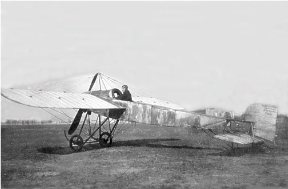
April 10, 1912
Today in 1912, French stunt pilot George Metache (pictured) took off from City Park in New Orleans with a letter addressed to Governor Jared Sanders in Baton Rouge. He landed his plane on the LSU Parade Ground which is now A. Z. Young Park on Third Street, jumped into a cab and delivered the letter to a somewhat surprised Governor Sanders at what is now the Old Capitol. It was the first city-to-city airmail flight in American history. Unfortunately, the governor would not be able to send an airmail reply back to New Orleans as Mestache had crashed his plan landing at the Parade Ground.
April 11, 1985
The Roumain Building at 345 Third Street was added to National Register of Historic Places today in 1985. The six-story concrete and terra cotta building was designed by the New Orleans architects Favrot and Livaudais in the Beaux Arts Style. It was built in 1913 by the Texas Building Company of Fort Worth at a contract price of $105,000. It is considered to be Baton Rouge’s first skyscraper and was built by jeweler and watchmaker J. K. Roumain, who lived in Beauregard Town in a two-story, galleried cypress house, perhaps designed by Baton Rouge architect Ben Goodman, at 201 St. Charles Street.
April 12, 1989
Today in 1989, Blaze, a highly-fictionalized film that chronicled former Gov. Earl Long’s relationship with stripper Blaze Starr, began principal photography in Baton Rouge. Paul Newman played Long in the film, which is set principally in 1959-60, the last two years of Long’s life and final, turbulent term as governor. Director Ron Shelton told the press that one of the films challenges was that, “Paul Newman’s better looking than any 63-year-old man in the world and, in his last year, Earl Long was worse looking that any 63-year-old man in the world.” Blaze received modest critical praise and opened in ninth place at the box office on its opening weekend.
April 13, 1935
LSU won the mythical national championship in basketball today in 1935. In the days before the NCAA Tournament. Coach Harry Rabenhorst’s SEC Champion Tigers and Coach Doc Carlson’s Pittsburgh Panthers, considered to be the two best teams in the country, were invited to the battle for the American Legion Bowl at the Atlantic City Auditorium. LSU won by four, 41-37 before a crowd of five thousand, and the game was a nail-biter. The Tigers started out very slowly and at one point, trailed 18-4. By the half, they were still were down by nine, 26-17, and roared back in the second half.
April 14, 1955
Today in 1955, WBRZ Channel 2 went on the air in Baton Rouge as an NBC affiliate. The station began broadcasting in color one year later, becoming the first Baton Rouge TV station to do so. In September 1976, it swapped network affiliation with WRBT and became an ABC affiliate. Thanks to its ties to Baton Rouge’s daily newspapers, WBRZ was dominant in its coverage of news for much of its history. The Manship family who owned both the station and the Baton Rouge Advocate originally wanted to use the call letters to be WBRA—think about it—but were eventually talked into swapping the A for a Z.
April 15, 1972
“Hungry? Ground Pat’i.” If you remember the ad, you might be interested to know that the first Ground Pat’I in Baton Rouge opened this week in 1972. The first location was on Florida at Ardenwood, and eventually, two others would be added, on Sherwood Forest Blvd. and Jamestown Avenue. The chain had started in New Orleans in 1971. Ground Pat’I locations remain open in Lafayette, Thibodaux and Houma, but the Baton Rouge restaurants have gone to heaven to join the likes of Giamanco’s, LaFonda, Hopper’s, Chalet Brandt, Shakey’s Pizza, the Silver Moon Café and too many other great places.
April 16, 1825
In 1824, President James Monroe invited Gilbert du Motier, the Marquis of Lafayette to tour the United States, partly to instill the “spirit of 1776” in the next generation of Americans and partly to celebrate the nation’s 50th anniversary. During his trip, he visited all twenty-four American states. On this day in 1825, he arrived in Baton Rouge by steamboat and was feted at a reception at the Tessier Building, which still stands in downtown. He led a parade up Second Street, which was renamed in his honor and reviewed troops at the newly-completed Pentagon Barracks. He then returned to the steamboat and resumed his journey.
April 17, 1992
This month in 1992, The Swine Palace Theater Company at the LSU Department of Theatre staged its first production, All the King’s Men by Robert Penn Warren. The company was founded to provide a platform for socially conscious productions under the direction of Barry Kyle, who had come to Baton Rouge after twenty years as a leading director for the Royal Shakespeare Company in London. It was Kyle who came up with the theater company’s name, Swine Palace, taken from his idea to turn an old livestock pavilion on the south side of campus into a theater. The pavilion was renovated and became the Reilly Theatre in 2000.
April 18, 1979
Today in 1979, President Jimmy Carter nominated Baton Rouge native and St. Francisville resident Robert H. Barrow to be the 27th Commandant of the United States Marine Corps. Barrow would serve four years before retiring to St. Francisviille in 1983. Because it offered free tuition and low boarding costs, Barrow attended LSU from 1939 to 1942, working as a waiter and a janitor and served in the university’s Corps of Cadets. In 1943, he enlisted and was sent to fight the Japanese from behind enemy lines in China. General Barrow died on October 30, 2008 at the age of 86.
April 19, 1953
WAFB, Channel 9 went on the air today in 1955. In its first five years, the station broadcasted on UHF Channel 28, before moving to VHF channel 9 in 1960. It launched as a television counterpart to local radio stations WAFB and WAFB-FM, which both signed on in 1948 and were affiliated with the MBS network. The Royal Street Corporation which owned Channel 6 in New Orleans, purchased the station in 1956, and later sold it to the locally based Guaranty Corporation. A long-time staple of the station was “Buckskin and Friends,” an hour-long show starring Bill Black that aired on Saturday mornings from 1955 until September 1990.
April 20, 1877
“The Fraud of the Century” paid off for Louisiana politicians today in 1877 as President Rutherford B. Hayes removed the last federal troops from the state. The deal to send the troops home had been sealed the previous November when Democrat Samuel J. Tilden carried Louisiana in the Presidential election of 1876, but the Democratic members of the Electoral College switched their votes to the Republican Hayes in exchange for an agreement to remove the troops. The removal of the troops was officially touted to be the official end of Reconstruction in Louisiana, but its effects would remain for decades to come.
April 21, 1931
The first Louisiana State Interscholastic Boxing Tournament held at LSU today in 1931. Between 1931 and 1958, high school boxing was the second most popular high school sport in the state after football. Requiring little equipment, so it was a cost-effective sport for cash-strapped schools. It wasn’t unusual to see three thousand fans show up for a Friday night interscholastic bout. The sport would reach its peak in 1952 when 250 boxers competed in the state tournament. But the end of was near. The last tournament was held in 1958 when only 11 schools in the state still fielded teams.
April 22, 1936
Baton Rouge’s last electric streetcar line closed this day in 1936. The streetcar system had dated back to 1892, when the system ran with six cars and 26 mules ran along Third Street, Government and Main Street. The route was replaced with cars powered by electricity in 1893, and by 1924, the electric system had expanded to provide service to the north from downtown to the Standard Oil Refinery near 22nd Street and Mohican, and along East Boulevard to South Baton Rouge. These spurs to the south and north would shut down in 1932 and 1934, respectively, and the last cars on the downtown route ran in 1936.
April 23, 2005
On April 23, 2005, voters in Central elected to incorporate as a city. The campaign had been a bitter one, dividing neighbors and friends, and sponsoring at least one lawsuit to block the election. The new city had about 25,000 residents and 18,000 registered voters, of whom 8,190 cast votes in the election. 5126 voted for incorporation; 3064 against. Central is bounded on the west and south by the Comite River, on the east by the parish line and on the north by Highway 64. Former Central High School principal Shelton “Mac” Watts became the temporary mayor and served until elections for the office were held on April 1, 2006.
April 24, 1953
The Bellemont Motor Hotel on Airline Highway, already the largest motor hotel in Louisiana and one of the largest in the United States, opened a new wing in April, 1953. Owner and Manager A. C. Lewis said that the new addition would include a French Provincial suite designated as the Governor’s Suite, and a suite decorated in a modern motif called the Petroleum Suite. A new meeting facility called The Great Hall would be opened in 1984. The hotel closed its doors in the early 2000’s and served briefly as a staging area for Hurricane Katrina relief efforts. It was demolished in 2012.
April 25, 1979
In the early 1970’s, the relationships among the city-parish, the not-for-profit Society for the Prevention of Cruelty to animals and the public had deteriorated due to a number of reasons, a lack of transparency by the SPCA being not the least among them. In 1975, the city-parish established the Animal Control board, a quasi-public institution, to take over the work of the SPCA, and the Capital Area Animal Welfare Society (CAAWS) was established in April, 1979, to provide not-for-profit support for the well-being of animals in the Baton Rouge community by providing, facilitating, and promoting the humane treatment and at all times supporting the practice of spay/neuter.
April 26, 1970
Around 9:30 on the evening of Sunday, April 26, 1970, somewhere between ten and thirty sticks of dynamite were placed in the Senate Chamber of the State Capitol Building. In the ensuing explosion, no one was hurt, but the explosive destroyed the podium and other furniture, the marble-paved floor and several columns. It was never discovered who placed the bomb. The repair would cost over $400,000. Today, visitors to the chamber can see a rather macabre reminder of the explosion—a pencil that had been sitting on a desk at the time of the explosion was hurled into the ceiling of the chamber, where it stuck. It’s still there.
April 27, 1993
This week in 1993, Baton Rouge businessman and grocer Brazil Calandro was killed at the age of 82 in a tragic automobile accident near Woodville, Mississippi. In 1941, Calandro, a native of Tickfaw, and his wife Vennera had opened the Plee-Zing Food Store on Government Street that would become Calandro’s. Several generations of the Calandro family would take an active role at the business. “I think what really sets Calandro’s apart is that we’ve remained a friendly, family-run local operation that loves and promotes our Baton Rouge and Louisiana roots,” said second generation member, Blaise Calandro proudly.“ A second Calandro’s would open in 2000 on Perkins Road.
April 28, 1956
Today in 1956, a private airplane crashed, exploded and burned near Lansing, Michigan, taking the life of Baton Rouge Mayor-President Jesse L. Webb, Jr., and two other men who were on their way to a conference at Michigan State University. Webb was the youngest person ever to be elected mayor-president, and during his administration, he worked to ease the strain of school bus desegregation in the parish. In the aftermath of the tragedy, his widow, Mary Jones Webb was sworn in as Baton Rouge’s mayor-president was sworn in as mayor-president to complete the seven-and-a-half months of his term. She was the first woman ever to serve in the office.
April 29, 2007
Today in 2007, the massive Union Tank Car Repair dome on Airline Highway was torn down. The steel, geodesic dome, designed by Buckminster Fuller, was completed in 1958. With a diameter of 384 feet, it was the largest free-span structure in the world at the time and was considered a marvel among engineers and architects. The dome was built to allow the company to repair dozens of tank cars at a time rather than one or two. As the years passed, the dome and rail yard fell into disuse and was torn down one year before it would become eligible to be listed on the National Register of Historic Places.
April 30, 1926
It would take LSU the better part of a decade to move its campus from downtown at the current site of the State Capitol to its present location in South Baton Rouge, but today in 1926, enough of the job had been done to dedicate the new campus on the 114th anniversary of Louisiana statehood. Several sites had been considered, but eventually the Gartness Plantation owned by C. P. Williams of Mississippi, was selected. On June 4, 1918, the legislature passed Act 6 which provided the funding for the purchase, and in 1920, the Olmsted Brothers landscape architecture firm was hired to create the overall plan for the new campus.
May 1, 1992
Today in 1992, the General Health Foundation purchased 66 acres on Bluebonnet Lane to establish the new campus of the Baton Rouge General Medical Center that opened on the site in 1994. The General traces its history to 1900, when railroad surgeon Dr. T.P. Singletary, brought two severely injured patients to a large frame building on the corner of Florida and Church streets for treatment after a train wreck. As he treated the men, he realized that doctors could treat patients more effectively if they were all in one location. In 1908, he built a three-story brick building next to his office to care for patients who needed hospitalization.
May 2, 1970
Thomas Harry Williams was born in Illinois in 1909, received his degree in history for the University of Wisconsin, and taught at the University of Nebraska before coming to LSU in 1941. After receiving critical and popular acclaim for Lincoln and His Generals in 1952, he became fascinated with Louisiana icon Huey P. Long. Williams interviewed dozens of Long’s advocates and enemies, and Huey Long, the book that would be one of the first biographies employ the techniques of oral history as a key source material was published in 1969. The book received the Pulitzer Prize for Autobiography today in 1970, and also won the National Book Award the same year.
May 3, 1888
Today in 1888, the U. S. Post Office at Cottonville, Louisiana, was relocated from Bayou Sara Road and redesignated as Baker. Prior to his death in 1851, Josephus Smith Baker had established the Baker Plantation on Baker Lane (now Groom Road) in the area around the town of Cottonville. By 1888, the town had died out, and the area began to take on the name of the largest landowner in the area. With the coming of the railroad, Baker would start to grow again and by the middle of the twentieth century, it would incorporated as the Town of Baker in December 1944.
May 4, 1823
Abraham Lincoln paddled his flatboat past Baton Rouge on his first visit to Louisiana. Sixty years later, LSU President David French Boyd would claim to discover an old guest book from the Baton Rouge Garrison signed by “A. Lincoln” on this day. If so, it would be the only written confirmation that Lincoln did anything other than admire the creamy white columns of the Pentagon Barracks as he passed through town. Historians doubt Boyd’s claim, stating that it’s highly unlikely that a comparative nobody from Illinois would leave his possessions on a flatboat to go to a high-security military installation where he would register as a guest.
May 5, 1978
Before this day in 1978, I-10 ended at Gonzales, and travelers driving to New Orleans were compelled to get off interstate, drive past the Norwegian Seaman’s Center and the rest of downtown Gonzales to get back to the highway at Airline Highway. The original contractor for the completion of I-10 project had defaulted and construction fallen almost two years behind schedule. Today in 1978, Governor Edwin Edwards cut the ribbon at the LA 44 interchange in Gonzales and the last 5.2 segment was opened. Ten years after the Horace Wilkinson Bridge at Baton Rouge had been completed, Louisiana would become the third state to complete its section of the highway.
May 6, 1949
Today in 1949, a boxcar from the Merci Train was dedicated to veterans of WWII at the Old State Capitol. The Merci Train, also called the French Gratitude Train, was given to the people of the United States by the people of France as a gesture of thanks for the Friendship Train, a WWII relief effort organized by columnist Drew Pearson in World War II. The Merci Train was comprised of 49 cars, including one for each of the 48 states. In Baton Rouge, Fred C. Dent Sr. led a drive to build a monument to friendship and a shelter for Louisiana’s box car at the Old Capitol.
May 7, 1931
“We Live for Those We Love” is a charming sentiment, but on this day in 1931, it was inscribed on the cornerstone that was laid at the New State Capitol. There was no ceremony at the setting of the stone on the west side of the building. Set into the cornerstone was a copper box containing copies of official acts and other documents pertaining to the building’s construction. The box also contains the answer to one of Baton Rouge’s greatest secrets—the location of caskets of the original settlers of Spanish Town whose cemetery was dug up while the Capitol was being built and later re-interred in a secret location.
May 8, 1882
Today in 1882, the Louisiana Legislature met at the Old State Capitol for the first time in twenty year. In April, 1862, with the Union Navy at the mouth of the Mississippi River, the governor and legislature removed the capital to Opelousas. In December of 1862, the old building was gutted by fire. In the late 1870’s, civic leaders in Baton Rouge began to advocate for the return of the capital, and in 1879, the legislature meeting in New Orleans voted to renovate the capitol. One of the demands of the legislature was that the City of Baton Rouge pay $35,000 of the cost of renovation.
May 9, 1972
Today in 1972, Edwin Washington Edwards was sworn in for the first of four terms as Governor of Louisiana. He would become the state’s longest serving governor and the sixth longest serving governor in the history of the United States. He was born in Marksville in 1927, attended LSU and served four terms in Congress before being elected to his first term as governor. Coincidentally, it would be twenty-eight years to the day and almost to the hour when he would be convicted in a New Orleans courtroom in 2000 on 17 counts of wrongdoings and sentenced to federal prison.
May 10, 1960
This week in 1960, Jimmie Davis was inaugurated as governor of Louisiana for the second time. The popular singer turned businessman had been elected to his first term in 1944, and he became the fifth person to be elected to the job a second time. Davis was born on a tenant farm in Jackson Parish in 1899 and had become a nationally popular country music and gospel singer in the 1930’s. At the sparsely attended event on the steps of the Capitol, Davis took the oath and promised to “remedy the state’s fiscal headache” and to continue segregation without either compromise or violence.
May 11, 2000
Tonight in 2000, Nobel Prize winner Nelson Mandela visited Baton Rouge and was feted by 1300 guests at a banquet at a fundraiser for the Nelson Mandela Foundation at the Radisson Hotel. At the banquet, Mandela was awarded honorary doctorate degrees from both Southern University and LSU. Mandela said that upon his release from prison in 1990, he didn’t want to talk to white politicians, but “our brains told us that if we didn’t talk to those people, our country would go up in flames.” LSU System President William Jenkins, a native of South Africa said in his remarks, “You walked free, and with you a nation walked toward freedom.”
May 12, 1890
Today in 1890, Louisiana became the first state to legalize prize fighting in the United States. The act, which was described as one of the shortest ever enacted by the legislature offered very few restrictions, except that the Marquis of Queensbury rules were to be followed at fights. Bare-knuckle fighting was still against the laws, so when a match between legendary fighter John L. Sullivan and Jake Kilrain was promoted in New Orleans, Governor Francis T. Nicholls forbade the illegal fight and called out the national guard. On May 6, 1895, the Louisiana Supreme Court declared voided the “glove rule”, thereby making all forms of prizefighting illegal in the state.
May 13, 1843
Since it had been founded in the 1830’s, the Baton Rouge Gazette had been p an anti-Whig, pro-Democrat periodical established in 1842rinted in both French and English. In early 1843, facing competition from the Democratic Advocate, an anti-Whig, pro-Democrat periodical established in 1842, the publishers of the Gazette stated that the fifty or so subscribers who preferred to read their news in French could all read English, whereas practically none of the English readers could decipher French. As a result, the French pages of the paper were suspended today in 1843. Another newspaper, the Louisiana Capitolian, was established in 1868 and later merged with the Advocate.
May 14, 1940
Today in 1940, reform governor Sam Houston Jones was sworn in as Louisiana’s forty-ninth governor before 60,000 cheering guests at Tiger Stadium. In his inaugural address, he sounded the death knell for Long-style politics which had dominated the state for the past twelve years. “I said I intended to destoy the state machine—and I mean it,” he said in his address. Outgoing Governor Earl K. Long refused to attend the ceremony, for fear of embarrassment to him or the new governor. The ceremony was followed by a massive barbecue on the LSU campus and an estimated crowd of 100,000 watched the inaugural parade to the Heidelberg Hotel downtown.
May 15, 1927
Today in 1927, the Mississippi River crests at 47.28 feet at Baton Rouge during greatest flood in American history. At the time, it was expected that the river would eventually rise to 49 feet, but a levee break upriver that would spread the flooding to parishes across the river stymied the rise at Baton Rouge. Refugees from the flood were received in Baton Rouge, where the Red Cross had established shelters for whites at dormitories on the former campus of LSU, and for blacks at a tented city on Jackson Road. At one time, more than 27,000 square miles were under water up to depth of thirty feet.
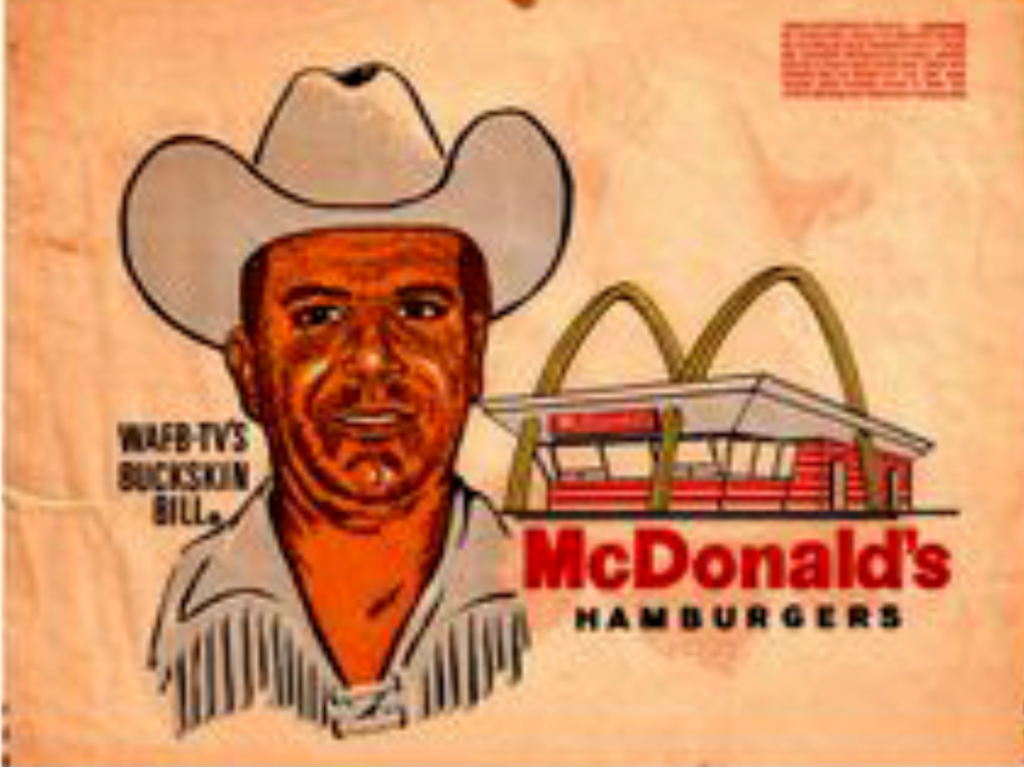
May 16, 1963
The world changed forever today in 1963 when the city’s first McDonald’s opened on Plank Road at the corner of Hollywood Street. Soon a second location would be added on State Street near LSU and third in Rebel Shopping Center near what is now the Baton Rouge Community College. In the late 1950’s, Charles “Rocco” Valluzzo, a dentist in Battle Creek, Michigan, was exploring retirement options and opened a McDonald’s franchise in Tuscaloosa, Alabama. Shockingly, the franchise failed and Valluzzo was offered Baton Rouge as a substitute. The rest was history, and today, there are more than twenty-five McDonald’s in Baton Rouge alone that are owned by the Valluzzo family.
May 17, 1946
Today in 1946, tempers flared between veterans and the city recreation commission over what to do with the old city market on St. Louis Street that had served as the USO Center during the war. Veterans advocated converting the facility into service center for the Veterans Administration and local civic clubs wanted it for a recreation center. The USO Center, which had opened on January 15, 1942, held its closing ceremonies on January 27, 1946. Local Girl Scouts led the effort to convert the building to recreation purposes, and eventually, the veterans were accommodated elsewhere and recreation center became an active community hub.
May 18, 1998
This week in 1998, Governor Mike Foster honored the Zion Travelers Spiritual Singers at the Governors Arts Awards. The Zion Travelers were founded in 1938. Organized in 1946, the Zion Travelers were featured in the Louisiana Pavilion Exhibit of the 1984 Louisiana World Exposition in New Orleans and in the 1985 Festival of American Folklife sponsored by the Smithsonian Institution in Washington, D.C. They were featured at the annual River City Blues Festiva, the annual Louisiana Folklife Festival and the New Orleans Jazz and Heritage Festival. The Zion Travelers had a popular radio program of gospel music on radio station WIBR and performed together for more than 60 years.
May 19, 1942
In May of 1942, the State-Times and Morning Advocate announced that it would establish an annual award that would be presented to the person who is considered to have added most to the material and spiritual advancement of the city during the past year. Charles P. Manship, publisher of the papers, said the award would be named the Golden Deeds Award and would bo presented annually. The first award was presented the following month at a banquet on the roof of the Heidelberg Hotel. The first recipient was Albert Miller Cadwell, vice president and manager of Cotton’s Bakery, who had–among other things–organized the Baton Rouge Community Chest.
May 20, 1955
The original office of Capital Bank and Trust Company opened today in 1955 at 1731, just across the street from Goudchaux’s Department Store. In 1974, the bank purchased the Wooddale Towers, where it established headquarters to be positioned for the “growth center” of Baton Rouge that research then pegged to be near Airline and Florida. The bank grew through the 1960’s and 70’s, but in the mid 1980’s, losses came hard and swift. In 1988, the bank was $40 million in the red when it was sold to Mississippi-based Grenada Sunburst System Corp. which itself was later acquired by Regions Bank.
May 21, 1928
Today in 1928, fifteen thousand people—a record at the time—watched the inauguration of Governor Huey Long at the Old State Capitol. A rainstorm failed to damage the enthusiasm of those who lined the parade route along Third Street and North Boulevard, and the new governor gave his first broad smile of the day as the parade passed the Govenor’s Mansion where Long heard high-pitched “Daaa-deee” from his family’s viewing platform. The evening was damp, but ten thousand guests were happy to show up for the massive inaugural ball, which was held at the Pavilion on the old LSU campus downtown.
May 22, 1943
Today in 1943, Second Lt. Charles J. Borden of Texas would be killed in a crash of his P-38 training fighter plane on Perkins Road. Harding Army Air Field, which would eventually become the Baton Rouge Metropolitan Airport, opened in 1941, and was used by the United States Army Air Forces Technical Service Command as a maintenance and supply base. Borden was one of hundreds of young army air force pilots undergoing flight training at Harding Field during World War II. He would be one of 58 people killed or injured while training at the base during the war. Harding Field would be renamed Ryan Field in 1954.
May 23, 1982
Today in 1982, the U.S.S. Kidd arrived at Baton Rouge after being towed from the Philadelphia Navy Yard. Ten thousand Baton Rougeans lined the river bank to welcome the World War II hero, and the ship would be opened to the public for the first time on August 27, 1983. Built at Federal Shipbuilding & Dry-dock Company of Kearny, New Jersey, the Kidd launched on February 28, 1943 in a record-breaking fourteen minutes. In World War II, the Kidd earned its nickname as “the Pirate of the Pacific,” and would be decommissioned in 1964. Over the years, KIDD has slowly been restored back to her August, 1945 configuration.
May 24, 1947
Tonight in 1947, the Baton Rouge Red Sticks opened a four-game series at home in Alex Box Stadium with the New Iberia Cardinals. Both teams were members of the Class D Evangeline League, which had begun in 1934 with six teams, none of them in Baton Rouge. The Red Sticks would join the league when it resumed play in 1946, following World War II, and remain until the league folded in 1957. In 1956, the team changed its name to the Rebels. Other teams in the league in 1947 included the Abbeville Athletics, Alexandria Aces, Hammond Berries, Natchez Giants and Thibodaux Giants.
May 25, 1942
Today in 1942, the first commercial fluid catalytic cracking plant began processing at what is now the ExxonMobil refinery in Baton Rouge. The fluid catalytic process is widely used to convert the high-boiling, high-molecular weight hydrocarbon fractions of petroleum crude oils into more valuable gasoline, olefinic gases, and other products. Cracking of petroleum hydrocarbons was originally done by thermal cracking, which has been almost completely replaced by catalytic cracking because it produces more gasoline with a higher octane rating. It also produces byproduct gases that have more carbon-carbon double bonds (i.e. more olefins), and hence more economic value, than those produced by thermal cracking.
May 26, 1999
This week in 199, owner Sam Haynes opened the Blue Bayou Water Park this week. The water park and the adjacent Dixie Landin’ Amusement Park replaced Fun Fair Park, a small-scale amusement park at the intersection of Florida Blvd. and Airline Highway. Best known for rides like the Galaxi and Wild Mouse, Fun Fair Park was also known for a pet chimpanzee named Candi, who famously got loose and bit a park patron, or so the urban legend goes. In response to complaints by animal welfare organizations, Candi was given a new home that was thirteen feet in diameter, to replace the much smaller cage at Fun Fair Park.
May 27, 1827
The First Presbyterian Church of Baton Rouge was established today in 1827. It was the first Protestant congregation in the city. Earlier in 1827, the Mississippi Missionary Society had dispatched Princeton theological student John Dorrance to Baton Rouge to conduct religious services every Sabbath. The church’s first services were held on in a frame building on the site of the old court house. The church later moved to a new home at the intersection of Florida Street and Church Street, which later became Fourth Street. In 1927 it moved to the present site on the corner of North Boulevard and 7th Street.
May 28, 1964
Today in 1964, Frank’s Restaurant was founded by Frank Dedman Sr. and his wife, Carolyn. At first, they called the business the Blue Bird Drive-In, and it was across Airline Highway from the current location. The restaurant is now in its third generation of family ownership and is beginning its fourth generation of loyal customers. The business has been owned by Frank Dedman Jr. and his wife, Cathy, since 1999. The family opened a similar restaurant with an identical menu, also called Frank’s, at 17425 Airline Highway in Prairieville in 2004 with a separate building housing a large reception center. Frank Dedman III and Ross Dedman operate the Prairieville restaurant.
May 29, 1862
Today in 1862, General Thomas Williams of the U. S. Army arrived in Baton Rouge with six regiments of infantry, two artillery batteries, and a troop of cavalry. During the early summer, Williams’ brigade began work on what later became known as Grant’s Canal, cutting a new channel across the base of De Soto Point on the west side of the Mississippi River across from Vicksburg, Mississippi. Williams would be killed during the Battle of Baton Rouge on August 5, 1862 at what is now the corner of Florida Street and Seventh Street. The U.S. Garrison and Ordnance Depot in the city would be renamed Fort Williams in his memory.
May 30, 1964
Today in 1964, Miss Bette Davis stepped smiling from a chartered Electra prop-jet at Ryan Field and was presented with bouquet of red roses by a petite third grader from Hollywood Elementary School in Baton Rouge. Davis was in Baton Rouge for the filming of Hush, Hush Sweet Charlotte at locations around Baton Rouge and Donaldsonville. The cast and crew were housed at the Oak Manor Motor Lodge on Airline Highway, Joan Crawford, who was also (briefly) in the cast and was then married to the chairman of the board of Pepsi,remarked, “What could be better than having my hotel room right here next to the Pepsi-Cola Bottling Company?”
May 31, 1977
Baton Rouge couldn’t help falling in love with Elvis Presley. The King played his last concert in Baton Rouge to twelve thousand adoring fans at the LSU Assembly Center tonight in 1977. During the concert, Elvis was alleged to have said, “Despite what you read or hear, we’re here and we’re healthy and the hell with anything else.” Writing in the Morning Advocate, Smiley Anders wasn’t sure. “He didn’t look healthy and the show was much like his 1976 performance, emphasizing his clowning around with fans rather than any solid musical accomplishment.” Seventy-seven days later in 1977, The King would die at his home in Memphis.
June 1, 1975
Today in 1975, the Rolling Stones kicked off their Tour of the Americas ’75 with two concerts at LSU Assembly Center. The Tour of the Americas ’75 was not tied to support of any newly released material, as it began more than seven months after the release of the album It’s Only Rock and Roll, and it was the Stones’ first tour with new guitarist Ronnie Wood. Long-time sidemen Bobby Keys and Jim Price were replaced by Billy Preston on keyboards and Ollie E. Brown on percussion. The setlist for the concerts started with “Honky Tonk Women” and finished up with “Midnight Rambler.”
June 2, 1994
The Prince Hall Masonic Temple on North Boulevard was added to National Register of Historic Places today in 1994. Built in 1925, it was the center of African American entertainment in Baton Rouge for more than two decades. Two major attractions of the building were the Temple Theatre, occupying most of the first floor and part of the second floor, and the Temple Roof Garden occupying the fourth floor. Best known were the appearances of national big-name bands such as Cab Calloway, Fats Waller, Louis Armstrong and Duke Ellington. When they played in warm months, the windows of the Roof Garden were thrown open and music reverberated throughout the neighborhood.
June 3, 1935
Today in 1935, the first PhD awarded in Louisiana was conferred at the seventy-fourth commencement at LSU. The first degrees were awarded to Gipson Lafayette Carter and Frank Atkinson Rickey, both of Baton Rouge. Carter had offered a dissertation called “A Survey of the Status of Ramie,” and Rickey countered with “The Foundation of Differentiated Geometry.” The Graduate School at LSU was established in 1931. From 1931 through spring 2012, ten thousand PhD degrees had been awarded, another ten thousand Doctor of Philosophy degrees, 576 other doctorates other than Doctor of Philosophy degrees, and over fifty thousand master’s degrees had been awarded.
June 4, 1956
Today in 1956, the Dow Chemical Company picked up an option to purchase two thousand acres just north of Plaquemine. Earlier in the year, the company had announced a new $20 million facility on the west side that would hire 500 people to produce chlorine, caustic soda and several organic minerals. The plant would open in November 1958. Today, the 1,500-acre integrated manufacturing facility near Plaquemine and brine operations in Grand Bayou comprise one of Louisiana’s largest petrochemical complexes. With more than 3,000 employees and contract employees, Louisiana Operations is the largest employer in Iberville and West Baton Rouge parishes and plays an active role in the surrounding communities.
June 5, 1879
Today in 1879, the U. S. Army post in Baton Rouge in downtown Baton Rouge was decommissioned, and the last soldiers left Fort Williams. The United States Garrison and Ordnance Bureau had been commissioned in 1817, and was the largest military base in the nation. Iin August, 1862, the garrison was renamed Fort Williams in memory of Union General Thomas Williams who had been killed in the Battle of Baton Rouge. Now that the garrison would be abandoned, another Union general from the war, William Tecumseh Sherman, went to work trying to secure the site as the new home for LSU, which would open at the site in 1885.
June 6, 1954
Today in 1954, Mt. Zion First Baptist Church moves to its current home on East Boulevard. since 1949. N In 1858, Isaac Palmer, an African American minister, and John Brady, a White minister and eight others formed the Mt. Zion First African Baptist Church in Baton Rouge. The years passed and the congregation grew, and in 1949, Dr. T.J. Jemison became pastor. During Jemison’s pastorate, he led many movements in the Baton Rouge community for the betterment of all citizens and because of his work in the community, the church began to grow larger in membership and many young people were found in church each Sunday.
June 7, 1968
In 1968, Baton Rouge’s only post office moved across the street from the federal courthouse building at the corner of Florida and Seventh Street to a new facility across the street. Today was the last day of service at the old facility before it would reopen the next day—a Saturday—at the new facility that is still in service today. Amenities advertised for the new post office included a stamp machine, coin changer and a vending machine for post cards and envelopes. Postmaster Alton Lea asked patrons to pick up keys to their new boxes today to avoid confusion at the new facilty on Monday morning.
June 8, 1991
Today, in 1991, LSU won its first College World Series in Omaha, Nebraska. Coach Skip Bertman’s Tigers had fallen short in the 1990 World Series and went into the series as the fourth seed behind Florida State, Clemson and Wichita State. LSU swept through the preliminaries undefeated, with two wins against Florida and one against Fresno State. In the finals, they faced the Wichita State, who had also swept into the Finals without a loss. LSU defeated the Shockers, 6-3, to take the title. Pitcher Chad Ogea, catcher Gary Hymel, first baseman John Tellechea and outfielder Lyle Mouton would make the All-Tournament team.
June 9, 1940
You don’t often think of oil drilling in the city of Baton Rouge but today in 1940, three new permits to drill at the University Oil Field. The field was bounded by Nicholson, Lee and Burbank Drives. In the 1920’s, the discovery of salt water in shallow wells on and near the LSU campus, attracted the attention of geologists. A survey in 1931 was followed by a dry hole drilled in 1933 southeast of the present field. Three separate seismograph surveys between 1934 to 1937 were made on the University structure prior to discovery in 1938. Twenty wells were still producing in 2017.
June 10, 1971
Piyush “Bobby” Jindal was born in Baton Rouge today in 1971. He graduated from the Baton Rouge Magnet High School in 1988 and attend Brown University, before enrolling at New College, Oxford, as a Rhodes Scholar. At Oxford, the theme of his thesis was “A needs-based approach to health care.” Governor Mike Foster appointed him secretary of the Louisiana Department of Health and Hospitals in 1992, and in 1999, at age 28, he was named president of the University of Louisiana System. He was elected to Congress In 2004 and 2006, and in 2007, he became the second youngest governor of Louisiana after Huey P. Long.
June 11, 1981
“I pledge allegiance to the flag of the state of Louisiana and to the motto for which it stands: A state, under God, united in purpose and ideals, confident that justice shall prevail for all of those abiding here.” In June of 1981, the Louisiana Legislature approved the state’s official Pledge of Allegiance. If you didn’t know that Louisiana had a Pledge, or if you thought it sounded like it had been written by a bunch of third-graders, it might interest you to know that Mrs. Chris Murphee and her class of third graders at Jefferson Terrace Elementary wrote the pledge as a class project and submitted it to the legislators.
June 12, 1964
The Baton Rouge Area Foundation was formed today in 1964. The first chairman was John W. Barton. Since its founding, the foundation has issued grants totaling close to $200 million and been involved in many projects to improve the quality of life in the Baton Rouge area, including helping to develop a master plan for downtown Baton Rouge and inner city neighborhoods. BRAF was instrumental in starting the East Baton Rouge Redevelopment Authority, the nonprofit that operates the animal shelter, and New Schools for Baton Rouge, a nonprofit that is recruiting and providing resources to charter schools and failed schools taken over by the state.
June 13, 1991
Today in 1991, Louisiana Insurance Commissioner and Baton Rouge native Doug Green was sentenced to federal prison for fraud, money laundering and conspiring with insurance officials who financed his election. Green had succeeded Sherman Bernard, who he upset in the 1987 primary. Green had run on a platform calling for reform in the department – he even called himself “Mr. Clean”. However, Green was subsequently heavily implicated in the Champion insurance scandal and received a far greater sentence than had Bernard for similar offenses for much less money. In turn, Green would be succeeded by Jim Brown, who was convicted of lying to an FBI officer in 2001.
June 14, 1985
Today in 1985, the choir of the New Light Baptist Church visited the Louisiana House of Representatives and serenaded them with “We Are the World.” Lyrics were passed out to legislators who were asked to sing along. The True Light Church was established on Blount Road in 1895, with Reverend Tony Scott as pastor. In 1910 a storm destroyed the church and the church was rebuilt on the east side of the railroad track, which is presently known as Crane Street in Scotlandville, Louisiana. Several years later the church moved to its present location at the corner of Blount Road and Scenic Highway
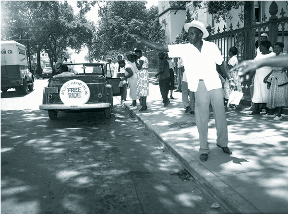
June 15, 1955
Today in 1953, Baton Rouge bus drivers walked off the job in an action that precipitated the bus boycott of 1953. Ordinance 222 provided that bus seating would henceforth proceed on a “first come, first served” basis had been passed by the city council on March 19th, but mostly ignored. Drivers complained that they had not been told about the ordinance and had no input into its creation, and when two drivers were suspended on June 14th for not complying with the ordinance, a strike was called for the first day. The drivers’ strike was a pre-cursor to a strike by African American passengers on June 20th.
June 16, 1960
Desire in the Dust, starring Raymond Burr, Joan Bennett and Martha Hyer was being filmed in Baton Rouge and Clinton this week in 1960. Even though the film would win a Golden Globe in 1961, one review summed it up as “another of those claptrap novels of demented, devious and oversexed Southern families that Yankees love to project upon the denizens who live below the Mason-Dixon line.” The movie featured a horse-riding vixen who cools off by taking a dip wearing nothing but a Merry Widow, a dotty matron who throws graveside birthday parties for her deceased son, a lecherous patriarch, and sexual blackmail galore.
June 17, 1931
Municipal Airport was dedicated this week in 1931. Would later become Downtown Airport. It was located at the end of Government Street. Thousands of spectators attended the two-day event featuring over a hundred military and civilian planes. The airport was advertised to be among the best in the South with one of the most elaborate lighting systems of any airport in the country. It was said that the flood lights could illuminate all two hundred acres of the field to an intensity that a newspaper could be read on any portion of the airport.” The airport would be closed and renamed Independence Park on July 4, 1976.
June 18, 1812
The War of 1812 started today, and Baton Rouge would play an important role in the war’s penultimate battle at Chalmette in 1815. As Louisiana had just become a state less than two months before the war started, Governor Claiborne wrote to Andrew Jackson that the attachments of Louisianans to the United States was neither general nor decided at that point. Jackson and his small army would arrive in Baton Rouge in December of 1814, establish a collection point for the volunteers who were pouring in from the western states, leave three hundred of his wounded and sick in the town, and take his remaining troops to New Orleans.
June 19, 1953
Today in 1953, African American tailor Raymond Scott spoke on radio station WLCS and announced the Baton Rouge Bus Boycott. A Free Ride System was put into effect the next day in the African American community, and progressively larger rallies were held over the next three days at Mt. Zion Baptist Church, McKinley High School and at Memorial Stadium on June 22nd, because of the enormous crowds. On June 24th, the city council enacted Ordinance 251 which provided that the first two seats on any bus were reserved for white people, and the last two seats on the bus for black people. People of any color could sit in between.
June 20, 1970
The Baton Rouge Press Club moved from the White House Inn to new quarters at the Capitol House Hotel today in 1970. The White House Inn was one of the many names of the hotel on Third Street that was originally called the Lakeshore Inn when it was built in 1962, and the Inn on the Lake when it closed permanently in the 1990’s. A spokesman for the press club stated–seriously, apparently–that the club’s offices would initially be located on the first floor of the hotel, and that eventually, they planned to the pool deck where they hoped to convert a cabana area into a lounge.
June 21, 1941
Today in 1941, the Hart Theatre was opened as a pure movie theatre with a showing of Meet John Doe. The Hart was operated by Paramount Pictures Inc. through their subsidiary E.V. Richards, who also operated the Paramount Theatre. The theater had a miniscule facade and entrance for such a large building. The main area of seating in the Hart Theatre was backed by a large stadium-style rear portion. Patrons entered from Convention Street down a long hallway to the concession stand, and then into the auditorium in between the main and stadium sections. The theater closed in October, 1978.
June 22, 245 Million, BC
Now that it’s officially summer, think cooling thoughts. For example, on this date in 245 million, BC, Baton Rouge occupied a position on the super-continent of Pangaea that was squarely on the equator. Earth was reeling from a mass extinction called the end-Permian event. The die-off had wiped out most life on Earth, including most land plants. The planet was baking, and life at the Equator struggled to survive. Pangaea started breaking up about 175 million years ago, and over the eons, Florida and the Yucatan Peninsula drifted apart, forming the Gulf of Mexico. As recently as 40,000 years ago, the some Baton Rougeans might still have enjoyed Gulf-front property.
June 23, 1956
Baton Rougean Randy Jackson was today in 1956. In his long musical career, he’s recorded, produced, or toured with many well-known artists and bands, including Mariah Carey, ‘N Sync, Whitney Houston, Céline Dion and Madonna. His credits as a musician include George Benson, Blue Öyster Cult, Jon Bon Jovi, Michael Bolton, Bob Dylan, Aretha Franklin, and Bruce Springsteen and playing at the Grand Ole Opry with The Charlie Daniels Band. In March, 2008, Jackson released an album produced entirely by himself, titled Randy Jackson’s Music Club, Vol. 1. In 2009. But for all that, he’s best known as a judge on American Idol from 2002-2014.
June 24, 1982
Today, this week and this month in Baton Rouge in June 1982, Jackie Gleason and Richard Pryor were filming The Toy in Baton Rouge. The city was called “Bates” in the film, and several locations were used, including One American Place, the State Capitol and the Exxon Refinery, which sported a sign reading “Bates Refinery”. The critics hated the movie, but it would go on to earn over $50 million in the United States. It would win an award for newcomer Scott Schwartz, who is best known as “Flick”, the kid who didn’t believe his tongue would stick to the flagpole in A Christmas Story.
June 25, 1868
To say that Louisiana was readmitted to the Union after the Civil War today in 1868 could be misleading. During the war, Congress had never acknowledged the rights of the Southern states to secede in the first place, so what did it mean to be “readmitted?” Essentially, it meant that states agreed to Reconstruction and could again send representatives to Congress. So when Louisiana, Alabama, Florida North and South Carolina were readmitted today in 1868, Republicans John S. Harris, who owned the largest cotton plantation in state, and William P. Kellogg, a port official in New Orleans, became Louisiana’s first U. S. Senators after the Civil War.
June 26, 1939
Governor Richard Leche resigned today in 1939 for “health reasons”. Earlier in the year, Leche and several of his cronies were indicted in what were termed the Louisiana Scandals. When he resigned, he was succeeded by his lieutenant governor, Earl K. Long. In 1940, Leche was convicted of using the mails to defraud; the particulars involved a scheme to sell trucks to the state highway department. Other charges included the use of stolen WPA resources and misuse of LSU funds. Leche was sentenced to ten years in an Atlanta penitentiary, released on parole in 1945 and pardoned by Harry Truman in 1953.
June 27, 1991
This weekend in 1991, the last National grocery store in Baton Rouge at the corner of Acadian Thruway and North Blvd., closed its doors forever. The closing was the ultimate result of a strike by members of the United Food and Commercial Works Union, who had been on strike since April 15 against National and urging shoppers to go elsewhere. “It’s a great loss to the community,” said Elizabeth “Boo” Thomas, director of the Mid-City Redevelopment Alliance, a non-profit organization trying to revitalize the area around Baton Rouge General Hospital. “We’re very disappointed. I thought that was a very profitable store, well used by the neighborhood and hospital personnel.”
June 28, 1879
Today in 1879, the Mississippi River Commission was created to plan for and ameliorate the effects of flooding in the Mississippi River Basin and to establish deep-water navigation in the lower Mississippi Valley. Today, the Lower Mississippi has become the largest port in the nation, based on tonnage. Collectively, the lower Mississippi ports include 256 miles of deep-draft navigable channels where each year, 10,700 vessels transport over 420 million tons of cargo. Individually, the ports on the lover river include the Port of South Louisiana (No. 1), the Port of New Orleans (No. 7), the Port of Plaquemines (No. 11) and the Port of Baton Rouge (No. 13).
June 29, 1995
Governor Edwin Edwards signed legislation today to create the Baton Rouge Community College. The college was created to promote more racial interaction in the city and was a part of the settlement of a federal desegregation suit. The college officially opened in August 1998 on a 60-acre campus on Foster Drive that had previously served as headquarters of the Louisiana State Police. It originally consisted of six main buildings: Governors Building, Louisiana Building, Cypress Building, Bienvenue Student Center, the Magnolia Library and Performing Arts Pavilion, and the Bon Santé Health and Wellness Center. The college’s current enrollment is more than 7,000 students.
June 30, 1863
During the siege of Port Hudson, Union General Neal Dow was wounded in action and commandeered the Heath Plantation, two miles from Port Hudson, as his base while he recovered. Mrs. Heath was not happy about her uninvited guest and notified the Rebels. On the night of June 30th, three Confederate soldiers slipped into the house–with the help of Mrs. Heath who had oiled the hinges on the door that day so that they wouldn’t squeak–and kidnapped Dow. The prisoner was later exchanged for Confederate general W. H. F. “Rooney” Lee, the second son of Robert E. Lee who had earlier been taken prisoner by the Union army.
July 1, 1963
Today in 1963, the Zone Improvement Plan went into effect in Baton Rouge and across the country. You probably know it better as the zip code. Blue-suited, orange-faced Mr. Zip was everywhere, reminding you to attach your own special code to your letters. In one particularly sad episode, he paid a visit to Baton Rouge Postmaster Alton Lea to tell him that using a zip code eliminates six of the ten basic routing steps used in the process of mail sorting. Anybody with a question was advised to write to the Hon. J. Edward Day, The Postmaster General, Washington, DC 20260.
July 2, 1939
Today in 1939, former LSU President James Monroe Smith was extradited to Louisiana while on vacation in Brockville, Ontario. He had turned himself in to the Royal Canadian Mounted Police the day before, stating that he’d been unaware that he’d been indicted the week before by a Baton Rouge grand jury looking into embezzlement charges at LSU. In 1940, Smith pleaded guilty to three charges of forgery and one of embezzlement. Governor Jimmie Davis commuted his sentence of eight-to-twenty-four years at Angola, but he did serve ten of his thirty month sentence at the United States Penitentiary in Atlanta, Georgia, on charges of mail fraud and tax evasion.
July 3, 1998
Tonight in 1998, the old McKinley High School destroyed by fire. As horrified alumni and friends watched the blaze on television, they said that watching it burn on television was like having their heart ripped out of their chest. Thomas H. Delpit Drive was choked the next morning as motorists drove by to see if it could really be true. Three teen-aged boys later confessed to setting the fire. The building school had been built in 1926 and closed in 1960. After the fire, it was purchased by the McKinley Alumni Association, and after a $5 million restoration completed in 2006, it would be reopened as the McKinley Alumni Center.
July 4, 1995
The Fourth of July fireworks over the Mississippi River were especially brilliant tonight in 1995 when the 114 175-watt metal halide lights outlining the superstructure of the Horace Wilkinson Bridge were flipped on for the first time at the end of the show. At the end of the twenty-minute fireworks show, the bridge lights gradually brightened for another twenty minutes. Funding for the bridge lighting project had been conducted by Forum 35, an organization of young professional men and women raised more than $275,000 for the project. As the Forum 35 members had hoped, the lights came to be something of a symbol of Baton Rouge.
July 5, 1940
America would not enter World War II for another sixteen months, but wartime suspicion was in the air tonight in 1940. An anonymous man who claimed to be frog hunting at the time, telephoned the police to report two men tunneling into the Dupont Ethyl chemical plant in North Baton Rouge. The plant produced one-third of the tetracthyl fluid used in the country for aviation and other high-performance fuels. No perpetrators were nabbed. In In the aftermath, additional guards were added at nearby plants, causing the sheriff to suggest that maybe the perpetrator who’d made the call might have planted the dynamite in order to boost job opportunities for watchmen.
July 6, 1817
The Louisiana Legislature made it official today in 1817. After offering some nebulous guidelines for establishing the city in January of 1817, the legislature finished the paperwork and issued a charter to the city. Baton Rouge receives first charter of incorporation. There were all of 1463 people in Baton Rouge in 1817, 266 of whom were slaves. Work was about to begin on the U. S. garrison. Spanish Town was starting to grow to the north, and Beauregard Village was sprouting in the south. In between, the town was beginning to expand into the unoccupied land to the east of Third Street.
July 7, 1972
Louisiana got its second female U. S. Senator today in 1972 as Governor Edwin Edwards announced that he would appoint his wife Elaine Schwartzenburg Edwards to fill the unexpired term of Allen Ellender, who had died in office. Mrs. Edwards was sworn into office on August 1, 1972, and served until November 13th of that year when J. Bennett Johnston was sworn in. Senator Edwards would prove to be nobody’s puppet. Although she was a Democrat, she endorsed Republican Gerald Ford over Jimmy Carter in 1976, while her husband first endorsed California governor Jerry Brown, and later endorsed Carter after Brown failed to obtain the nomination.
July 8, 1945
In 1945, Vince Distefano was running a card game called Georgia Skin on Florida Boulevard. While the men played for horses, Vince’s wife, Stephanie, made good tips cooking for the crowd—that is until the morning that the sheriff show up and hauled the Distefanos off to jail. The sheriff was sympathetic and urged the couple to get out of town – at least outside the city limits. So they bought a lot on Airline Highway and built a new place. It became so popular that travelers sometimes mistook the building for a restaurant. The Distefanos decided they might as well feed all those hungry motorists and The Village was born.
July 9, 1863
The Civil War Battle of Baton Rouge was fought in 1862, but a much more important battle was fought on the border of East Baton Rouge and East Feliciana Parishes the following year. While Union General Ulysses Grant was besieging Vicksburg upriver, General Nathaniel Banks was ordered to capture the Confederate stronghold of Port Hudson. When his assault failed, Banks settled into a 48-day siege, the longest in US military history. A second attack also failed, and it was only after the fall of Vicksburg that the Confederate commander, General Franklin Gardner surrendered today in 1863, giving the Union complete control of Mississippi River.
July 10, 1941
Today in 1941, a 7.9 mile bypass was opened to traffic to connect the Huey P. Long Mississippi River Bridge in North Baton Rouge to the Nesser Overpass at Jefferson Highway, opening to traffic in July 1941, This bypass was part of Airline Highway, but it was not connected to the rest of the highway until 1953. A further extension of Airline Highway continued west to the Atchafalaya Bridge at Krotz Springs. The remainder of the highway widened during the 1940’s and the 1950’s. For a short time, it was the longest toll-free four-lane highway in the nation ran 124 miles from the Atchafalaya River to New Orleans.
July 11, 1928
Today in 1928, East Baton Rouge’s first female sheriff was running for re-election to the post. Robert B. Day had been elected in 1916, and was fatally shot while breaking up a Scenic Highway ambling den in 1924. He was the first and only parish sheriff to die on duty. The next day, Eudora S. Day, the sheriff’s widow, was literally, “the next Day”, as she was appointed to fill his unexpired term, becoming the first and only female sheriff in the history of the parish. When she ran for election in her own right, newly-enfranchised women rushed to her cause and swept her to victory.
July 12, 1983
Tonight in 1983, sixty thousand flocked to Tiger Stadium for the Opening Ceremonies of the Sixth International Special Olympics. More than 4,000 parents, grandparents, brothers and sisters of Special Olympians from all fifty states and five continents were housed free by sponsor families. 21,000 volunteers devoted more than two million hours to raise funds and develop hospitality services in preparation for the games, and then served as games officials, timekeepers and supporters during that week. More than 500 families in Baton Rouge opened their hearts and homes to the largest gathering of family members ever to participate in an international Special Olympics. The games ran through July 18th.
July 13, 1923
Today in 1923, C. E. Woolman moved to Baton Rouge to join the extension department of Louisiana State University at Baton Rouge as an agricultural sciences instructor who travelled out to farmers to pass on the latest techniques. He lived in a house described as an “airplane bungalow” on North Sixth Street, three blocks from the LSU Experimental Farm, which was, at the time, located at the site of Arsenal Museum. Woolman would later move to Monroe and start a crop dusting service that would eventually become Delta Air Lines. Today, C. E. Woolman Drive, better known as the drop off lane at Metropolitan Airport is named in his honor.
July 14, 1861
Today in 1861, a week before the first Battle of Bull Run, Union forces attempted to cross Potomac River at Seneca Falls, Virginia. They were repulsed by Confederate forces that include the “Louisiana Tigers” rifle company, which was fighting in its first action of the war after arrived in Northern Virginia. Originally, the Tigers wore red cloth fezzes, blue-striped pants, and dark blue jackets with red lacing, but they quickly changed to the Confederates’ standard gray uniforms. Originally applied to a specific company, the Louisiana Tigers nickname expanded to a battalion, then to a brigade, and eventually to all Bayou State troops in the Confederate Army of Northern Virginia.
July 15, 2000
The newly-completed Mormon Temple on Highland Road was dedicated this week in 2000. Four separate dedicatory services were held to accommodate all the members who wanted to attend. The church had announced plans for the Baton Rouge Temple on October 14, 1998, and construction for the 10,700-square-foot building began after a groundbreaking ceremony on May 8, 1999. President Gordon B. Hinckley dedicated the temple on July 16, 2000, making it the Church’s 94th temple and the first in Louisiana. The temple serves 24,000 LDS Church members from throughout the state, as well as members in Gulfport, Hattiesburg, and Jackson, Mississippi.
July 16, 1948
Fiesta starring Esther Williams was the opening night selection at the brand new Tiger Drive-In on Airline Highway tonight in 1948. The theater featured the largest screen in the South and other novelties such as baby bottle warmers and adjustable volume controls. It would close forty years later in 1988, but during the middle of the twentieth century, there were no fewer than six outdoor movie theaters in Baton Rouge. In addition to the Tiger, they included the Dreamland–later the Florida Drive-In 1941, the Airline Drive-In 1950, the Rebel on Government Street in 1952, the Elm in 1955 and the Showtown Twin on Airline Highway in 1969.
July 17, 1930
Today in 1930, Lieutenant Governor Paul Cyr complained that Governor Huey Long vetoed three bills enacted at the last legislative session just to spite him. Long had vetoed a bill appropriating $500 for salary to the lieutenant governor while the governor is out of the state, stating that it was unnecessary as he had no plans to leave the state. Cyr retorted that perhaps Long shouldn’t leave the state. “I would like to get hold of the state machinery for about forty-four minutes. I am quite sure I could do more the people in that short time than he had done in the past two years.”
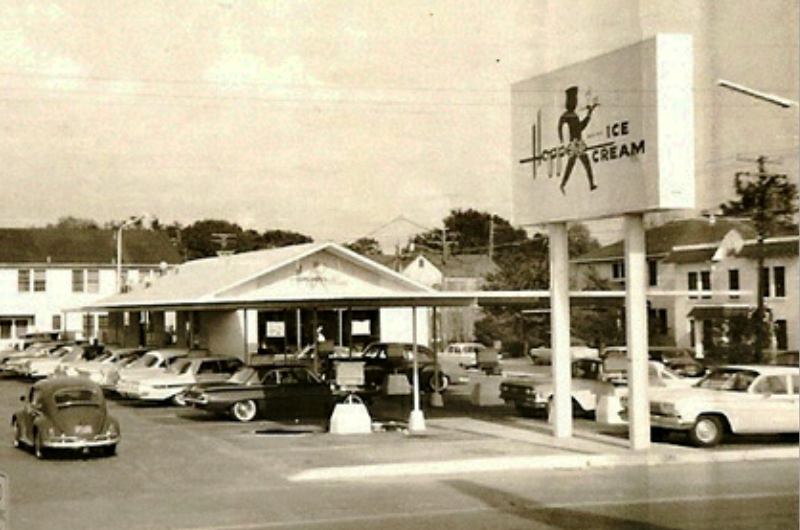
July 18, 1961
The first Hopper’s Drive Inn in Baton Rouge in 1947, and by 1961, the future looked bright as the company had just opened its newest outpost on Highland Road near LSU and announced this week that it was expanding to New Orleans and other cities in Louisiana. Baton Rouge loved Hopper’s, and there was no better time to be there on a warm night in July when a milk shake sounded like just the thing. But despite the optimism, the writing was already on the wall for Hopper’s and its ilk. Within two years, the first McDonald’s franchise in Baton Rouge would open and the burger business would never be the same.
July 19, 1897
The new Baton Rouge Post Office and Courthouse opened at the corner of North Blvd and Fourth Street today in 1895. The venerable yellow brick building would be the hub of the city until 1935, when the courthouse and post office moved to new quarters at the intersection of Florida and Seventh Streets. At that time, the old building would serve as Baton Rouge’s City Hall until the Municipal Building was completed at the corner of North Boulevard and St. Louis Street. After an extensive renovation In 1957, the old building became the home of the City Club, a private dining establishment.
July 20, 1969
While most Baton Rougeans were glued to their televisions watching the big show from the moon today in 1969, a giant leap for Baton Rouge aviation was taking place at Ryan Field. Helicopter Airways, Inc., of Memphis established jet helicopter service between the airport to the White House Inn near the Capitol and between Baton Rouge and New Orleans, making Baton Rouge one of the first four cities in the nation to have such a service. Three more copters were promised to be put into service in January, 1970, but instead, the company shut down and dissolved a couple of months later.
July 21, 1787
Today in 1787, Jose Vesquez Vahamonde, commander of Spanish Fort San Carlos at Baton Rouge, awarded a lumber contract to a local sawmill. The old fort that Bernardo de Galvez had taken from the British eight years earlier was crumbling and in need of extensive repair and upgrading. Like too many government contracts over the course of history, something went wrong and the lumber was never delivered. Fort San Carlos would continue to be described as decaying or decrepit until it fell to West Florida rebels in September of 1810, when the fort’s last commander, Don Antonio de Granpre would die, defending the flag of Spain.
July 22, 1997
Today in 1997, Rite-Aid announced that it had purchased the chain of Katz and Bestoff drug stores. K&B had begun in New Orleans in 1905 and expanded to Baton Rouge in 1966. They were noted for their signature color–not quite violet, not quite lavender—that came to be known as K&B purple. In the days before paper bags, pharmacists would wrap a purchase in brown paper and tie it with a string. A New Orleans merchant had a car load of purple wrapping paper he couldn’t sell, so K&B scooped it up. It was good advertising. When customers carried their purple parcels home, everyone knew where they had shopped.
July 23, 1943
Today in 1943, Governor Sam H. Jones announced that he has notified Delta Air Lines that the state had acquired equipment needed to establish regular air service to Baton Rouge. It was final step in inaugurating passenger service to the city. Governor Jones said that he’d received a telegram from C. E. Woolman, vice president and general manager of Delta–and a former LSU extension agent and Spanish Town resident–that he had been notified that the equipment had been obtained. Delta’s initial Baton Rouge flight, didn’t go anywhere near Atlanta, instead, originating in Fort Worth and flying through Shreveport, Alexandria and Baton Rouge to New Orleans.
July 24, 1975
Today in 1975, the Old Governor’s Mansion on North Blvd. was added to National Register of Historic Places. When Long was first elected governor in 1928, an older Governor’s Mansion on North Boulevard was something of a mess, with holes in the roof, leaking pipes and crumbling masonry. The legislature was not disposed to build a new residence, so one evening, a squad of convicts from the state penitentiary was brought in to tear down the old house. Long lived at the Heidelberg Hotel until a new residence could be completed. The building cost $150,000 to complete, and $22,000 to furnish with crystal chandeliers and other fine appointments.
July 25, 1964
Today in 1964, Councilman W. W. “Woody” Dumas upset incumbent Jack Christian in a primary election for Baton Rouge Mayor-President. Dumas was born in Opelousas and named for Woodrow Wilson, the U.S. President at the time of his birth. In 1924, the Dumas family moved to Baton Rouge. He served in the United States Navy on a submarine during World War II and the Korean War. Aft Dumas moved to Baker to play semi-professional baseball. In 1952, he was elected to the Metro Coucil for the first of three terms before running for Mayor-President. He would be re-elected three terms and eventually leave office at the end of 1980.
July 26, 1781
Today in 1781, a Baton Rouge woman named Marie Glass was hanged for torturing and killing a fifteen-year old girl. It didn’t help her case that she was black and the girl was white. She was tried and hanged on the same day–the first Baton Rouge woman to earn such a distinction. One of the more interesting aspects of the disposition of Ms. Glass’s case was that court documents were written in three languages—English, French and Spanish. It’s disconcerting to imagine a time in the city’s history when there were only about a thousand people in the entire settlement, and not all of them spoke the same language.
July 27, 1953
The armistice ending the Korean War was signed today in 1953. 422 Louisianans had been killed in the Korean War between 1950 and 1954. Over the next fifty years, veterans of that war and the one in Vietnam that followed it would sometimes sense that their service to the country had been overlooked or unappreciated. To address that misgiving, Korean War veterans raised funds and dedicated a memorial near the Louisiana Arts and Science Center Museum on River Road. The plaque at the museum states that it was “erected by those who served in honor of the more than 34,000 Americans who made the supreme sacrifice.”
July 28, 1968
Many Louisianans were scratching their heads this week in 1968 when it was announced that Governor John McKeithen had dropped by Buckingham Palace to have a cup of tea with the Queen during a visit to London. In reality, it was part of a trade mission to the UK. One newspaper wag at the Advocate went so far as to write a front-page article pondering what could have been discussed, even managing to squeeze in the tag line from McKeithen’s first campaign for governor in 1964. McKeithen: “Your Majesty, may I ask a small favor of you?”
Queen: “Anything, my dear Governor.”
McKeithen: “Won’t you he’p me?”
July 29, 1938
This week in 1938, Thousands of Baton Rougeans lined up on the city dock downtown to tour Standard Oil Company’s new oil tanker, the “Esso Baton Rouge”, which had just been completed and about to go into service. When asked for an estimate for the number of people visiting the ship during inspection hours, one of the members of the crew asked with another quesiton, “What’s the population of Baton Rouge?” The Esso Baton Rouge was 464 feet long, 64 feet wide and had a capacity of 106,000 barrels of oil. The tanker’s life would be a short one. It was sunk by a German u-boat in 1943.
July 30, 1968
Tonight in July of 1968, the Jimi Hendrix Experience played at Independence Hall in Baton Rouge. The oddly cylindrical Independence Hall had opened as the Lakeshore Auditorium in May of 1966. It was built as a convention and event venue for the Lakeshore Hotel next door when had opened in 1965. Like the hotel which changed names practically every year, the auditorium had become Independence Hall by the summer of 1968 when Hendrix came to town. It was a popular venue for musicians as varied as Three Dog Night, Alice Cooper, the Blue Oyster Cult, Black Oak Arkansas, Charlie Daniels, Kris Kristofferson, Otis Redding and Kiss.
July 31, 1968
Today in 1968, the “New Mississippi River Bridge” on I-10 was named for Horace Wilkinson. In reality, it was named for three different Horace Wilkinsons. Three generations of the Wilkinson family of West Baton Rouge Parish served in the legislature for a total of fifty-four years. Horace, Sr. served in the legislature for twenty-six years and introduced the bill to buy the land for the new LSU campus. Horace, Jr. served for sixteen years and fourteen years on the LSU Board of Supervisors. Horace III had served for ten years when he suffered an apparent stroke while preparing to go onstage to make a speech at the Capitol House Hotel.
August 1, 1878
Yellow Jack came to Baton Rouge today in 1878. Louisiana had suffered devastating yellow fever epidemics throughout the nineteenth century, and although the last cases would be reported in 1905, the last major outbreak would occur in 1878. It had been an unusually wet spring which led to an increase in the mosquito population. 236 Baton Rougeans would die between August and November, the most since 1853, when 202 died. At the height of the epidemic, the steamboat John D. Porter left New Orleans with four passengers thought to be infected. Word spread, and the boat roamed the Mississippi for two months before being allowed to dock and unload passengers.
August 2, 1885
The town of Zachary was incorporated today in 1889. Much of the land which the city now occupies was part of a 160-acre farm owned by Darel Zachary, born in 1827. In the 1880’s, Zachary sold his land to the Illinois Central Railroad, who built a track and a depot on it. A village quickly grew up around the depot, which came to be called “Zachary” after the original owner. Zachary’s first post office was opened in 1885. First Mayor was Tom Ed McHugh, whose grandson with the same name would be Mayor-President of East Baton Rouge Parish one hundred years later.
August 3, 1976
As the ads said at the time, Baton Rouge entered a new world of shopping this week in 1976, when Cortana Mall opened its doors. With two million square feet and two hundred stores, it was one of the ten largest enclosed malls in the world at the time. The official dedication would be held on August 4th, when new stores for J.C. Penney, Sears and the Baton Rouge-based H.J. Wilson Catalog Showroom would open their doors. Goudchaux’s (later to become Dillard’s) would open in September, and the three-screen Cortana Mall Cinema would open tonight, showing The Omen and Mel Brooks’ Blazing Saddles.
August 4, 1966
Today in 1966, teen-aged girls flocked to Plank Road to swoon over Omar Sharif as Doctor Zhivago at the brand-new Robert E. Lee Theater which opened its doors for the first time. The original theater had one screen and catered to long-running road-show type films like The Sting, which would run for over a year. The theater would later add a second screen, and in response to the influence of television and the waning enthusiasm for watching movies in theaters, it would divide each of the screens and reopen in 1974 with four smaller theaters. But the writing was on the wall, and the theater would close permanently in 1987.
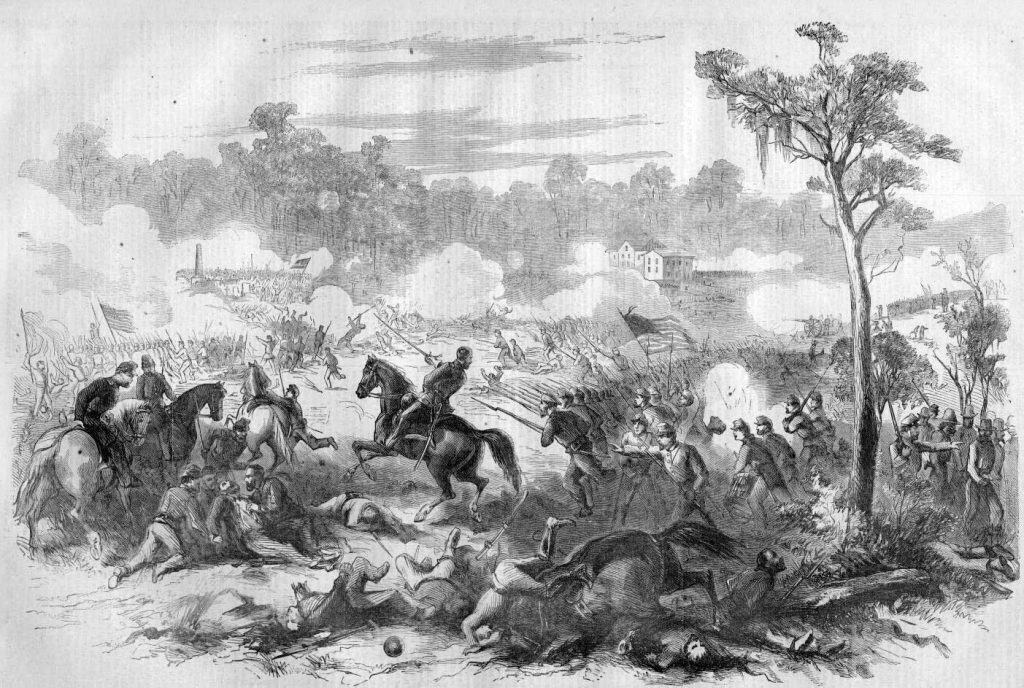
August 5, 1862
Baton Rouge had been the first Southern state capital to fall when General Thomas Williams unloaded his army at the town at the end of May. By the morning of August 5th, the Confederates under General John C. Pemberton had marched from Camp Moore in Tangipahoa Parish to the outskirts of the city which were at the time in the area around 22nd Street. Each side had fought with about fifteen hundred soldiers and each side lost about four hundred killed and wounded, including General Williams, who was shot off his horse near Florida and Fourth Street. It was called a draw, but the Confederates were compelled to withdraw.
August 6, 1862
Today in 1862, in the aftermath of the Civil War Battle of Baton Rouge, the Confederate ironclad Arkansas was scuttled on the river near Port Hudson. The Arkansas to have taken part in the battle, but engine problems delayed its arrival. On the morning of 6 August, the Union ship Essex came in sight, and the Arkansas moved to meet her. Just at this time, crank pins on both engines failed almost simultaneously, and Arkansas drifted helplessly to the shore. The Confederate commander ordered the ship to be scuttled. Today, the Arkansas rests under a levee 690 feet past river mile 233
August 7, 1968
It might have been Wednesday in the rest of America, but today in 1968, it was Herman’s Hermits Day in Baton Rouge. The Hermits were past their prime by 1968—I’m Henry the Eighth, I Am and Mrs. Brown, You’ve Got a Lovely Daughter had hit in 1965, and their last hit had been 1967’s There’s a Kind of Hush, but their adoring fans in Baton Rouge didn’t care. They stomped and screamed when the band made an appearance at a screening of the new film, Mrs. Brown, You’ve Got a Lovely Daughter at the Gordon Theater and packed two sold out concerts at Independence Hall.
August 8, 1952
The first Pak-a-Sak convenience store in Baton Rouge opened this week in 1952. The first location was 2223 North 33rd Street at Winbourne. Two other locations would open in the next three four months. Pak-a-Sac would become the chain of convenience stores in Baton Rouge that opened at 7 a.m. and closed at 11 p.m., seven days a week. As part of the grand opening sale, a free bag of groceries worth $3.03 was given away with every purchase. Pak-a-Sak would hold the unique distinction of becoming the first store in Baton Rouge to serve Icees after the drink was patented in 1960 and started selling franchises.
August 9, 1971
The Mary Bird Perkins Radiation Center, later the Mary Bird Perkins Cancer Center opened this month in 1971. Prior to the center’s opening, local cancer patients used to go to New Orleans, Houston or Jackson for radiation therapy. Dr. M. L. Rathbone spearheaded a fund-raising campaign and the Cancer, Radiation and Research Foundation was formed to locate a center here. Baton Rouge philanthropist Paul D. Perkins donated a gift of valuable land to help finance the center, which was named in honor of his daughter, Mary Bird Perkins. The center moved to its new home on Essen Lane in 1996.
August 10, 1940
The Huey P. Long Bridge, now known as the US 190 Bridge was dedicated today in 1940. Legend has it that Huey Long ordered the bridge to be built unusually low to the waterline in order to prohibit ocean- going vessels from going upriver beyond it. However, Long had been dead for two years when construction began in 1937, so while such reasoning might account for the height of the bridge, the blame or credit can’t be given to its namesake. As a sign of the times, the first vehicles to cross the bridge carried National Guard troops headed to a training exercise to prepare for World War II.
August 11, 2016
Early today in 2016, a mesoscale convective system flared up in southern Louisiana around a weak area of low pressure that was situated next to an outflow boundary. In English, that means It Started Raining. Over the next two days, often- torrential downpours occurred in the areas surrounding Baton Rouge. Many rivers and waterways, particularly the Amite and Comite rivers, reached record levels, and rainfall exceeded 20 inches in multiple parishes. Volunteers in boats calling themselves the Cajun Navy would rescue stranded residents for three days. Thirteen deaths were attributed to the Flood of 2016 would be called the worst natural disaster in the United States since Hurricane Sandy in 2012.
August 12, 1947
Today in 1947, East Baton Rougeans went to the polls and voted to abolish the East Baton Rouge Police Jury. Changing the parish’s charter to establish the Office of Mayor-President and a Metropolitan Council was presented as a “good government” measure and denigrated by others as a power grab by residents of the City of Baton Rouge. The vote was close, 7012 for and 6705 against. Naturally, there were charges of “chicanery, and the losers threatened a recount. Powers Higginbotham, who had been the mayor since 1944, was elected the first Mayor-President in 1948. The plan went into effect on January 1, 1949.
August 13, 1978
This weekend in 1978, the Baton Rouge High School (Sports) Hall of Fame inducted its first class of thirty greats at a banquet attended by more than 350 people. LSU and NBA Hall of Famer Bob Pettit and All-Pro Jimmy Taylor were among the first honorees. Among the female honorees were Mary Elizabeth Norckauer, a pfofessional ice dancer in the 1940’s and 50’s, who would become a Senior Olympian at the age of 90, and Miss Reine Alexander, one of the school’s first principals who supported the school’s athletic programs and led Baton Rouge High to become one of the finest schools in the state.
August 14, 1975
Time Warp, Anyone? The Rocky Horror Picture Show opened in theaters to unimpressive reviews and ticket sales today in 1975. It the years ahead, it would become a cult classic around the world, including Baton Rouge where midnight showings on weekends regularly sold out first at the Varsity Twin Cinema on Highland Road and later at Tinseltown USA on Siegen Lane. Singing along, improvising witty banter and throwing things at the screen were all part of the Rocky Horror experience. In 1999, Tasty Stuff, the “official” Baton Rouge Rocky Horror cast was formed and became a regular feature of performances until regular showings at Tinseltown were discontinued.
August 15, 1945
Today was VJ Day in Baton Rouge and throughout the Free World in 1945. World War II had finally ended after three-and-a-half years of American participation, and thousands of Baton Rougeans with horns and confetti on Third Street. But many others celebrated by going to the service stations. Gasoline rationing had finally come to an end and motorists were at last free to shout, “Fill ‘er up!” And they did. Herbert Wimberly, owner of the Auto Hotel on Convention Street, said that he sold six thousand gallons that day after averaging about one thousand gallons per day during the war.
August 16, 1831
Perhaps the most deadly hurricane ever to hit Louisiana came ashore today in 1831. It was called the Great Barbados Hurricane. Barbados had been the first to feel its wrath. Bridgetown had been obliterated on August 10th by a seventeen-foot surge that killed 1,500 people. It ravaged Puerto Rico and Cuba before making landfall as a Category 3 in Terrebonne Parish and destroying the resort community of Lost Island. New Orleans experienced its 10-foot surge that flooded the back part of the city. 1500 were killed in Louisiana, and the sugar cane crop was wiped out. In all, the stormed created damage estimated to be $185 million in 2016 dollars.
August 17, 1998
Today in 1998, Baton Rouge became “The 225”. 504, which was one of AT&T’s original area codes, had served the entire state of Louisiana from 1947 until 1957, when area code 318 was established to serve western and northern parts of the state. 225 became Louisiana’s third area code, serving the parishes in the greater Baton Rouge area. Many Baton Rougeans spent the better part of the day either reprogramming telephones, fax machines, pagers and burglar alarms or ordering new stationery and business cards. At the time, the phone company claimed that the numbers 2-2-5 corresponded on the alpha-numeric keyboard to the letters C-A-J; a nod to the area’s Cajun heritage.
August 18, 1920
Today in 1920, the Tennessee legislature adopted the 19th Amendment to the U. S. Constitution, the 36th state to do so, and women’s suffrage became law and women became voters. (No thanks to Louisiana, where the 19th amendment would not be adopted until June 11, 1970–fifty years later!) Baton Rougeans celebrated the way Baton Rougeans always celebrate something big—by driving around town and honking horns. A large rally was held in front of City Hall, and the effects of the amendment were almost immediately evident in Baton Rouge, where women were instrumental in the success of the first female candidate for sheriff, Eudora S. Day, in 1928.
August 19, 1967
Before they ever played a game in New Orleans, the New Orleans Saints played a game in Baton Rouge tonight in 1967. In their inaugural season, the Saints were drumming up enthusiasm around the state by playing exhibition games in Baton Rouge and Shreveport. 40,000 loud and happy fans thronged Tiger Stadium, despite heavy rains in the afternoon and a civil rights march in South Baton Rouge. The Saints came from behind to defeat the Pittsburgh Steelers in the second half to become the first NFL expansion team to win two games in pre-season. It was the first professional football game ever played in Baton Rouge.
August 20, 1967
Today in 1967, A. Z. Young, then head of the Bogalusa Voters League, led approximately one thousand marchers from Capitol Junior High School to the State Capitol in support of a number of demands for racial equality. The demands included “a fair proportion of the population” on all state agencies, including the state police, the Welfare Department, the state public health unit, the Louisiana Employment and the Washington-St. Tammany Charity Hospital. The march had begun in Bogalusa on August 10th and arrived in Baton Rouge on Saturday evening. Young, the leader of the march, would later be honored with the naming of a park near the Capitol.
August 21, 1862
In the aftermath of the Civil War Battle of Baton Rouge, the Union Army burned or tore down all of the houses in Spanish Town, except for those along North Street used for hospitals and officers’ quarters for the army. When the army evacuated the city on today in 1862, an earlier order to burn the rest of the city was countermanded to save asylums for orphans and the handicapped. Instead, they sacked the community before their departure. Sarah Morgan?s diary gave a detailed description of the wholesale destruction visited on her family?s house. Portraits were slashed, bureaus and desks were rifled, furniture overturned, dishes shattered, and smaller objects were looted.
August 22, 1991
Today in 1991, the Varsity Theater on Highland Road opened its doors as a music venue, after a fifty-three year run as a movie theater. Following months of rumors that they were going to take over the Varsity, Tim Hood and Michael Ryan, owners of the next-door Chimes Restaurant and Bar, signed a 10-year lease on the building. Renovations began this summer and continued until moments before the grand opening. Func Haus and the Bluerunners played opening weekend. The original Varsity Theater had screened mainstream films from 1937 until 1969, and then showed adult films until 1976. The theater closed for remodeling and reopened in 1977 as a twin cinema.
August 23, 1973
The University Cinema in the University Shopping Center on Highland Road re-opened today in 1973 with four screens. The South’s first Jerry Lewis Twin Cinema was Baton Rouge’s first twin cinema when it had opened in November, 1970. The marketing plan was that a movie for adults would show in one auditorium and a movie suitable for children would show in the other so that families could go to the movies together. In its ads, the theater promised that it would never show an X-rated film. Two more screens and the new name debuted in 1973. The theater was sold to the UA cinema circuit in 1986 and closed in 2000.
August 24, 1955
This week in 1955, the Fifth Circuit Court of Appeals in New Orleans ruled that LSU could not deny admission to qualified African-Americans in its undergraduate division. The court had ruled earlier that African Americans must be admitted to the graduate school and law school. The ruling came in a case filed against the LSU Board of Supervisors by Alexander P. Tureaud, Sr. of New Orleans on behalf of his son, Alexander P. Tureaud, Jr. Previously, the circuit court had ruled that the district judge was without jurisdiction to hear and determine the application for judgment and that a three-judge court was required.
August 25, 1991
Today in 1991, Baton Rouge native Lynn Whitfield, won an Emmy award for Lead Actress in a mini-series for her portrayal of Josephine Baker in ‘The Josephine Baker Story” on HBO. She had also received a Golden Globe nomination for her role in the series. Whitfield was born in Baton Rouge in 1953, the daughter of Jean and Valerian Smith. She is the eldest of four children and a graduate of Lee High and Howard University. Her dentist father was active in local theater and was instrumental in developing her interest in acting. She appeared off-Broadway in New York and in Los Angeles before breaking into film and television work.
August 26, 1976
This week in 1967, Trinity Christian College, later Trinity Baptist College purchased one thousand acres on Greenwell Springs Road as a site for a new college that was envisioned for Baton Rouge. Dr. Mack P. Stewart, pastor of the Trinity Baptist Church, chairman of the college’s board of trustees and president of the college said that surveying and engineering work on the new campus would begin immediately, with construction getting underway in a few weeks. Degrees in business, elementary and secondary education, Bible and physical education were envisioned. Dr. Stewart and the Trinity Baptist Church parted ways in 1968, and the writing was on the wall for the college.
August 27, 1963
Today in 1963, the Lakeshore Hotel on Third Street near the State Capitol opened its doors. Over the next twenty years, it would change its name to the Parliament House, the White House Inn and—briefly, the Lakeshore Statler Hilton Hotel. Its proximity to the capitol would make it a magnet for legislators and lobbyists. In the late sixties, Governor John McKeithen would joke that he could go out on the porch of the Governor’s Mansion and hear the lobbyists plotting against him across the lake. When it closed for the last time in the 1990’s, it was called Inn on the Lake.
August 28, 1977
This week in 1977, Lou Brock became the all-time major league stolen base leader in Major League Baseball when he broke Ty Cobb’s career record of 892 stolen bases. The record had been one of the most durable in baseball history. After attending high school in Mer Rouge, Louisiana, Brock attended Southern University and tried out for the baseball team to secure an athletic scholarship. In his second year as a Jaguar, he hit for a .500 average. Southern won the NAIA baseball championship during his junior year, and Sweet Lou was selected for the United States baseball team in the 1959 Pan American Games.
August 29, 2005
Today in 2005, everything changed. Katrina roared ashore on the Louisiana-Mississippi state line, and it would become one of the deadliest natural disasters in U.S. history, leaving at least 1,245 people dead, and a further 135 missing. Broken levees in New Orleans forced the evacuation of the city. More than 200,000 people would relocate to Baton Rouge, making it Louisiana’s largest city for the next seven years. Although the effects of the storm would continue to be felt for years, by the end of just four days, the American Red Cross announced that it was already their largest relief effort ever.
August 30, 2006
Today in 2006, the Hilton Baton Rouge Capitol Center, which had begun life as the Heidelberg Hotel in 1927 held its Grand Opening today after a $65 million renovation. the LSU Tiger Marching Band played in Lafayette Street, and a black-tie gala benefitting the Foundation for Historic Louisiana featured a 1920s theme. In the late 1920’s the Heidelberg Hotel was a favorite dwelling of Louisiana Governor Huey Long, who had a seventh-floor suite. He lived there exclusively for over a year as he waited for a new Governor’s Mansion to be built after he’d ordered state convicts to tear down the old one.
August 31, 1959
On this first day of school today in 1959, eight new elementary and secondary schools in the city opened their doors for the first time. Robert E. Lee High Junior and Senior High, Capitol High, Bakerfield Elementary, Villa del Rey Elementary, Progress Elementary, Capitol Avenue Elementary and Westdale Elementary schools were ready to absorb the parish’s burgeoning school population which had grown by eight thousand over the previous year. In a period of unprecedented growth, Broadmoor Junior and Senior High, Scotlandville High, Glen Oaks High, and South Greenville Elementary schools were under construction at the same time and would open in 1960.
September 1, 2008
Today in 2008, Hurricane Gustav became the worst storm to hit Baton Rouge in at least 50 years. Gustav made landfall near Cocodrie in Terrebonne Parish as a Category 2 storm and brought wind gusts of 91 mph in East Baton Rouge Parish. Trees were down all over the city, and an older couple were killed in their home when a tree fell on it Three hundred thousand Entergy customers in the parish were without power, and the American Red Cross reported that 63,590 people had taken refuge in shelters. Across Louisiana, 48 people were killed by the storm, and over a million lost power.
September 2, 1928
The movie version of Uncle Tom’s Cabin, directed by Harry A. Pollard and starring Margarita Fischer as Eliza and James B. Lowe as Uncle Tom was released today in 1928. It was the first “big” Hollywood movie to be filmed partially in Baton Rouge, and more than 200 local citizens were cast as extras. The movie’s racial sensibilities might confound modern viewers, but it was representative of its era and was considered to be a classic. It would be a while before the film screened in a Baton Rouge theater, but it definitely created an appetite for movie making in the city.
September 3, 1984
Today in 1984, nearly six hundred students were gathering in Baton Rouge for the opening of the newly-founded Jimmy Swaggert Bible College on Bluebonnet Lane. Dr. Don Paul Gray would be the college’s president, and Swaggert would serve as chancellor. Swaggert had predicted in 1983 that the college would enroll 500-1000 students in its first year, and over the course of the next two years, enrollment would exceed 900. A twelve-story dormitory with two wings—one for boys, one for girls—had been built across Bluebonnet Lane from the World Ministry, and by the time had come for students to check in, four floors in each wing would be needed.
September 4, 1920
The Columbia Theater on Third Street opened in 1920. With1,451 seats, and was the first theater in the United States to have lights lining the aisles. The grand opening of the theater was a blockbuster in itself. The theater was awash in flowers from well-wishers. After an opening prayer by the Reverend Canon Racine of St. Joseph’s Church, eleven hundred theatergoers settled in for a concert by the Stanocola Brass Band and the Columbia Concert Orchestra, followed by Miss Norma TaImadge in Yes or No?, and Magda Lane in Bought and Fought For. The theater was renamed the Paramount in 1937, and closed and demolished forty-two years later in 1979.
September 5, 1862
Today in 1962, the First Louisiana Native Guard was formed, becoming the first all-black regiment to serve in the Union Army during the Civil War. While based in New Orleans, several members of the guard were Baton Rougeans. Free men of color were in the minority in the Guard, as most were African American men who had escaped from slavery to join the Union cause and gain freedom. The Guard would play a prominent role in the Siege of Port Hudson near Baton Rouge in the summer of 1863, and would become the 73rd Regiment Infantry U.S. Colored Troops. The regiment would be disbanded at the end of the war.
September 6, 1975
WLPB, Baton Rouge’s first public television station and Louisiana’s first PBS affiliate, went on the air in 1975, broadcasting on UHF Channel 27. In 1971, the legislature had created Louisiana Educational Television Authority to build and sign on the stations needed to bring Big Bird, Frontline and Masterpiece Theatre to the state. Over the next eight years, LPB would expand its signal over the state, adding stations in Monroe, Shreveport, Lafayette, Lake Charles and Alexandria. (In case you were wondering, Shreveport native and longtime Baton Rouge resident Beth Courtney would be named president and CEO of Louisiana Public Broadcasting and become a fixture at the network in 1985.)
September 7, 1972
At the Munich Olympics today in 1972, Rod Milburn won the gold medal in the 110-meter hurdles, tying the world record of 13.2 seconds. A native of Opelousas, “Hot Rod” was the outstanding high school hurdler in the United States and broke the national age record for the 120-yard hurdles. He was voted to the Louisiana Sports Writers Association All-State track and field team in both his junior and senior years. Following high school, he attended Southern, where he was coached by Dick Hill, and also where he met Willie Davenport, the 1968 110-meter hurdles champion. Davenport recognized his potential and mentored the young athlete.
September 8, 1935
Tonight in 1935, somebody shot Senator Huey Long. Police witnesses said that Baton Rouge physician Carl Austin Weiss approached Long and fired the shot that would cause his death thirty hours later. Weiss’s defenders would say that the doctor approached the Senator in a manner that the Senator’s bodyguards deemed to be threatening. An errant bullet from a guard’s gun struck Long, before their next sixty-two bullets would strike Weiss. It was said later that when Weiss’s body was moved, the sound of bullets falling out of his body and hitting the marble floor sounded like somebody dropping a fistful of nickels.
September 9, 1935
Today in 1935, Dr. Carl Austin Weiss, the man who’d been named as the gunman in an attempted assassination of Senator Huey Long the night before, was given a funeral at St. Joseph’s Church. There had been some discussion of whether an accused assassin could be given a burial in the church, but as Long was still alive and expected to live, the service proceeded. It was attended by hundreds of people, including two former Louisiana governors, and later said to be the largest funeral ever held for a political assassin. Long would die from complications from his wound later that night at Our Lady of the Lake Hospital.
September 10, 1968
This week in 1968, the 24-story Louisiana National Bank building downtown on Florida Street was dedicated. One of the building’s most popular features would be the Camelot Club, a private dining club on the 24th floor that would become the location of power lunches in the city for the next forty years. At the dedication, Mayor Woody Dumas said, “Those who think downtown is dying are dying themselves. This $12.5 millinn building is evidence of the confidence of business in this community.” Louisiana National Bank was absorbed by Premier Bank in 1988, which was absorbed by Capitol One in 2001, which was absorbed by Chase in 2004.
September 11, 1955
Delmont Village Shopping Center on Plank Road held its Grand Opening on Plank Road this month in 1955. The new center and its thousand convenient parking spaces featured nineteen stores, including J. C. Penney, Young Fashions clothing for children, Rochelle for ladies’ fashions, Kinney Shoe Store, Halpern’s Fabrics and a Piccadilly Cafeteria. The anchor for the center was the 27,000 square foot branch of Dalton’s Department Store, featuring “fine walnut veneers, modern fixtures, vinyl floors and paint ranging from soft green to pink to tan.” Within a few years, Dalton’s would be sold to the D.H. Holmes chain of New Orleans.
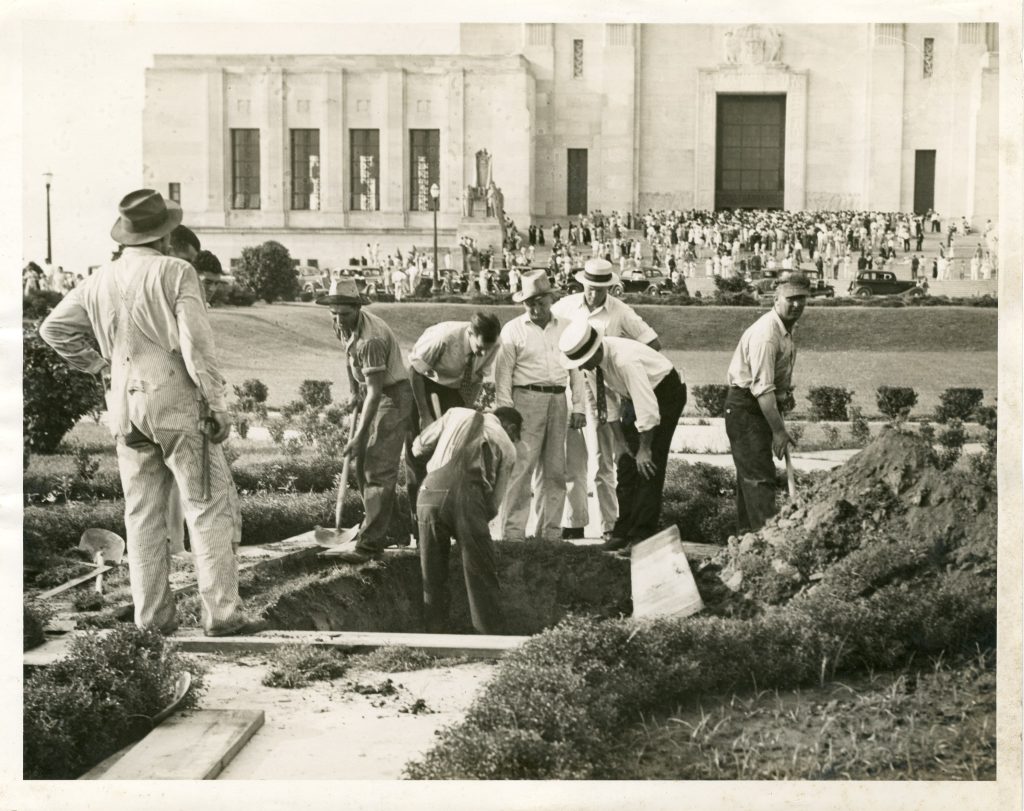
September 12, 1935
It was said that every cut flower between New Orleans and Lake Charles was sitting in the garden of the Louisiana State Capitol today in 1935, as Senator Huey Pierce Long was laid to rest on the grounds of his beloved Capitol building. An aerial shot of the funeral later confirmed that the thousands of mourners had been surrounded by ranks of bouquets on stands that stretched from the parking lot to Spanish Town Road. An estimated hundred thousand mourners had filed past the casket in Memorial Hall a day earlier. At the service, the LSU Band under director Castro Carazo, offered Ev’ry Man a King at dirge pace.
September 13, 1944
The Southern University Marching Band, “The Marching 100”, made their debut this month in 1944. In the years ahead, the band would become “The Human Jukebox” and under the baton of seven distinguished directors, would perform around the world, including performances for three United Stated presidential inaugurations, four Sugar Bowl and five Super Bowl appearances and six weeks at Radio City Music Hall. When the New Orleans Saints returned to the Louisiana Superdome on August 25, 2006 to play their first home game since Hurricane Katrina, the Human Jukebox ushered in the rebirth of the Saints, reducing some in the crowd of 75,000 to tears of joy.
September 14, 1992
This week in 1992, Senator–and later Oscar and Nobel Prize winner Al Gore stopped at Po Boy Lloyd’s on Florida Street for a bowl of gumbo and a plate of shrimp and sausage jambalaya. Gore was running for Vice President on a ticket with Arkansas Governor Bill Clinton and made a campaign stop in the city. Earlier, Gore had walked along Third Street between Florida and Laurel Streets, shaking hands and looking into empty storefronts. Dining at Po Boy Lloyd’s with six small business owners, Gore suggested that his environmental policies would not be detrimental to Louisiana’s oil and gas business.
September 15, 1955
This week in 1955, there were over twelve hundred entries in a city-wide contest to name the new street that would connect 33rd Street in the north with Stanford Avenue in the South, but Mrs. Julie C. Cusachs of St. Ferdinand Street won the $100 prize offered by City-Parish councilwoman Mildred DuBois. The winning entry was “Acadian Thruway”. Mrs. Cusachs, a native of Natchitoches Parish, said she submitted the name because she’d just completed a course in Louisiana history while working on a master’s degree at LSU, and that she thought the word “Acadian” connected with local heritage and that “Thruway” sounded “modern.”
September 16, 1972
Today in 1995, some Sherwood Forest residents had had just about enough of their fellow Baton Rougeans. Crime statistics that were going up and real estate values that were going down prompted residents of the area to ask the Metro Council to look into closing some of the twenty-nine streets that lef into the neighborhood. Gary Patereau, president of the Sherwood Forest Civic Association, said that while Sherwood Forest was still one of the safest places to live in the city, pro-active steps were needed to be taken to keep it that way. Some members of the council claimed to be sympathetic to Mr. Patereau’s concerns, but no streets were closed.
September 17, 1925
This month in 1925, Baton Rougeans were invited to come out to the Baton Rouge Circus Grounds to see real European clowns and majestic animals at the spectacular Bob Morton Circus. The circus, which would be running for six nights, was one of several traveling circuses which visited Baton Rouge in the early twentieth century. The Circus Grounds was located at the corner of North Street and Decatur Street, across the street from St. Joseph’s Cemetery. Decatur Street would become North 17th Street in 1929, and the circus grounds would die out in the mid-1950’s as traveling circuses took their show to the parking lot of Memorial Stadium.
September 18, 1919
This month in 1919, Norman “Cap” Saurage started selling Community Coffee to Baton Rouge grocers. In the early 1900’s, he had opened the Full Weight Grocery Store near the Standard Oil Refinery in North Baton Rouge. He started grinding coffee for his customers, and made his coffee available to other grocery stores in 1919. Demand for the coffee increased to the extent that in 1924, Saurage left his grocery business to focus on coffee. In 1946, the “Community Coffee Mill” opened a new plant equipped with the latest coffee roasters. Community was named the Official State Coffee of Louisiana in 1998.
September 19, 1927
Today in 1927, McKinley High School opened on Texas Street, which is now Thomas H. Delpit Drive. McKinley is the oldest high school established for African Americans in East Baton Rouge Parish and McKinley’s first four graduates became the first African American high school graduates in Louisiana. McKinley moved to a new facility at the corner of Louise Street and McCalop Street in 1950, and the old facility became McKinley Junior High School. In 1962, the third and present-day McKinley Senior High School was built on East McKinley Street, the Junior High School was moved to the Louise Street site, and the Delpit Drive site became McKinley Elementary.
September 20, 2001
Today in 2001, Baton Rouge mourned the passing of Abe Mickal. “Miaracle Mickal” played halfback, punter and placekicker for LSU in 1933-35 and was a charter member of the LSU Athletic Hall of Fame in 1937. In 1967, he became the the first Tiger inducted into the College Football Hall of Fame. At LSU, Mickal had been elected president of the university’s student body, prompting U.S. Senator Huey Long to offer him a seat in the Louisiana State Senate that had been vacated. Mickal demurred and declined the offer. Mickal earned his medical degree in 1940, and after serving in World War II he began a lifelong career in medicine.
September 21, 1779
Today in 1779, the Spanish Governor in New Orleans, Bernardo de Galvez, sensed that the British fort at Baton Rouge, was ripe for taking. The British, who had held Fort New Richmond since 1763, were defending the fort with only about four hundred men and a few old cannon. Galvez led fifteen hundred troops up the river and arrived in Baton Rouge on September 19th. Galvez set up his artillery on a Native American burial mound on North Boulevard that has since been leveled and starting shelling the fort on September 21st. After an extended bombardment, the British, under the command of Colonel Alexander Dickson, struck their colors and surrendered.
September 22, 1966
Today in 1966, Baton Rouge native David Barclay Dowling pitched a complete game for the Chicago Cubs, a 7–2 victory over the Cincinnati Reds at Wrigley Field. The victory was his second major league start and his first, last and only victory. Dowling was a leftie who signed with the Cardinals in 1963 after attending the University of California at Berkeley. He was called to the show in 1964 when he pitched the ninth inning of a lopsided 15–5 loss to the last-place Mets. Dowling spent two years in the Chicago farm system before another end-of-season recall in 1966. The last-place Cubs started him against Cincinnati.
September 23, 1810
Today in 1810, captured Fort San Carlos at Baton Rouge, ending Spanish domination of the area. Americans had been gaining in numbers and influence throughout the era of Spanish governance, and by 1810, they were ready to make their move to declare independence. American “rebels” under the command of Philemon Thomas weren’t willing to accept the losses associated with an attack on the old fort, but one of his lieutenants, Larry Morgan, had a better idea. An unguarded cattle chute on the river side of the fort allowed the Americans to slip into the fort early on a Sunday morning and take it with no losses to the rebels.
September 24, 1968
Presidential candidate George Wallace’s chickens came home to roost in Baton Rouge this week in 1968, as District Judge Luther Cole ruled that the Louisiana Democratic Party could list the state’s ten Presidential electors pledged to Vice President Hubert Humphrey under the traditional emblem of the Democratic Party, which was, at the time, not a donkey but a rooster. Supporters of the Alabama governor had filed a suit to enjoin Secretary of State Wade O. Martin from printing paper ballots listing Humphrey’s electors under the rooster symbol. After five hours of testimony-some of it hilarious-Cole issued a twelve-page ruling that the was not valid.
September 25, 2006
All the King’s Men, the third screen version of Robert Penn Warren’s Pulitzer Prize-winning novel, released this week in 2006. The film about a populist politician named Willie Stark, a character based on Louisiana’s own Huey P. Long was filmed on locations in Baton Rouge, including the State Capitol, and in Thibodaux and on a plantation near Jeanerette. The film starred Sean Penn as Stark, along with Jude Law, Kate Winslet, James Gandolfini, Patricia Clarkson and Anthony Hopkins. Critics questioned the casting of Penn in the central role and pondered why the three prominent British actors in the cast hadn’t bothered to leave their accents at home.
September 26, 1787
Today in 1787, Don Jose Pedro of the Baton Rouge District of the Spanish Province of West Florida required all Baton Rouge residents to take oath of loyalty to Spanish king. The move outraged some American settlers who were beginning to move into the Baton Rouge area from the original colonies in the aftermath of the Revolution. Pedro’s predecessor, Don Carlos deGranPre, had developed an easy relationship with the Americans, but had been recalled to Havana to face questions about the province’s finances. Pedro was to oversee the deterioration of that relationship that led to the Americans seizing West Florida in 1810.
September 27, 1941
Today in 1941, the new Harding Army Air Field opened in the last weeks before World War II began. It was used by the United States Army Air Forces Technical Service Command as a maintenance and supply base, and during the war, hundreds of flyers received flight training in the city. Harding Field Lieutenant Colonel Cornelius O’Connor was credited with the first official landing at Harding Field. In reality, the first plane had landed there the day before when foggy conditions at the Downtown Airport on Goodwood Blvd. forced Lt. J. B. Thomas to divert to Harding Field. The Harding Army Air Field would be renamed Ryan Airport in 1954.
September 28, 1932
Today in 1932, the great interstate milk war was churning away in Baton Rouge. The Louisiana Legislature had enacted legislation to require Louisiana dairies to produce milk of a quality consistent with the standards of the United States Public Health Service. In 1932, a bill was passed to require milk from out of state to be of the same quality as milk produced in the state. Disgruntled Mississippi dairy produces banded together to discuss their legal alternatives, but they really didn’t have a milking stool to stand on. The Mississippi legislature passed a bill the next year requiring public health standards be observed in that state as well.
September 29, 1895
Today in 1895, a hurricane raged through Baton Rouge, causing the ferry boat “Istrouma” to break loose from the Main Street landing and run aground near where the I-10 bridge now stands. Over the next years, the Istrouma would be replaced by the “Brookhill” and the “Port Allen”, both of which sank in service. In 1916, the Baton Rouge Transportation Company owned by the Cohn family bought the ferry service and brought the ferry boat “City of Baton Rouge” to town. The City of Baton Rouge would serve travelers until 1968, when the I-10 bridge opened and downtown ferry service was discontinued.
September 30, 1965
This weekend in 1965, the “Wildest Show in the South” the Angola Prison Rodeo was first held at the Louisiana State Penitentiary. It was America’s first prison rodeo, and according to one observer, the event got its start when “they’d just back pick-ups into a field and go out and play around on horses.” The rodeo opened to the public in 1967, and over the years has expanded into a 10,000-seat arena surrounded by a fairground-like craft market. Money raised by the rodeo has financed Baptist seminary classes at the prison, funerals for inmates, educational programs and maintenance of the prison’s six chapels.
October 1, 1894
Today in 1894, St. Vincent’s Academy was founded by the Brothers of the Sacred Heart and opened at the corner of North Street and Fourth Street. The school was named in recognition of the Society of St. Vincent de Paul, who helped organize and establish the school. The original site of the school was an old frame building, and the enrollment was 106 students, which grew to approximately three hundred students in the 1920’s. In 1929, St. Vincent’s would change its name to Catholic High School and move into a larger facility on North Street. A state office building now occupies the site.
October 2, 1991
Today in 1991, Baton Rouge became a one-daily newspaper town. In 1904, William Hamilton of Shreveport bought The Advocate, which had been publishing several issues during the course of the day since 1842. He changed the name to the Times and began publishing in the afternoon. About the same time, another paper, The State, secured the state printing contract, bought the Times and changed the name to the State-Times. Charles P. Manship, Sr., who had been writing for the paper, bought the State-Times in 1909 and The Advocate the next year. 133 employees of State-Times lost their jobs when the state’s largest afternoon newspaper folded.
October 3, 1931
Let there be light! LSU played its first night game at Tiger Stadium tonight in 1931. The Springhill Badgers from Alabama provided the first nocturnal feeding for the Tigers, and five thousand fans turned out to watch the game in a constant drizzle. LSU held its best players in reserve until the fourth quarter against the overmatched opponent and pummeled the Badgers, 35-0. W. J. Spencer, the sports editor of The Advocate wrote the next day, “But you can have your night football. The entire night layout has demoralized our office. But if the fans take to it, we will be in there to suffer.”
October 4, 1943
Jamil Abdullah Al-Amin, born Hubert Gerold Brown and known as H. Rap Brown, was born in Baton Rouge today in 1942. In the 1960’s, Brown was the fifth chairman of the Student Nonviolent Coordinating Committee, and during a short-lived alliance between SNCC and the Black Panther Party, he served as their minister of justice. He is perhaps most famous for his proclamations during that period that “violence is as American as cherry pie” and that “If America don’t come around, we’re gonna burn it down.” He is currently serving a life sentence in Georgia for shooting two Fulton County Sheriff’s deputies. One deputy, Ricky Kinchen, died in the shooting.
October 5, 1997
The Grand Opening of the Mall of Louisiana was celebrated this month in 1997. The center cost $300 million to build and was developed by Jim Wilson & Associates, who had earlier developed the Riverchase Galleria in Birmingham. Prior to the grand opening of the mall, Sears and J. C. Penney jumped the gun and opened a week before other stores. The other three anchor tenants, Maison Blanche, Dillard’s and McRae’s and 150 other stores opened a week later. Over the years, Maison Blanche would become Macy’s, and McRae’s would be bought by Dillard’s, which it would remodel and operate separate stores in the mall for men’s and women’s fashions.
October 6, 1975
Today in 1975, the State-Times reported that more than two hundred families of Vietnamese refugees had made their way to Baton Rouge after the fall of Saigon and the South Viet Nam government earlier in the year. These families were among the first of the 800,000 Vietnamese who would escape the country between 1975 and 1979. 130,000 of them would eventually settle in the United States. Pam Trahan, resettlement coordinator for the Diocese of Baton Rouge said that the Catholic Church alone had resettled forty-two families of 199 refugees in the area. Lutheran, Presbyterian, Methodist and Seventh-Day Adventists also sponsored families from refugee camps.
October 7, 1977
The Grand Opening of the Riverside Centroplex was celebrated with two days of festivities that began tonight in 1977. Three thousand formally-clad guests shuffled across the floor and through the concourses of the arena, thinking perhaps, of the rabbit ears and balloon hats they’d need to purchase before the Steve Martin concert a couple of months later. The next day, Bishop Stanley Ott would bless the building, Earl Taylor of Southern University would sing, dignitaries would be recognized, and Senator Russell Long and Governor Edwin Edwards spoke and assisted in the cutting of the ribbons. Raising Cane’s would purchase naming rights to the building in 2016.
October 8, 1988
Tonight in 1988, 79,431 delirious fans at Tiger Stadium (less a couple of thousand Auburn fans) erupted in cheers when LSU scored on an 11-yard touchdown pass from Tommy Hodson to Eddie Fuller, and went ahead of the fourth-ranked Tigers with less than two minutes left in the game. But it would be the next morning before the game got its name. The “eruption” registered as an earthquake by a seismograph located in LSU’s Howe-Russell Geoscience Complex around 1,000 feet from the stadium. The seismograph reading was discovered by LSU seismologist Don Stevenson and student worker Riley Milner. The legend of “The Earthquake Game” was born.
October 9, 1763
This week in 1763, British monarch George III proclaimed the British colony of West Florida. The province would consist of parts of Florida, Alabama, Mississippi and the Florida Parishes of Louisiana. George proclaimed that henceforth, the French fort at Baton Rouge would be called Fort New Richmond. For all of his grand words and plans to strengthen the fort, George and the British weren’t much interested in Baton Rouge. Their interest in West Florida began and ended at the harbor at Pensacola which was declared to be a perfect base for their Caribbean fleet. Fort New Richmond would fall to the Spanish sixteen years later in 1779.
October 10, 1973
This week in 1973, OPEC announced an oil boycott of the United States due to America’s support for Israel in the 1973 Yom Kippur War. The price of a barrel of oil soared from $3.00 to over $12.00 and a gallon of gasoline spiked from 38 to 55 cents. In Baton Rouge and across the country, lines of cars waiting to buy gas, rationing and harsh words ensued. President Nixon urged conservation and signed legislation to establish permanent daylight savings time, and Governor Edwards suggested that maybe Louisiana should think about requiring that the gasoline produced in Louisiana should stay here.
October 11, 1926
Today in 1926, Baton Rouge native Governor Henry L. Fuqua died in office, halfway into his term. After working in the engineering and hardware industry, he established his own business, the Fuqua Hardware Company. From 1916 to 1924, he served as the warden of the Louisiana State Prison at Angola. Fuqua entered politics in 1924, winning the Democratic gubernatorial nomination and defeating Public Service Commissioner Huey Long and House Speaker Hewitt Bouanchaud to succeed Governor John M. Parker. During his tenure, Anti- Klan legislation was sanctioned that secured harsh penalties for anyone wearing a mask or anyone committing a crime while masked.
October 12, 1943
Today in 1943, Baton Rougeans were given a weather forecast. For the past year, newspapers and radio stations were limited to providing weather conditions in their own state and up to four surrounding states. As the Americans’ situation in World War II improved, the Office of Censorship relaxed restrictions on the publication and radio broadcast of weather forecasts. The office emphasized that only official forecasts could be provided, ruling out prognosticators and their long-range predictions. Also, mentioning wind direction and barometric pressure would still be prohibited, except in emergencies. On the next day, newspaper readers were delighted to be informed that it was unseasonably warm in Chicago.
October 13, 1903
F. G. Clark was born in Baton Rouge today in 1903. Felton Grandison Clark was the son of Joseph Samuel Clark, the first president of Southern University. He received his early education on the Baton Rouge Academy, where both of parents worked. After college, he taught at Wiley College in Texas for a couple of years before coming to Southern to teach child psychology, philosophy and sociology in 1927. In 1938, he would succeed his father as president of the university. Over the fifty-four tenure of father and son, Southern’s faculty would grow from seven to over a thousand, and the student body would grow from 70 to over 14,000.
October 14, 1980
Before it was NoGo or SoGo, it was just Beauregard Town, and it was added to National Register of Historic Places today in 1980. In 1806, Captain Elias Beauregard subdivided his plantation into 60′ x 120′ lots, which he originally called Beauregard Village. With a unique street configuration, it was envisioned as a new administrative center for the growing city as well as its elite new residential area. Original plans called for a cathedral square in the middle of what would become Government Street, roughly where the parking lot of the Wesley United Methodist Church is now. Beauregard Town contains the Old State Capitol and other significant government buildings.
October 15, 1960
Today in 1960, Presidential candidate John F. Kennedy touched down in Baton Rouge in the last weeks leading up to the Presidential election. The South was not a one-party region that year, and Kennedy strategized that Louisiana might be one of the few states in the region where his Catholic religion might actually benefit him. The trip was significant, in that Kennedy came to Baton Rouge on his family’s plane, the Caroline, on its maiden voyage. He spoke at the Capitol House Hotel on Lafayette Street to a sellout crowd. In the election, he would carry Louisiana with 50.2 percent to 28.5 percent for Nixon.
October 16, 1890
Today in 1958, Metro Councilman Woody Dumas withdrew his proposed ordinance to prohibit alcohol at football stadiums. The ordinance had originally been aimed at LSU Stadium, but then it was pointed out that the stadium was in the city limits and not subject to a parish ordinance. As it was written, the ordinance prohibited liquor at only the stadiums at Southern University and Central. When asked why he was introducing the proposal, he said, “A lot of others like to go to a stadium to see a football game.” His stated reason for withdrawing the proposal was that no one at Southern or in Central had asked for it.
October 17, 1968
Today in 1968, Southern University star Willie Davenport took the gold medal in the 110 meter hurdles at the Mexico City Olympics. Davenport took part in his first Olympics in 1964, but injured his thigh and was eliminated in the semifinals. In Mexico City in 1968, he reached the final and won: “From the first step, the gun, I knew I had won the race.” In 1972 he finished fourth, and in his third consecutive Olympic 110 meter hurdles final, in 1976, he won a bronze medal. At his last Olympics in 1980, he was a four-man bobsleigh runner, and his team finished 12th.
October 18, 1969
Today in 1969, Goudchaux’s at 1500 Main Street reopened after a renovation of its flagship store. To reflect the change, Ripley’s Believe It or Not would credit the store’s 961-foot lengh with being the “world’s longest purpose-built department store.” The original Goudchaux’s had opened on Main Street in the early twentieth century. In 1936, as the Nazis continued their ascent to power, Erich Sternberg smuggled $24,000 out of Germany and came to America, going first to Philadelphia, then to Jackson, Miss., before settling in Baton Rouge. In 1939, Erich bought Goudchaux’s, which at its height in the 1980’s employed over 8,000 workers in Louisiana and Florida.
October 19, 1970
Today in 1970, Metro Council Roland Stevens said he asked Police Chief Eddie Bauer to assign a police officer to attend each council meeting and committee meeting “to protect the council from the mayor.” Mayor Woody Dumas had appeared on a radio show earlier in the day and commented on the actions of the councilmen. Stevens met him in a hall later and told him to lay off. Stevens said the he feared that Dumas would strike him. Commenting on the situation, Councilman Joe Delpit said that it should not be necessary for intelligent men to have to protect councilmen from each other. “I didn’t come here for this.”
October 20, 1970
The Billy Graham Crusade came to Tiger Stadium this week in 1970. Speaking to a crowd estimated at 30,000 on the first night of the crusade, Graham said “We have false gods in America today—sex, drugs—even education.” In reference to campus violence, Graham said that what is happening on some of our college campuses today could lead to what has happened in Latin America, where universities had become a hotbed of political rebellion. In addition to Graham’s remarks, a Cliff Barrows led a 3500-voice choir in How Great Thou Art and 73-year-old Ethel Waters also sang. Miss America Phyllis George would appear at the Thursday session.
October 21, 1932
Today in 1932, the ‘Personals’ column of the Morning Advocate featured a notice that Miss Helen Wurzlow had motored to Houma recently to visit her parents, Mr. and Mrs. Calvin Wurzlow. At the time, Calvin Wurzlow was the mayor of Houma, and his daughter Helen had recently moved to Baton Rouge to take a position as “official hostess” of the newly-completed State Capitol. Her responsibilities included giving tours to visiting dignitaries and ordinary citizens who flocked to Baton Rouge in the thousands to tour the magnificent building which had been dedicated five months earlier. Helen would eventually take a staff writer position for the New Orleans Times-Picayune.
October 22, 1942
Today in 1942, the keel was laid for the destroyer, U.S.S. Kidd at the Federal Shipbuilding & Drydock Co. in Kearney, New Jersey. The Kidd would be launched five months later and commissioned on April 23rd, 1943. On its inaugural cruise across New York harbor, the Jolly Roger pirate flag was run up the mast. One New York newspaper writer spied the flag and joked that it was the first time that pirates had been spied in the harbor since the 1700’s. The crew liked the joke and opted to keep the Jolly Roger. Throughout the remainder of the war, the Kidd would bear the nickname, “Pirate of the Pacific.”
October 23, 1940
Today in 1940, Jitters the Circus Mule was the star of an animal auction at the Owen Brothers stockyard on Choctaw Drive. The Ringling Brothers and Barnum and Bailey Circus was auctioning off horses and other animals that had been used in the 1940 edition of the circus, which had recently closed. Bidding for Jitters was fierce, and he was eventually sold to a New Orleans man who planned to use him in advertising. Gold Dust, a full-blooded, five-gaited Palomino brought the highest price at $200, and “Master of the Dance” Jiggs, whose ability to rhumba and cake-walk made him a feature of the show, were also sold.
October 24, 1965
The Greater Baton Rouge State Fair got its start this week in 1965 when the Baton Rouge Jaycees expanded a trade show at the Bon Marche Mall (now Bon Carre Technology Center) and added a carnival midway at the corner of Airline Highway and Evangeline Street. J.H. Martin was the first fair chairman. In the last ten years, the Fair Foundation has given $1.175 million of grants to sixty-two different local nonprofits. In addition, the Fair Foundation has funded $500 scholarships to area students chosen by their schools for exemplary community service—that’s more than $300,000 to individual high school students over the last twenty years.
October 25, 1958
Today in 1958, the Southern Jaguars defeated the Jackson State Tigers in the first of their annual battles that would go on to be called the “Boombox Classsic.” The teams first met in 1929, a 98–0 blowout by Southern. They did not play again until 1958, when Jackson State joined the Southwestern Athletic Conference. Since then, the conference rivals have played each other every year, and twice in 1999, when Southern defeated Jackson State 31–30 in the SWAC Championship Game. Both teams went into the game at Memorial Stadium undefeated on the young season. Southern’s prolific offense would run wild in the game, and the Jaguars won, 30-6.
October 26, 1953
Today in 1949, Mary Hill was on trial for her life in Baton Rouge in one of the grisliest murders in the city’s history. Shadrack Chandler, a tenant in her mother’s house on South 13th Street had been butchered with twenty-eight whacks with a hatchet on August 25th. Three hundred spectators packed the courtroom to hear testimony from several of Hill’s friends who said she’d asked them to drop a body-shaped bundle she called a “dummy” off the Mississippi River Bridge. Testifying in her own defense, Ms. Hill said it was a crime of passion. After two-and-a-half hours of jury deliberation, the 63-year-old Hill was convicted of murder without capital punishment.
October 27, 1810
Today was the last day of Fulwar Skipwith’s 43-day term as the first and only governor of West Florida in 1810. On December 10, West Florida would become a territory of the United States. Skipwith was a distant cousin of U.S. President Thomas Jefferson and left college at the age of sixteen to enlist in the army during the American Revolution. In 1809, he moved to Spanish West Florida and served as a member of the West Florida judiciary. He was a leader in the rebellion against Spain in September 1810 and would serve as governor until West Florida was annexed to the United States.
October 28, 1923
This week in 1923, Leland College was reestablished in Baker. The college had originally been chartered in New Orleans, but the campus had been destroyed by a storm in 1915. It would take the college eight years to assemble the resources it needed to reopen on the Baker campus. Enrollment on the Baker campus would never exceed 100, and the school would struggle until the Baptist churches and the American Home Missionary Society of New York, which had been sustaining the college during its residency in Baker, withdrew their funding in the late 1950’s. The school would close permanently in 1960.
October 29, 1942
Today in 1942, American was nearing the end of its first year of its involvement in World War II. A front- page editorial in the Morning Advocate admonished children that if they planned to go out on Halloween night and have fun, they’d be helping Hitler win the war. Letting the air out of the neighbor’s tires was sabotage, ringing doorbells and running away ruined the sleep of war workers, soaping window wasted valuable wartime materials, and wearing a mask was something that only a saboteur would do. The paper advised children that if they wanted to hobnob with hobgoblins, they should stay home and make faces at each other.
October 30, 2005
On this Sunday afternoon in 2005, the New Orleans Saints and Miami Dolphins played the first regular season NFL game at Tiger Stadium. Hurricane Katrina had rendered the Louisiana Superdome unusable in the first week of the season, and the Saints would be compelled to divide their home schedule among Tiger Stadium, the New Jersey Meadowlands and the Alamodome in San Antonio. Throughout the season, there was a pervading fear that the Saints would never return to New Orleans, and the anxiety must have affected the teams play. The Saints would play the Dolphins, Bears, Buccaneers and Panthers in Baton Rouge, and they would lose all four games.
October 31, 1959
On Halloween in 1959, trick-or-treating had been moved from Saturday to Friday night so that parents could go watch the most famous game in Tiger Stadium history. LSU and Ole Miss were ranked No. 1 and No. 3 in the country, and they would play an epic game in Death Valley. The Rebels were leading 3-0, when Billy Cannon took a punt on his own 37-yard line and ran it into the history books, giving the Tigers a 7-3 victory. The Sugar Bowl Committee thought the game was so good that they scheduled a re-match for New Year’s Day in New Orleans. It was a mistake. The Rebels won, 21-0.
November 1, 1869
Today in 1869, the Louisiana State Seminary and Military Academy held its first classes in Baton Rouge after fire destroyed the school’s Pineville campus in October. LSU’s move to Baton Rouge was supposed to be temporary, but the state had little money in the years after the Civil War and funding was elusive. LSU shared space on South Boulevard with the Louisiana School for the Deaf, Dumb and Blind, and during that time, President David French Boyd enlisted the aid of the school’s first president, William T. Sherman, to petition the federal government to secure the buildings and grounds of the U.S. garrison on Third Street, which was being decommissioned.
November 2, 1994
This week in 1994, Callin’ Baton Rouge by Garth Brooks peaked at Number 2 on the Billboard Country Chart his week. The song was written by Dennis Linde and originally recorded by The Oak Ridge Boys on their 1978 album, Room Service. It was later covered by New Grass Revival on their 1989 album, Friday Night in America. Starting in Les Miles’ first year as coach at LSU, the song became part of the pageantry of football at Tiger Stadium. In 2015, Brooks told The Today Show that that the song was his favorite to perform for a live audiences. “There’s something that happens with the crowd.”
November 3, 1964
Today in 1964, W. W. “Woody” Dumas was elected to the first of three terms as Mayor-President of East Baton Rouge Parish. Woodrow Wilson was born in Opelousas and moved to Baton Rouge with his family at the age of eight. After service during World War II, he moved to Baker to play semi-professional baseball. He was elected to three terms on the Metro Council starting in 1952. Dumas unseated incumbent Jack Christian in 1964, and would later win re-election contests against Crayton Green. After being succeeded by Pat Screen in 1980, he attempted a comeback in 1992, but lost to Tom Ed McHugh.
November 4, 1923
The new Our Lady of the Lake Sanitarium opened today in 1923. When the twentieth century began, Baton Rouge was growing fast, and the Catholic bishop implored the Franciscan Missionaries of Our Lady, who were operating a hospital in Monroe to open in Baton Rouge. When Mother deBethany Crowley came to town to scout locations for the new hospital, she was shown a number of choice sites by city leaders. She spurned them all and asked the driver to stop when saw an abandoned garbage dump on Capitol Lake between Standard Oil to the north and LSU and downtown to the south. “This is where we will build.”
November 5, 1887
This week in 1887, the common council of Baton Rouge adopted an ordnance contracting for the construction, building, maintenance and operation of the city’s water system and to supply water to the city and the city’s residents. Ownership of the company changed in 1910, and the enterprise became the Baton Rouge Water Company. Over the next few years, the council would contract with E. Smedley and John H. Wood of Dubuque, Iowa to build a water works company. One of their first tasks was to build the standpipe that still stands on Lafayette Street that was completed in 1889. Its original capacity was 132,500 gallons.
November 6, 1984
Pat Screen elected to second term as Mayor President in 1984. Screen was born in New Orleans and had first won the hearts of Baton Rougeans as an LSU football star.He would be sworn in on New Years Day, 1985, nineteen years to the day after he took over from an injured Nelson Stokely and led LSU to an 14-7 upset of 2nd ranked and heavily favored Arkansas in the 1966 Cotton Bowl. He was elected Mayor-President in in 1980, defeating three-term incumbent Woody Dumas. He didn’t seek a third term in 1988, when he was succeeded by Tom Ed McHugh. Screen died in 1994, at the age of 51.
November 7, 1848
Zachary Taylor was elected President of the United States today in 1848. Taylor had been born in Barboursville, Virginia, in 184, and received his education through tutors and practical experience. In received an officer’s commission in the army in 1808 and was sent to Louisiana for the first time. He throughout the remainder of his life, he would consider Baton Rouge a permanent home. While he was away with the army, Mrs. Taylor would help to establish the Episcopal chapel, which later became St. James Church. In 1848, he would become the first person to be elected with President without ever holding another political office.
November 8, 1961
A ceremony to proclaim the newly-formed Diocese of Baton Rouge was in the city today in 1961. The diocese had been created by bull of erection “Peramplum Novae Aureliae,” issued by Pope John XXIII in July of that year, and on this date in November, Most Rev. Robert Emmet Tracy was ordained as the first bishop of the diocese and the diocese was proclaimed at the church which would heretofore be known as St. Joseph Cathedral. St. Joseph is Baton Rouge’s oldest church, built on land donated by Don Antonio de Gras in the 1700’s and William S. Pike in the 1800’s.
November 9, 1916
It was only an intramural game, but Southern University played its first football game this week in 1916. They weren’t yet the Jaguars, but they defeated the black Baton Rouge High School, 6-0. In the early days of football at Southern, games would be played either in City Park, at Stanocola Park in Scotlandville or on a practice field on campus until University Stadium opened in 1928. The WPA would complete the first permanent seats at University Stadium in 1940 and it would be enlarged in 1952, but by the 1970’s, Southern had outgrown University Stadium. An enlarged and renovated stadium was opened in 1952 as A. W. Mumford Stadium.
November 10, 1960
Today in 1960, the Bon Marche Shopping Center on Florida Boulevard at Lobdell held its Grand Opening. The center was open-air and wouldn’t become a mall for another few years, but in 1960’s, shoppers gawked at the center which was larger than the downtown shopping area around Third Street. Montgomery Ward, Steinberg’s Sporting Goods and a Top Value Stamps redemption center were among the first to open. D. H. Holmes and Gus Mayer would open within the month. In December, 1967, the mall announced a major expansion that would enclose the mall and add a number of new stores, including a Maison-Blanche Department Store.
November 11, 1932
Today in 1932, Southern University and Grambling State played each other for the first time in football. The Jaguars skunked the Tigers, 20-0 in a game played in Monroe. Over the years, the Jaguars and Tigers have had the most Southwestern Athletic Conference and titles and black national titles. In 1974, the teams played the first Bayou Classic at Tulane Stadium in New Orleans, inaugurating what would become one of the most storied traditions in college football. In 2014, a Bayou Classic trophy that had been used for more than twenty-five years was retired and presented to the National Museum of African American History and Culture.
November 12, 2012
Gus Piazza, owner of Phil’s Oyster Bar, passed away this week in 2007. In 1945, Phil Tuminello and his family opened a seafood market in front of their house on Government Street and expanded it into a full-service restaurant in 1950. In 1971, Phil sold his restaurant to a couple of local men who hired Gus Piazza as the manager and gave him a small stake in the business. Gus bought out the owners in 1975, and brought in his parents and his sister to run Phil’s Oyster Bar until it moved to Concord Avenue in 2003. Gus’ declining health forced him to close in 2007.
November 13, 2004
Tabby’s Blues Box and Heritage Hall closed its doors tonight in 2004. Ernest Joseph “Tabby” Thomas was born and grew up in Baton Rouge. Winning a radio talent contest while serving in the U.S. Air Force in 1950’s, led to a few unsuccessful recordings in California. He returned to Baton Rouge, recorded for small local labels, and eventually released the modestly successful “Hoodo Party” in 1961. He became one of the best-known blues musicians in Baton Rouge, and in 1978, he opened a run-down building on North Boulevard as Tabby’s Blues Box and Heritage Hall. The club moved to new quarters in 2000, before closing for good in 2004.
November 14, 1978
Tonight in 1978, Richard Pryor made his first Baton Rouge appearance in a concert at a packed Riverside Centroplex Arena. Pryor was at the top of the show business food chain in 1978. He had crossed over into the mainstream in 1976 in the film Silver Streak, and he was in the process of filming The Wiz, when he appeared in Baton Rouge. Patti Labelle was also part of the show, then just beginning her career as a solo artist after splitting up with Labelle in 1976. Pryor would return to Baton Rouge for an extended stay in 1982 while filming The Toy with Jackie Gleason.
November 15, 1909
Today in 1909, the new Standard Oil Refinery in Baton Rouge began processing gasoline just seven months after construction started on the massive project. Within ten years, more than two thousand people would be working at the refinery, and it would be processing over 40,000 barrels of oil each day. Standard Oil, now ExxonMobil, would revolutionize life in Baton Rouge as few other things ever would. The relationship between the people who lived in North Baton Rouge who worked at the refinery and their neighbors to the south would change forever, and all Louisianans would slowly begin to see themselves as residents of a petroleum-producing, rather than an agricultural state.
November 16, 1991
Today in 1972, two twenty-year-old Southern University students, Leonard Douglas Brown and Denver Allen Smith were shot and killed with shotgun pellets during a round of protests and class boycotts at the university. Smith of New Roads, and Brown of Gilbert, Louisiana, were part of a civil-rights demonstration that day that involved a group of students who presented a list of grievances and demands to the university’s administration. The students wanted better housing conditions, improved classrooms, a share of financial resources closer in line to LSU’s and a stronger voice in state policymaking decisions for Southern. No police officers were charged or prosecuted for the shootings.
November 17, 1977
Disco reared its ugly head on Highland Road today in 1977 as The Bengal Bar and Lounge reopened after a renovation as a place to dance. Disco fever was slow to infect Baton Rouge, but as 1977 progressed, places like Dax, which modeled itself on New York discos, replaced Faps and Zachary as the place to be seen. Beefeaters in the Rodeway Inn, 2001 with its VIP Room and “big ball” room, and the all chrome and beige Square Peg at Corporate Mall were popular. Even The Kingfish Bar on Perkins Road got in on the act with Thursday night disco contests.
November 18, 1968
Woman’s Hospital opened its first hospital on Airline Highway this week in 1968. The hospital’s dedication was marked with a day-long technical program featuring a symposium by officers of the American College of Obstetricians and Gynecologists. The idea for Woman’s originated in the mid-1950’s when Drs. Julius H. Mullins, Sr., Jack Jones, Cary Dougherty and sixteen other physicians dreamed of a facility that would be centered on the unique needs of women and newborn babies. Woman’s would become one of the first women’s specialty hospitals in the nation, and more than 300,000 babies have been there. In 2012, Woman’s relocated to its present location on Airline Highway at Pecue Lane.
November 19, 2010
Legendary Baton Rouge area businessman Price LeBlanc passed away today in 2010. He started his career in cattle farming, but when he was 32 years old, Price LeBlanc purchased two cars, parked them in his front yard and stuck a “For Sale” sign on them. Their quick sale suggested that there might be an easier way to make money than raising cattle. He purchased an American Motor’s franchise in the mid-1960’s, in 1969, a Toyota franchise. The business grew, and Price’s advertisements on local television would become legendary, each ending with the iconic exclamation, “Dah’lin!” Price LeBlanc Toyota was officially recognized as one of the nation’s largest dealerships in 1984.
November 20, 1971
One of the most anticipated games ever played in Tiger Stadium was contested tonight in 1971. In 1969, the Cotton Bowl had snubbed LSU, opting to select Notre Dame for the National Championship. A game in South Bend a year earlier had been a Note Dame win, so in 1971, the entire city was wired to watch the 14th-ranked Tigers and seventh-ranked Notre Dame. It would be the game that launched Bert Jones to stardom, as he scored on throws of 36 and 32 yards in a 20-8 Tiger victory. After the game, LSU coach Charles McClendon said, “Gentlemen, there has never been a bigger victory in Tiger Stadium.”
November 21, 1909
This week in 1909, Massachusetts Governor Ebenezer Draper with fifty-nine state officials and Union Army veterans traveled to Baton Rouge to dedicate a 40-foot monument to honor the Massachusetts Civil War troops–seventeen infantry regiments and seven artillery batteries—that served in the U. S. Army Department of the Gulf during the Civil War. The granite monument was placed in the National Cemetery on Florida Street at 22nd Street and was inscribed with the names of the Infantries and Light Batteries that served in the Gulf theater of operations. Louisiana Governor Jared Sanders participated in the program, which included music, speeches, a military salute and the playing of taps.
November 22, 1958
Today in 1958, Paul Dietzel’s Fightin’ Tigers mauled the Tulane Green Wave 62-0 at Tulane Stadium in New Orleans. The win capped an 10-0 season for the Tigers. In the Tulane game, LSU was led by a backfield of Louisiana locals Billy Cannon, Warren Rabb, and Johnny Robinson, all of whom received first-team All-SEC honors after the season. On New Year’s Day 1959, the team would be back at the same Tulane Stadium to take a 7-0 win over Clemson and claim a consensus national championship. The 1958 team is also remembered for coach Paul Dietzel’s unique three-platoon system that included the famous “Chinese Bandits”.
November 23, 1975
The 300-room Sheraton Baton Rouge Hotel opened its doors this week in 1975. But by the time it had been half-built, it had already attained one distinction claimed by no other hotel in the city. The hotel had been built with plans that its owner, the Greater Gulf Coast Management Company had secured from the owner of a similar hotel in California. Halfway through construction, the contractor–the Charles Carter Construction Company noticed that the costs of construction of the property were running significantly higher than comparable properties in Louisiana. It was then that they looked at the plans and realized that they were building Louisiana’s first earthquake-proof hotel.
November 24, 1788
Zachary Taylor was today in 1784 in Orange County, Virginia. He fought bravely and well in the War of 1812, the Second Seminole War and the Mexican-American War, where a string of victories made him a popular hero. He was given a brevet promotion to major general and a formal commendation from Congress. The national press compared him to George Washington and Andrew Jackson, both generals who had ascended to the presidency, although Taylor denied any interest in running for office. “Such an idea never entered my head,” he remarked in a letter, “nor is it likely to enter the head of any sane person.”
November 25, 1973
Today in 1973, restauranteur Charles Brandt opened Chalet Brandt on Old Hammond Highway near Jefferson Highway. Chalet Brandt was a small yet refined place, and for the next 30 years the restaurant would serve as one of Baton Rouge’s finest dining establishments. Known for its traditional French cuisine, it was beloved for its top-flight service and elegance. During the grand opening, the restaurant featured a multi-course dinner that included a choice of filet of sole, crisp Long Island duckling or Entrecote with sauce Bernaise–for the princely sum of $10. In 1995, Brandt sold the restaurant to his son Eric, who continued to operate it until its closing in 2002.
November 26, 2005
Today in 2005, the Bayou Classic is played outside of Louisiana for the first and only time. Hurricane Katrina had pummeled the Louisiana Superdome and Southern and Grambling officials were scrambling for a site. Consideration was given to playing the game in Baton Rouge or Shreveport, but neither city had hotel space in the aftermath of Hurricanes Katrina an Rita. Other cities making pitches for the game had included Jacksonville, Orlando, Birmingham, Jackson, Dallas, Los Angeles and Detroit. Eventually, the decision was made to keep the game as close to home as possible so the decision was made to play at Reliant Stadium in Houston, where Grambling prevailed, 50-35.
November 27, 1924
Thanksgiving was celebrated today in 1924. In New York, the first Macy’s Thanksgiving Day Parade was making its way down Central Park West, and here in Baton Rouge, new and interesting things were in the air as well. First was the sound of the LSU Memorial Tower chimes, which were sounded for the first time at noon. Later that afternoon, LSU played its first game at Tiger Stadium. It was a 13-0 loss to Tulane, but brighter days lay ahead. Ten days earlier, LSU had played its last game at State Field on the university’s old downtown campus, defeating Louisiana Normal (now Northwestern State), 40-0.
November 28, 1985
Baton Rouge’s first Wal-Mart store opened near Cortana Mall on Black Friday this week in 1985. In keeping with the company’s philosophy of concentrating its efforts in small communities, the first Wal-Mart in the Baton Rouge area had opened in Plaquemine in 1982, followed by stores in Zachary and Gonzales. In Baton Rouge, unfounded rumors had circulated the company might purchase the Woolco stores on Florida Boulevard and Perkins Road. Today, there are eight Walmart and counting in Baton Rouge. The company is the largest retail organization in the world by sales and the largest private employer in the world with 2.3 million employees.
November 29, 1907
Today in 1907, three-term mayor of Baton Rouge Leon Jastremski died at the age of 64. He had been a Confederate soldier, journalist, and served three terms as mayor of the city between 1876 and 1882. As mayor, he led the fight to urge the legislature to return the capital to Baton Rouge after a twenty-year absence. But he was also a founding member of the United Confederate Veterans, a member of the Ku Klux Klan and a powerful voice in the repression of rights of African Americans in the years after the Civil War. As a newspaper editor, he penned several editorials advocating racial separatism.
November 30, 1935
This week in 1934, “Camp Millerville”, a work camp for transient single men was established at the depth of the Great Depression. It was located on Millerville Road at Old Hammond Highway on land that had previously served as winter headquarters for an amusement company. The entire twelve-hundred-acre site was employed for the camp, and it was said that agricultural work would begin in the spring. At ibe point, five to six hundred single men would be housed there. Meanwhile, families were accommodated at a receiving station which had been established earlier on Jay Bird Lane, the original name of Foster Drive, where the community college now stands.

December 1, 1947
“Jingle, jangle, jingle…Here comes Mr. Bingle!” The lovable snowman whose hat was an ice cream cone made his debut this week in 1947 at the Maison Blanche Department Store in New Orleans. Mr. Bingle, voiced by Oscar Isentrout, was the star of his own show performed at the Canal Street Maison Blanche each day in the weeks before Christmas. After the Baton Rouge department store Goudchaux’s purchased Maison Blanche, Mr. Bingle would make his Baton Rouge debut during the 1982 Christmas season. While Bingle-mania would never be as intense in Baton Rouge as it had been in New Orleans, he remained an everlasting symbol of the Christmas season.
December 2, 2007
Perkins Rowe Cinema opened this weekend in 2007, one of several businesses to open in the $170 million complex at the intersection of Perkins Road and Bluebonnet Lane. Developers had foreseen a $350 million development with more than eight hundred condominiums and apartment units, offices, a hotel and trendy national retailers, including a department store. Baton Rougeans had been particularly titillated by the possibility that the center would contain a branch of New Orleans’ famous Camellia Grill. But the development was stifled by the recession, which saw retail chains dramatically cut back on their expansion plans that would see fewer than three hundred residential units open at the complex.
December 3, 1894
Today in 1894, LSU played its first on-campus football game on its old downtown campus. The university’s first football game ever had been played the year before, a 34-0 loss to Tulane that had been played in New Orleans in Sportsmans Park and was LSU’s only game of the season. In 1894, the Tigers, played a three-game schedule, the first game being a 40-0 win on the road against the Natchez Athletic Club. They came home to play their first game at State Field against Ole Miss. The result was a 26-6 loss, and LSU’s only touchdown in the game was scored by the head coach, Albert Simmons.
December 4, 1943
Author Frances Parkinson Keyes (rhymes with “skies”) was the guest of honor at the LSU Campus Club’s annual Christmas Tea this week in 1943. Ms. Keyes had been a long-time resident of New Orleans, but in 1943, she was in Baton Rouge and about to take up temporary residence at a house called “The Cottage” on the river south of the LSU campus. While in residence, she would work on a book called The River Road about ante-bellum plantation society. Today, her work would be called insensitive at best, or perhaps racist and anti-semitic, but it was invocative of a specific time and place in American history.
December 5, 1948
Today in 1948, the Southern University Jaguars made their post-season football debut when they travelled to San Francisco to participate in the second annual Fruit Bowl game, played at Kezar Stadium. The opposition would be provided the hometown San Francisco State College Beavers, but they would be no match for the powerful Jaguars, who never allowed the Beavers inside their 34-yard-line and prevailed, 30-0. The field was wet, and the crowd of 5000 or so was damp, but the Jaguars completed an undefeated season in which they outscored their competition, outscoring their opposition, 335-21. With their win, the Jaguar’s claimed the National Black College Championship.
December 6, 1946
Today in 1946, The Male Animal, the first production of the Baton Rouge Civic Theater, premiered at the Woman’s Club House on East Boulevard. The Civic Theater had grown out of a discussion among dedicated theater fans about the popularity of little theater groups across the country. John Wray Young of the Shreveport Little Theater urged the Baton Rouge group to follow that trend, and the Civic Theater was born. With no performing or rehearsal space, Civic Theater used space at Building 326 at Harding Field for the purpose and would remain there from 1948 until 1961, when it moved into a permanent building at the Bon Marche Mall. Later, it would rename itself, Theater Baton Rouge.
December 7, 1810
This week in 1810, the Stars and Stripes are raised over Baton Rouge for first time when 43-day-old independent Republic of West Florida became part of Louisiana Territory. The West Florida flag had been hastily stitched together in September by Melissa Johnson, wife of Isaac Johnson, one of the rebels who had seized Fort San Carlos. The flag she sewed was a single white star on a blue field. The West Florida flag was put away after December 7, 1810, but it would make another appearance years later at the outbreak of the Civil War when it would be called the Bonnie Blue Flag.
December 8, 1942
Bob Love of Southern University and the Chicago Bulls was born today in 1942. After starring at Morehouse High School in Louisiana, Love played basketball for Southern, earning All-America honors in 1963. When he turned pro, he flourished while playing for Dick Motta’s Chicago Bulls. In 1969–70, he became a full-time starter, averaging 21 points and 8.7 rebounds. He appeared in his first two NBA All-Star Games in 1969 and 1970, and earned All-NBA Second Team honors both seasons. He would average at least 19 points and six rebounds every season until 1976–77. His #10 jersey was the second jersey number to be retired by the Bulls.
December 9, 1872
Today in 1872, Lieutenant Governor Pinckney Benton Stewart Pinchback was sworn in as Governor after the resignation of his predecessor, Henry Warmoth. Pinchback was the son of a white Mississippi planter father and slave mother, and was the first African American governor of any American state. Pinchback’s thirty-five-day term would be short. State law had required Warmoth to step aside as his case was being tried in the state senate, but he was never convicted. After his brief term as Governor, Pinchback served as a delegate to the 1879 state constitutional convention, where he was credited with gaining support to establish Southern University, which received its charter in 1880.
December 10, 1953
Today in 1931, the Good Fellows appealed to the citizens of Baton Rouge to remember needy children at Christmas. City firemen had been busy for weeks, repairing and repainting slightly worn toys. King Knox had donated space at 345 Main Street, and the Southern Bell Telephone Company and Baton Rouge Electric Company had donated their services. Walker C. Young in charge of wrapping presents for 800 children. Mrs. L. U. Babin led the organization and took time out of her busy schedule to tell the children of Baton Rouge that she’d be happy to deliver their letters to Santa, if they’d just get them to the office by December 20th.
December 11, 1934
Today in 1934, Radio station WJBO went on the air in Baton Rouge, becoming the city’s first radio station. WJBO had actually begun life in New Orleans in 1922 with the call-letters WAAB. It was licensed to Valdemar Jensen of New Orleans who operated it from his basement. It was the first station to receive a 4-letter call sign in 1922. In 1925, he obtained a federal license for the station, and in 1926, the call letters changed to WJBO and it became the first commercial station in the South. In 1932, he sold the station to the Manship family, who relaunched the station in December 1934 in Baton Rouge.
December 12, 1786
Today in 1786, the property where Magnolia Mound Plantation on Highland Road would be built was granted by the Spanish crown to a man named James Hillin, HIllin sold it a short time later to John Joyce of Mobile, who built what is now the oldest part of the house on the property. The property had fallen into disrepair by 1966, when the City of Baton Rouge exercised its right of eminent domain to purchase the house and sixteen acres to preserve the house. The property was listed on the National Register of Historic Places in 1980, and a visitor’s center opened in 1990.
December 13, 1977
Baton Rouge audiences flocked to see Saturday Night Fever when it in theaters this weekend in 1977. After the movie and throughout the disco era, people in Baton Rouge who wanted to dance wanted to go to del lago on Constitution Avenue. It was the hottest nightclub in town, and its ads referred to it as “the Magic Kingdom for Adults,” which was probably as good of a description as any. But by 1979, del lago—like America—had moved on. It cut dancing back to weekends and wanted Baton Rougeans to start thinking of it as a restaurant—and they did—but only after it eventually closed and became Ninfa’s.
Decmber 14, 1965
Today in 1965, Mack Lee Hill of the Kansas City Chiefs suffered severe knee injury in a game against the Buffalo Bills in Kansas City. Hill had played football at Southern from until 1963, and in 1964, his determination and skill impressed the coaches and he made the Chiefs as a rookie free agent. After suffering his injury, he underwent surgery at a local hospital. In the operating room, his temperature suddenly spiked to 108 degrees, triggering severe convulsions and death. To reflect Hill’s inspiration, the Chiefs created the Mack Lee Hill Award, given each season to the team’s most outstanding rookie. His Number 36 jersey has been retired.
December 15, 1961
2000 people, mostly Southern University students, marched from campus to the EBR Courthouse to protest segregation at 12 downtown counters. Police arrested 49 and used tear gas and dogs to disperse the peaceful crowd. The legislature had previously passed a law stating that college students arrested in such disturbances must be expelled from school. So later that night, when 3000 SU students marched on the home of President F. G. Clark, he promised that those arrested would not be expelled. The next day he called off classes for the rest of the semester, and when the January term began, seven students were expelled for their participation in the march.
December 16, 1944
Today in 1944, the Battle of the Bulge began in the Ardennes Forest in Belgium and France. The key to the Ardennes was Bastogne, a town of five thousand in eastern Belgium where seven major roads in the region converged and commanded the communications network in the area. Major General Troy Middleton, commander of the VIII Corps, had established his headquarters in Bastogne in November 1944 and, understanding the town’s importance, ordered that it be held. And it was—in heroic fashion. After the war, Middleton would be named president of LSU in 1948 and retire in 1962. Historian Mark Carleton would call him the “First Citizen of Baton Rouge.”
December 17, 1957
Lucille May Grace, Louisiana’s first woman elected official died at the age of 57 this week in 1957. She was born in Plaquemine and grew up in Baton Rouge. “Miss Grace” would become the first woman ever to be elected to a state-wide political office in Louisiana. Huey Long had appointed her to become the Register of the State Land Office in 1931, at the death of her father who had held the position. She was then elected register in her own right in 1932, 1936, 1940, 1944, 1948. In 1952, she ran for governor, lost and was elected register again in 1956.
December 18, 1961
Starting today in 1961, classes were called off for the rest of the semester at Southern Univeristy, following unrest on the campus which had begun on December 15th, when two thousand Southern University students marched to downtown Baton Rouge to support fellow students jailed for picketing. Bond for the jailed students had been posted at $1500 per person, but many preferred to remain in jail in protest. In calling off classes, Southern President F. G. Clark promised that—in violation of state law—no protesting students would be expelled. A new wave of protest kicked off when school resumed in January and seven of the protesters were expelled.
December 19, 1830
Today in 1831, St. Joseph’s Church on Main Street was dedicated. It was the third church to be built in that location, and the Catholic community wanted to be sure it would last so a fundraising campaign was undertaken to subscribe donors for the project. It soon became apparent that the Catholic community of Baton Rouge was not going to be able to fund the church on its own, so the congregation turned to generous Protestant neighbors for help. The Protestants, many of whom had no church of their own in the young town responded. In gratitude, Father Antoine Blanc began offering Mass in English on Sunday afternoons for non-Catholics.
December 20, 2002
City Park Golf Course was added to National Register of Historic Places today in 2002. It is one of only twenty golf courses listed on the Register. City Park was originally part of the 1786 land grant from the Spanish crown that also included Magnolia Mound Plantation. The land was acquired by the city in the 1800’s and loaned to LSU as an experimental farm. LSU moved to its new campus in the 1920’s and grudgingly returned the property. Construction on the golf course began in 1924, and when the course officially opened on August 3, 1928, it was the first and only public golf course in the city.
December 21, 1938
This week in 1938, Istrouma High School of Baton Rouge defeated Haynesville at Tiger Stadium to win its first state championship in any sport. Istrouma High School had started in 1917 as a two-room frame building with a faculty of two. In 1921 the school moved to a larger brick building at the corner of Erie and Wenonah Street. The first high school graduation ceremony was held in 1924, and in 1931, another building was added at the corner of Erie Street and Tecumseh Street. In 1935, the school first fielded a football team and band only three years before it would win its first championship.
December 22, 1957
Today in 1810, Territory of Orleans Governor William C. C. Claiborne granted a charter to establish East Baton Rouge Parish. West Baton Rouge Parish, which had been part of the Louisiana Purchase and thus part of the Territory of Orleans since 1803, had received its charter in 1807. On December 22, 1810, Claiborne issued advanced ordinances that divided the old County of Feliciana into six parishes, East Baton Rouge, Feliciana, St. Helena, St. Tammany, Biloxi and Pascagoula. among them. The ordinances were formally confirmed and made binding through the Legislative Council of the Territory of Orleans Act 28 of 1811.
December 23, 1925
The city commission approved retirement pensions for firemen for the first time this month in 1925. When engineers from the National Underwriters Association would come to town 1926 to inspect progress the city had made in fire protection, they’d be told that in the past ten years, not only had pensions been approved, the fire department budget had risen from $3000 to over $50,000; the number of paid firefighters had risen from eight to thirty-six; all of the city’s streets had been paved, and Baton Rouge had some of the finest firehouses in the South. It worked. The city received a first class rating it has not relinquished to this day.
December 24, 1989
Today in 1989, an explosion at the Exxon Refinery in North Baton Rouge killed two men. frigid eight-degree temperatures on Christmas Eve caused a pipe rupture, causing one man to be killed when the concussion and fireball crushed his truck and another to die of smoke inhalation later. The blast at 1:30 on Sunday afternoon blew paint off of pipes a mile away. It was felt in Hammond and the smoke cloud that was hundreds of feet high could be seen in LaPlace. Most of giant refinery had already been shut down due to cold weather, but several tanks, pipelines, buildings and other facilities were burned or destroyed.
December 25, 1858
Today in 1858, former U. S. Secretary of State James Gadsden died at the age of 70. While best known as the author of the Gadsden Purchase, he is remembered in Baton Rouge as the man credited with the design of the Pentagon Barracks. While serving under Andrew Jackson after the Battle of New Orleans, he assisted in the establishment of the United States Garrison and Ordinance Depot in Baton Rouge. Construction was begun in 1817 and completed in 1823. Originally, there was a building on the fifth side to house a kitchen and warehouse, but it was torn down within two years.
December 26, 2004
Lacumba II, Southern University’s last live mascot died today in 2004. Southern had had the distinction of owning the only live mascot at a Historic Black College and University in the nation. Lacumba, whose name means “Heart of Africa” was the offspring of a black female jaguar and a black male jaguar and born on May 12, 1991. She could often be seen eating her specially prepared diet, roaming her cage and resting in her water pool on Harding Boulevard. The 15-year-old 200-pound Lacumba died of kidney failure, a result of old age. Animal rights advocates and others persuaded administration to abandon policy of keeping a live mascot.
December 27, 1956
Today in 1944, Governor Jimmie Davis issued proclamation establishing the Town of Baker. Twelve years to the day later, the Baker High School Band boarded the train that would take them to Pasadena, California, to march in the 68th Tournament of Roses Parade. Before the train departed, students and boosters paraded in decorated cars up Third Street and down Fourth Street with banners proudly flapping in the breeze, and carrying the announcement, “We Are On Our Way to the Rose Bowl!” Asked what they looked forward to in California, the girls seemed intent on seeing the home of Rock Hudson. The boys were more interested in the Rose Bowl itself.
December 28, 1862
The Old State Capitol burned tonight in 1862. The Old State Capitol had been shelled by Union gunboats in May, 1862, but it was still usable as a camp for soldiers and sailors. Soldiers quartered in the old state capitol carelessly but unintentionally set the building on fire. As the ten-year-old structure burned, its flames lit up the waterfront. In the morning, the blackened walls of the proud structure were still standing, but the interior had been gutted. The dilapidated building would sit empty until 1879, when the legislature voted to return to Baton Rouge and appropriated funds to begin the process of restoring the building.
December 29, 1967
New Orleans contractor Dalton Smith waived extradition and was returned to Baton Rouge from Los Angeles today. Smith had been charged with offering a $25,000 bribe to Aubrey Young, an aide to Governor John McKeithen and a Baton Rouge Teamster official in connection with what the state alleged was a scheme to buy Teamsters Union President Jimmy Hoffa’s way out of prison. The money was allegedly offered to Young to arrange a meeting with Edward Grady Partin, business agent for the Teamsters, who had been a key witness in the trial in which Hoffa had been convicted. After a three-day trial in April of 1969, Smith was acquitted.
December 30, 1967
Today in 1967, Fire Chief W. T. Miller announced that no one would be admitted to the department’s annual Fireman’s Ball at the Capitol House without a date. The annual Fireman’s Ball had been a long-standing fund-raising event for the department, but according to the pun-riddled announcement in the Morning Advocate, there would be “no smoking stags around to cut in on happy couples.” The article went on to say that “the chief’s fiery ruling may backfire on the chief. Mrs. Miller has the flu and could be buring with fever. Which means the chief will either stay home or obeys his own rule and gets a date.”
December 31, 1938
The first National Championship for High School football was played at Tiger Stadium this afternoon in 1939. Governor Richard Leche had expressed a desire to see a championship game played in Louisiana, and the Louisiana Sports Association sponsored contest. DuPont Manual High School of Louisville, Kentucky, defeated New Britain High School of Connecticut, 28-20. Clarence Sidebottom of Manual was the star of the game, scoring three touchdowns, including one in the last minute to win the game as a disappointing crowd of 10,000 watched. There would be another national championship played the following year, won by Pine Bluff, Arkansas, over an undefeated Baton Rouge High, before the game was abandoned.