March 16, 2014
A new visitor center named for J.D. “Prof” Lafleur, a retired principal from Ville Platte, was dedicated at the Louisiana State Arboretum in Evangeline Parish this week in 2014. It is the first state-supported arboretum in the nation was established in 1961 and opened to the public in April, 1964. Naturalist, artist, and author Caroline Dormon, who had worked as a forestry educator for the Louisiana Department of Conservation’s Forestry Section in the 1920s, first suggested the idea of a State Arboretum. Her goal was to create a State Arboretum to educate all Louisianans about the importance of trees. Dormon also authored and illustrated several books about native plants and was instrumental in the establishment of Kisatche National Forest.
March 16, 1945
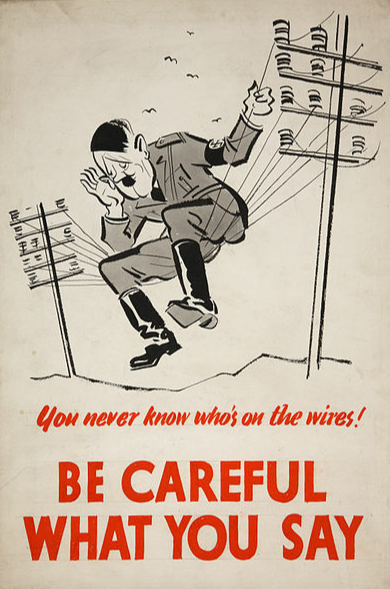
Baton Rougeans were being advised to keep their observations to themselves today in 1945, as Major Albert Stowe, Assistant Chief of Military Intelligence at the Pentagon spoke to civic clubs in Baton Rouge today in 1945. In the waning days of World War II, Stowe warned that civilians must let down their guard just because the news from the front was improving, warning, “Often it is more effective than a great superiority of force. A puny opponent with good eyesight can usually defeat a blind Samson.” He warned further that no bit of information of information was too “atomic” to be of interest to the enemy.

March 17, 1866
After the Civil War had depleted the state of men of working age, state officials realized that immigrants who’d begun flooding into other states weren’t coming to Louisiana. Reasons given included the perception that the state had been devastated by the war, yellow fever was rampant, and the state’s leadership was not looking to the future that leaders in other states were. To encourage immigration to Louisiana, the legislature created the Louisiana Immigration Bureau today in 1866. Through the end of the nineteenth century, the bureau and the state would enjoy limited success in attracting newcomers to the state. One area where Louisiana was wildly successful was in Sicily, there thousands fled declining fortunes in agriculture to come to Louisiana to settle, primarily in the southeastern corner of the state.

March 17, 1699
In late 1698, Pierre LeMoyne, Sieur d’Iberville sailed from Brest in France, charged with exploring the Mississippi River and scouting locations for a fort that would enforce France’s claim to the river. He entered the river in early March 1699, and by today in that year, he had reached the first high ground along the river, where a small stream entered the river, he found a settlement of Native Americans that the residents called Isse Trouma or Istrouma. In his journal, d’Iberville would translate the word to “Baton Rouge” or red pole or red stick. The name stuck. French settlers would return to the area approximately twenty years later.

March 18, 1956
High school students took over the city government offices of Monroe and West Monroe today in 1956. In subsequent days, no one seems to have noticed that the quality of the cities’ services had gotten substantially worse. In this instance it’s probably reasonable to assume that if either city had truly been in danger, adults would have jumped back into the breach, as this was an annual exercise sponsored by local Junior Chamber of Commerce Clubs to provide a “hands-on” civics lesson t students. Officeholders had been “officially” elected on actual voting machines in their respective high schools prior to taking office. The “Jaycees” had been founded in St. Louis in 1921 and spread quickly to Louisiana and the rest of the nation. Other Louisiana Jaycee projects over the years have included the establishment of the Greater Baton Rouge State Fair.

March 18, 1967
Ánh Quang “Joseph” Cao was born in Saigon this week in 1967. His father had been an officer in the South Vietnamese army, so his mother and four brothers and sisters fled to the United States in 1975 and settled in New Orleans. After entering public life as an adult, he ran unsuccessfully for Attorney General of Louisiana before being elected to Congress in 2008. He is the first Vietnamese American to serve in Congress, but he would serve only one term. In December 2015, he announced that he would run unsuccessfully for the open U.S. Senate seat being vacated by David Vitter in 2016.

March 19, 1850
Dugdemona Parish was established by the legislature today in 1850. Parts of Catahoula, Natchitoches, and Rapides Parishes were to combine into one parish on land now occupied by LaSalle, Grant, and Winn Parishes. The name presumably came from the 127-mile long Dugdemona River, which flows through the area. Creation of the parish was dependent on an enumeration to determine whether the proposed new parish contained the number of electors required by the Constitution. When the survey discovered an absence of an acceptable number of qualified voters, the effort to create the parish was determined to be unsuccessful the following year.

March 19, 1779
Some of the first of the five hundred Malaguenos (residents of Malaga) who had left Spain to colonize the region around Bayou Teche arrived in the area this week in 1779. The expedition left from the Mississippi River on February 7th, and entered Bayou Plaquemines, until they reached their destination, the Bayou Teche. Four German families in very bad circumstances were already settled in the area and invited to join in the settling of the new town. An appropriate site was selected and construction began on a Spanish-style community built around a central plaza that would be called Nueva Iberia, or New Iberia.

March 20, 1949
Happy birthday, Marcia Ball! She was born in Orange, Texas, today in 1949, and spent many of her formative years in Vinton. Her grandmother and aunt both played piano music of their time, but when Marcia started piano lessons, her interest was in New Orleans style playing, as exemplified by Fats Domino, Professor Longhair, and James Booker. She has named Irma Thomas as her chief vocal inspiration. She studied English at LSU in the late 1960’s while playing in a band called Gum. In 1970, at age 21,Marcia was in the audience at the One Knite club listening to Dub and the Dusters when she was invited onstage. She was an instant success and the band morphed into a progressive country band called Freda and the Firedogs in Austin, before beginning her solo career in 1974.

March 20, 1839
Shreveport was incorporated today in 1839. Originally, the town consisted of 64 city blocks, created by eight streets running west from the Red River and eight streets running south from Cross Bayou, one of its tributaries. Shreveport had been founded in 1836 by the Shreve Town Company, a development corporation established to start a town on the Red River to connect with the Texas Trail. The city is named for Henry Miller Shreve, who had been born in New Jersey in 1785 and had been instrumental in clearing the Ohio, Mississippi and Red Rivers to navigation in the early 1800’s.

March 21, 1917
Today in 1917, the Monroe News-Star reported that a bond issue to improve services in the City of Monroe passed, $1,209,632 to $571,420 on the previous day. If that looks odd today, remember that Louisiana’s 1898 Constitution had created a poll tax, literacy and property-ownership requirements, and a complex voter registration form to inhibit African Americans from voting. From this, Louisiana’s legislature crafted statutes that municipalities could issue the bonds only if they were approved by a “majority in number and amount of the property taxpayers qualified to vote . . . [who vote at the bond election].” These Jim Crow laws remained in effect until the U.S. Supreme Court struck down the statute in the case of Cipriano v. City of Houma on June 16, 1969.

March 21, 1818
This week in 1818, legislature “that any white person imported into the state as redemptioners, it shall be the duty of the governor, or of the person exercising that authority of the governor for the time being, to appoint two or more discreet and suitable persons to be guardians of such redemptioners.” Redemptioners were European immigrants who gained passage to American Colonies in the 18th and 19th centuries by selling themselves into indentured servitude to pay back the shipping company which had advanced the cost of the transatlantic voyage. Most of the redemptioners who were landed in Louisiana were of German origin.

March 22, 1976
Laura Jeanne Reese Witherspoon was born at Baptist Hospital in New Orleans today in 1976. Her father, an otolaryngologist, and mother, professor of nursing at Vanderbilt University, moved to Nashville when Reese was very young. In 1991, After several acting jobs as a child in 1991, she auditioned for a part in the film Man in the Moon, set coincidentally in Louisiana. Instead, she was cast for the lead role of Dani Trant, a 14-year-old country girl who falls in love for the first time. The rest, as they say, is history. Forbes listed her among the world’s 100 most powerful women in 2019 and 2021; and in 2021, Forbes named her the world’s highest-paid actress.

March 22, 1936
Fashion icon Henri Bendel died in New York today in 1936. Henri Willis Bendel had been born in Lafayette, when it was still called Vermillionville, in 1868. His first business had been a millinery business in Houma. At the urging of his New York-born wife, he moved to New York in 1899, and opened a small millinery shop on Ninth Street which would eventually become Henri Bendel, Inc. In June 1923, gave 45 percent of his company’s stock to his employees. In 1927, Bendel acquired 180 acres on the Vermilion River in Lafayette. Formerly the Walnut Grove Plantation, it is known today as Bendel Garden.
March 23, 1913
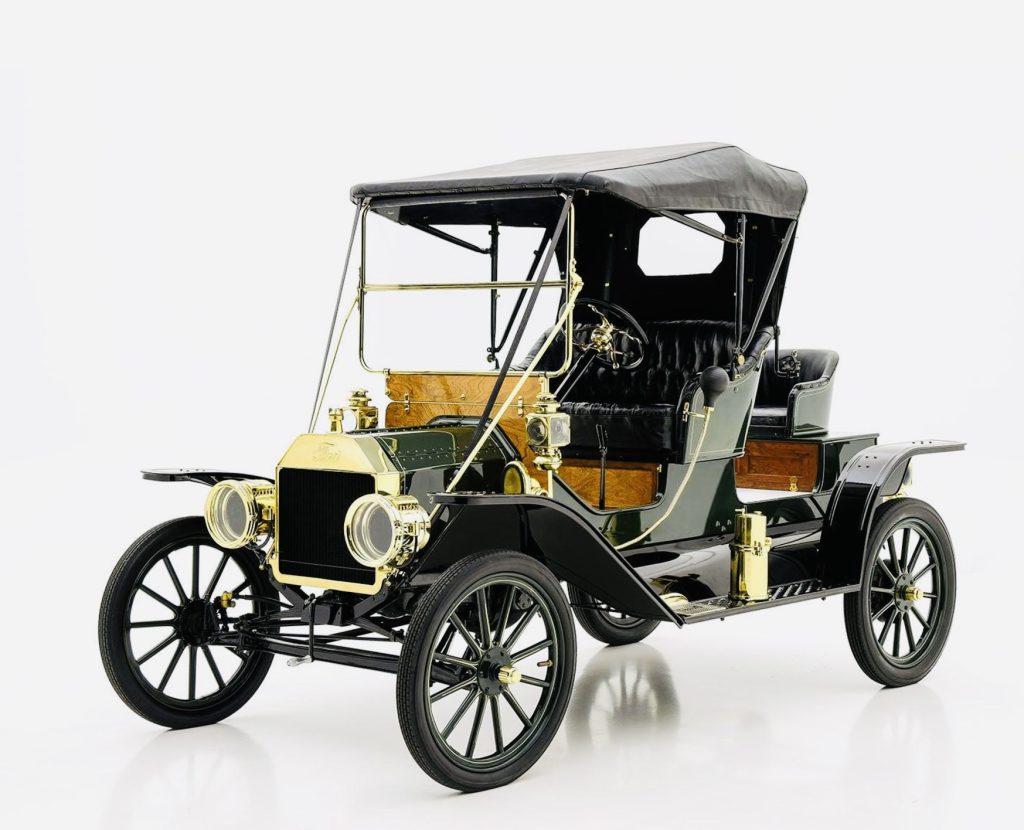
Defective “parts” from Louisiana led to the first automobile recall in 1913. According to the HOTCARS website, Henry Ford was continually tinkering with the design of the Model T (1912 model in photo), and at one point decided to commission vendors in the Atchafalaya Basin to build cyrpress boxes made to his specifications, fill the boxes with spanish moss, and send them off to Detroit. At the plant, the boxes were taken apart and shaped into moldings for the Model T’s, and the moss was used to stuff upholstry. While spanish moss is famously neither “spanish” nor “moss”, it is an excellent breeding ground for chiggers, which unfortunate drivers and passengers began discovering to their disgust after experiencing painful rashes on their legs and backsides. Ford ordered the vermin-ridden Model T’s to be recalled to replace the afflicted upholstry.

March 23, 1927
F. M. Goodman and Fidelia Adams faced the music in Shreveport, tonight in 1927. “Music he beguiled from the quivering vibrations of a handsaw accompanied the banjo Mrs. Fidelia Adams played at the revivals she and her husband conducted contributed to the mutual fascination which led to the(ir) elopement.” Alas, handsaw beguiler Goodman had left a wife and four children in his hometown of Lufkin, Texas, and Mrs. Adams was also Reverend Adams, a preacher at the Apostolic Church in Lufkin. Their love, forged in the harmony of their banjo and handsaw, was doomed as they were returned to Texas to face charges of deserting their families.

March 24, 1840
So who was “Charles”? Today in 1840, the legislature allowed the southern part of Attakapas Parish to secede and become the Imperial Calcasieu Parish. The parish seat was set at Marion, a crossroads and ferry crossing about 10 miles northeast of the City of Lake Charles. Meanwhile, in the late 1700’s, Charles Anselm Sallier moved from Bordeaux in France to the southwest Louisiana area, married a girl named Catherine LeBleu, and had six children with her. According to legend, Charles thought that Catherine was having an affair with the famous pirate Jean Lafitte. In rage, he shot at her, assumed she was dead, and fled. Happily, Catherine survived and lived a long life. Local residents began calling the area “Charlie’s Lake,” and by the late 19th century, the area where Charles Sallier once lived was called “Charleston”, “Charles Town”, and eventually “Lake Charles.”
March 24, 1724
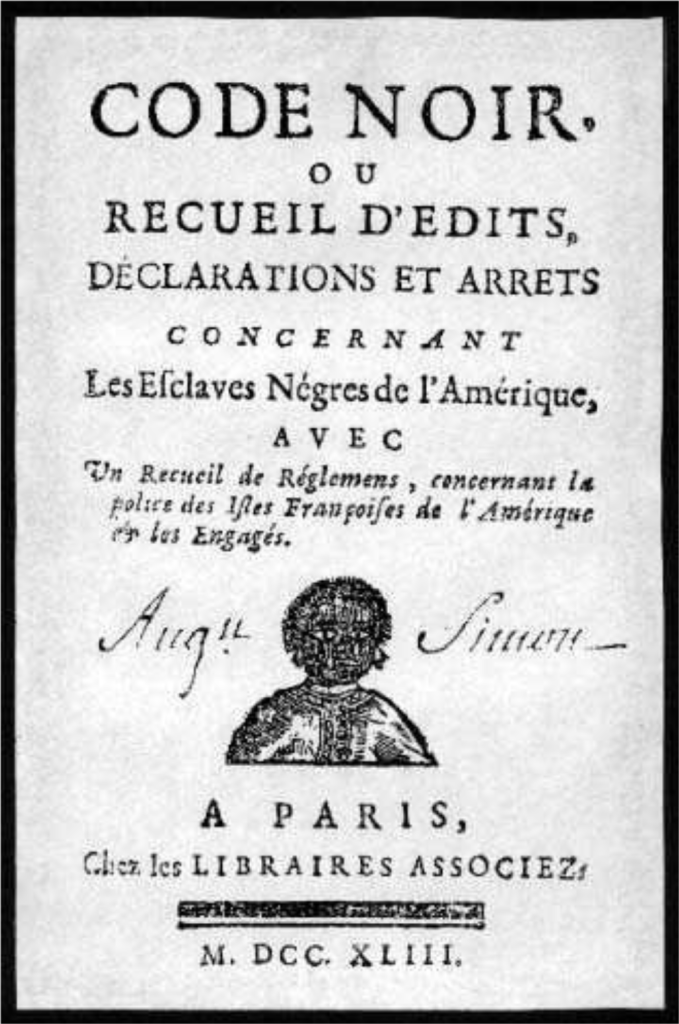
This week in March, 1724, the Louisiana Code noir, or slave code, based largely on that compiled in 1685 for the French Caribbean colonies, was introduced and would remain in force until the United States took possession of Louisiana in 1803. The Code’s first eleven articles refer to religious matters in the colony, including the expulsion of Jews, the recognition of Roman Catholicism as the only legitimate religion, and the mandate against interracial marriages and other kinds of mixing between blacks and whites. The next forty-four articles covered the obligations of masters, illegal activities and forms of punishment, the lack of legal rights afforded the enslaved, and rules for manumission.

March 25, 2001
Today in 2001, Baton Rougean Steven Soderbergh won the Academy Award for Best Director for Traffic, a film that also won Best Picture. Soderbergh’s father had been dean of education at LSU and Steven discovered film-making as a teenager, directing short Super 8 mm films with equipment borrowed from LSU students. His first major film, sex, lies and videotape, was shot in Baton Rouge and won the Palme d’Or at the 1989 Cannes Film Festival. It was influential in revolutionizing the independent film movement of the early 1990’s, and Soderbergh would go on to direct such hits as Erin Brockovich and the Ocean’s 11 films.
March 25, 1822
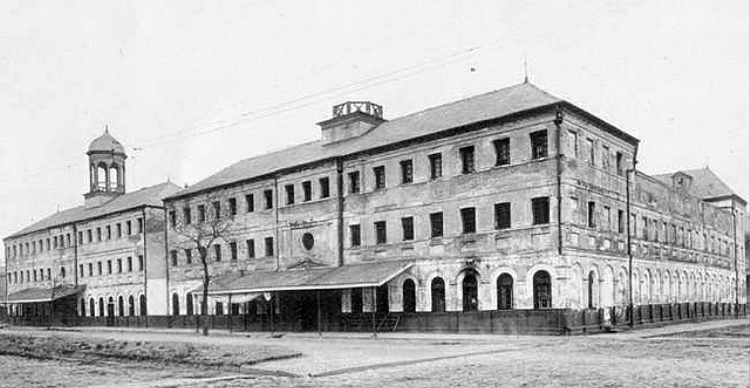
Today in 1822, the legislature established Louisiana’s first state penitentiary in New Orleans. The legislature appropriated $25,000 for the construction project, which should be “within one league” of City Hall and on the same side of the river. The site chosen was on the upriver side of Place d’Armes, now Jackson Square. The penitentiary “on the reduced plan of one Robert Mills, of South Carolina,” would remain in New Orleans for only ten years, as the legislators voted to remove the institution to Baton Rouge in 1832. In the 1840’s, the Pontalba Apartment buildings were built at the former site of the prison on St. Peter Street.
March 26, 1920
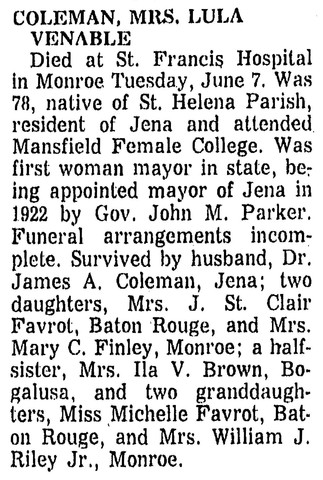
This week in 1920, Lula V. Coleman of Jena was appointed by Governor John M. Parker to be the town’s first female mayor. She was, in fact, the first woman to serve as may of any community in Louisiana. By the time she was sworn in as mayor, Mrs. Coleman had already made history in LaSalle Parish. In 1918, she had been elected as the first female deputy sheriff in the parish and was one of the first in the United States.

March 26, 1911
The South’s first Saenger Theater opened in Shreveport today in 1911. Julian Henri Saenger had been born in Norfolk, Virginia, in 1873, and moved to Shreveport with his father in 1890. In the late 1890’s he and his brother opened the Saenger Drug Company which became Shreveport’s first twenty-four-hour drugstore. In 1911, the brothers organized the Saenger Amusement Company and operated movie and vaudeville theatres in Shreveport, later opening the Strand Theater. In the 1920’s, they moved the business to New Orleans and operated over three hundred theatres throughout Louisiana, the South, and the Caribbean. The Saengers also owned or operated theaters in Alexandria, Baton Rouge, Covington, Minden and Monroe.

March 27, 1901
Today in 1901, the Board of the Central Louisiana State Penitentiary purchased Angola (pictured in 1910), Loango, Bellevue, and Killarney plantations, totaling approximately 8,000 acres, from the estate of Samuel L. James for $25 per acre. The sharecroppers were distressed at the sale of the plantation, and James tried to relocate as many of them as possible to other plantations. Still standing at Angola when the Board took over were at least 45 two-room cabins, 3 three-room cabins, 23 four-room cabins, and 30 other buildings, including three residences. The house at Bellevue was valued at $18,000, and the Angola big house at $30,000. Camps for prisoners were established at the old quarters and industrial complexes still standing across the property. Numerous new buildings were also constructed, including a blacksmith shop built east of the Angola big house where the antebellum slave quarters once stood.

March 27, 2002
Oops, I Did It Again propelled Kentwood native Britney Spears to the pop super-stardom when it was released today in 2000. Britney Jean Spears was raised in Kentwood, Louisiana, performing in stage and television shows as a child-most notably The Mickey Mouse Club. Spears went on to become the best-selling teenage artist of all time and a pop icon, credited with influencing the revival of teen pop during the late 1990’s. She has sold out arenas across the world and garnered honorific titles including the “Princess of Pop”, and in 2009, Billboard Magazine recognized her as the best-selling female artist of the 2000’s.

March 28, 1982
Today in 1982 in Norfolk, Virginia, Louisiana Tech defeated Cheyney College (an HBCU that would become Cheyney University of Pennsylvania the following year), 76-62, to win the first ever NCAA National Championship in Women’s Basketball. In addition to Cheyney, the Lady Techsters had defeated Arizona State, Kentucky, and Tennessee. In 1981, Tech had won the last ever 1981 AIAW National Division I Basketball Championship, defeating Tennessee in Eugene, Oregon. They would go on to win the second NCAA title in 1988, defeating Auburn in Tacoma, Washington. The leading scorers in the 1982 National Championship game for Tech were Center Janice Lawrence, followed by Pam Kelly, Debra Rodman (older sister of NBA star Dennis Rodman) and Angela Turner, who finished in double digits.
March 28, 1973
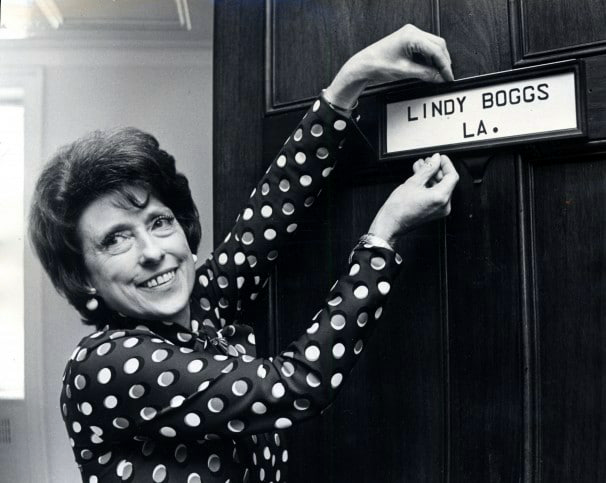
Marie Corinne “Lindy” Morrison Boggs became the first woman elected to the U. S. House of Representatives from Louisiana today in 1973. Rep. Boggs was born in Pointe Coupee Parish. She attended a convent school and then Tulane University. At college, she met her future husband, Hale Boggs. In 1940, Hale Boggs won election to the U.S. House of Representatives but failed to be reelected in 1942. He was elected again in 1946, serving until October 1972, when he was killed in an airplane crash. Boggs won a special election to replace her late husband in 1973 and served until 1991.
March 29, 1956
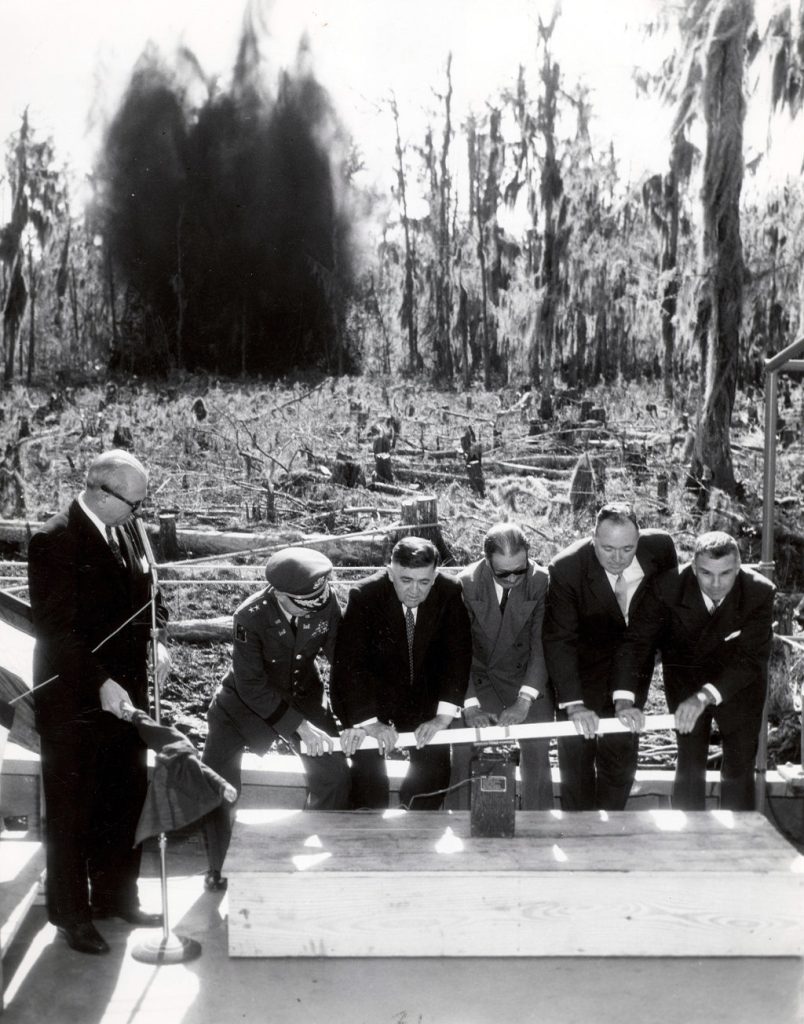
The Mississippi River-Gulf Outlet (MRGO) was authorized by Congress today in 1956 to provide an emergency outlet from the Mississippi River in the interest of National defense and general commerce and as a safer and shorter route between the Port of New Orleans and the Gulf of Mexico. In addition to the advertised advantages, MRGO also devastated the coastal lands it transited and acted as a “hurricane surge super-highway,” channeling storm surge into New Orleans and causing catastrophic flooding in areas like the Lower Ninth Ward. (Perhaps the photo of officials dynamiting a cypress forest at the channel’s groundbreaking should have been a tip-off.) Efforts to close MRGO had begun in the 1990s and the devastation of Katrina in 2005 hastened its
demise. It would be closed for good in 2009.

March 29, 1976
Food as we know it got a little blacker this week in 1976 as Paul Prudhomme was named the new executive chef at Commander’s Palace in New Orleans. The youngest of thirteen children, Prudhomme was raised on a farm near Opelousas. In 1957, he opened his first restaurant, a hamburger stand called Big Daddy O’s Patio in Opelousas. Big Daddy O’s would last only nine months, and in 1970, he became a sous chef at Le Pavillon Hotel in New Orleans, later helping to open Clarence Dupuy’s restaurant Maison Dupuy. At Commander’s Palace, Prudhomme would
introduce the world to blackened seafood. He would open his own French Quarter restaurant, K-Paul’s, in 1979.
March 30, 1980
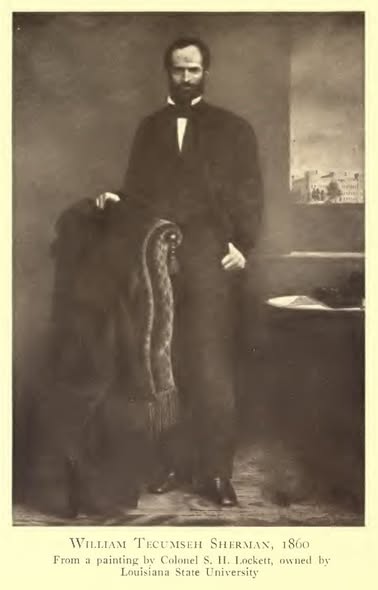
An art thief with rather eccentric taste was at work tonight in 1980. Four unusually large paintings of historic figures were stolen from the university’s David Boyd Hall by a thief or thieves who used a razor blade to cut the paintings out of their frames. The stolen works included a painting of Robert E. Lee and Stonewall Jackson; and portraits of William T. Sherman, the university’s first president, painted by the University’s first engineering professor, Samuel H. Lockett; ; George Mason Graham, the first president of the LSU Board of Supervisors; and Dr. George King Pratt, a member of the Board of Supervisors. The paintings have never been recovered.

March 30, 1871
The legislature created Vernon Parish today in 1871. The official story is that the parish is named for Mount Vernon, the home of President George Washington, but there are other possibilities. Some say the parish was named for a racehorse owned by Joe Moore, one of the members of the committee chosen to name the parish. Another tale suggests that the committee had been arguing over the name while drinking in a store. Trying to preserve his precious whiskey and profits, the host suggested the committee stop a local man passing by on a mule-drawn cart and name the parish whatever the man said was the mule’s name.

March 31, 8000 BC
If you were in St. Helena Parish today in 8000 BC–well, let’s just say that it wouldn’t have been a good idea to be there. A massive meteor, estimated to be 100 feet across, struck along what is now Highway 37 southeast of Greensburg. LSU scientists investigating the site in 2023 suggested that anyone or anything within twenty to thirty miles of the impact would have been either killed or very badly injured. Today, the mile-wide vaguely circular impact site is referred to as the “Brushy Creek feature” for the headwaters of Brushy Creek, which lie within the crater. Small space rocks and dust hit Earth’s atmosphere daily, with roughly 17,000 to over 500 significant meteorites reaching the surface annually. While tiny particles burn up constantly, 1-meter bodies hit every few months, 10-meter bodies hit every few decades, and catastrophic, city-destroying events occur once every few thousand years.

March 31, 1943
The first “government rubber plant” for the manufacture of synthetic rubber, sufficient for the manufacture of four million tires per year, went into operation in North Baton Rouge today, just four-and-a-half months after the first earth was turned in the first year of World War II. The plant was constructed by the H. K. Ferguson Company, directed by the Firestone Tire and Rubber Company. It was financed by the Defense Plant Corporation and would be operated by the Copolymer Corporation. The plant was described as the “fastest job in the entire war construction effort.” Not surprisingly, the entire output of the plant supplied the Army and Navy.