April 1, 1891
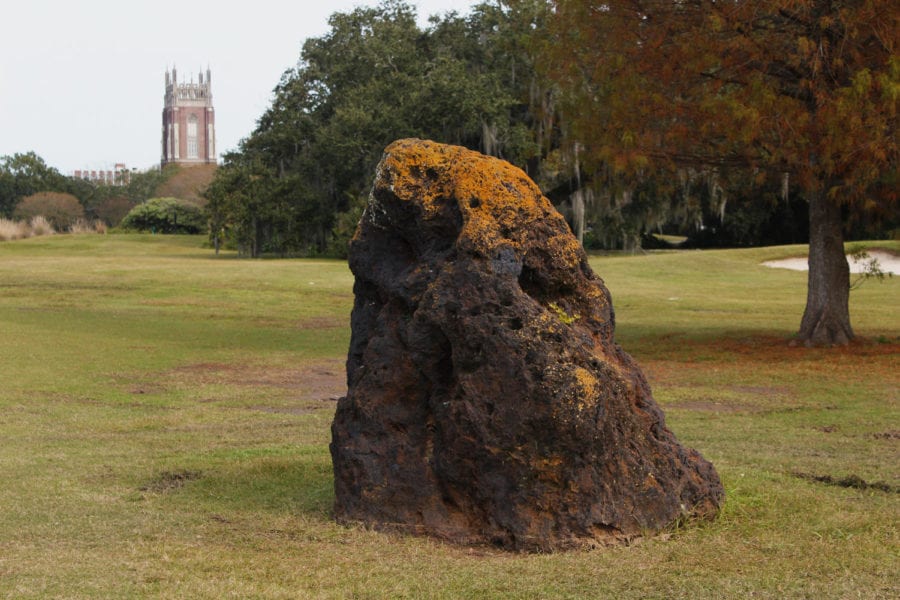
It was the biggest April Fool in Louisiana history, so big that some folks still believe it. On April Fool’s Day, 1891, the Daily Picayune in New Orleans reported that a large meteorite had crashed before daylight in Audubon Park. The writer described the landing as loud enough to awaken sleepers as far away as Biloxi and Atlanta. According to the article, the boulder’s grand arrival shook houses and broke window panes as far as a mile away, but left no one hurt. In reality, the large chunk of iron ore in the park was a remnant of the Alabama Exhibit at the World Cotton Centennial held in New Orleans in 1884-1885. The big rock was deemed too large to try to lug back to Alabama, so it was left where it sat. It’s still there, just off the fairway of the Audubon Park Golf Course.

April 1, 1764
This week in 1764, the first Acadians to arrive in the Louisiana territory consisted of twenty-one people in four families who arrived in Mobile from Nova Scotia, by way of Savannah. Based on church records, we know that this group included Jean Baptiste Poirier, Madeleine Richard and their children; Jean Baptiste Richard, Catherine Cormier and their children; Jean Baptiste Cormier, Magdeleinee Richard and their children; and Olivier Landry, Cecile Poirier and their children. They made their way to New Orleans and were settled along the west bank Mississippi River on what was to be called the Acadian Coast in the first week of April 1764.

April 2, 1866
Today in 1866, fifty-one weeks after Lee surrendered to Grant at Appomattox Court House in Virginia, President Andrew Johnson signed a proclamation declaring the “End of the Confederate Rebellion.” Now, therefore, I, Andrew Johnson, President of the United States, do hereby proclaim and declare that the insurrection which heretofore existed
in the States of Georgia, South Carolina, Virginia, North Carolina, Tennessee, Alabama, Louisiana, Arkansas, Mississippi, and Florida is at an end and is henceforth to be so regarded. The formal end of the war would come on August 20, 1866, when Johnson signed a proclamation “Declaring that Peace, Order, Tranquillity, and Civil Authority Now Exists in and Throughout the Whole of the United States of America.”

April 2, 1963
This week in 1963, 149,044 persons in New Orleans received the new Sabin oral polio vaccination. Dr. Dennis H. Groome, Jr., chairman of the KO Polio Campaign, said that a total of 738,351 people in Orleans, Jefferson and St. Bernard parishes had received the vaccine over the previous two weeks. This total reflected 80 percent of the area’s
population at the time, and officials were confident that they would be able to reach almost everyone by the time final totals were published on April 8th. A second type of the vaccine would be offered to the public beginning on April 28th, and a third beginning June 2nd.

April 3, 1948
The famous Louisiana Hayride hit the stage at Shreveport’s Municipal Auditorium for the first time tonight in 1948. The musical cast for the inaugural broadcast included the Bailes Brothers, Johnnie and Jack, the Tennessee Mountain Boys with Kitty Wells, the Four Deacons, Curley Kinsey and the Tennessee Ridge Runners, Harmie Smith, the Ozark Mountaineers, the Mercy Brothers, and Tex Grimsley and the Texas Showboys. Over the next twelve years, the Hayride would become an incubator for major talents, including a couple of guys named Elvis and Hank. The Hayride continued until 1987 under other names and formats.

April 3, 1889
Hammond became a town and elected its first officials today in 1887. Peter Hammond, said to be the “father of Hammond”, was born in Sweden in 1798 and left home in his early teens to become a rigger, sailmaker, and sailor. He was captured by British while on way to United States in War of 1812, escaped from prison and made his way to
Louisiana. He settled near present-day Hammond where he established a commissary and naval stores industry in the 1820’s. When the New Orleans, Jackson and Great Northern Railroad crossed Hammond’s property, the area became known as Hammond’s Crossing and later changed to Hammond.

Easter Weekend, 1973
In 1973, residents of Bessieres, a town in Department of Haute-Garonne, reenacted a scene from their past when they created an omelette made of 15,000 eggs. The original omelette dated to Napoleon’s time when the general was marching through the region and asked the locals to prepare food for the troops. The omelette became a tradition, and in 1985, it spread to Louisiana when three Abbeville residents visited Bessieres and thought that bringing a similar festival to their hometown would deepen ties between the French communities in France and Louisiana. The Abbeville festival is held annually in the fall. If you’re thinking of trying this at home, here are the ingredients: 5000 eggs, 75 bell peppers, 40 pounds of onion tops, two gallons parsley, six-and-a-half gallons of milk, 52 pounds of butter, two pounds of salt, two boxes of black pepper, and 15 pounds of crawfish tails. Tabasco to taste. Bon appetit!

April 4, 1859
Paul Charles Morphy of New Orleans was proclaimed as “the best chess player who ever lived” at a special banquet held in his honor in Paris today in 1859. Morphy had learned to play by watching games between his father and uncle. His family soon recognized his talents, and by the age of twelve, he defeated a visiting Hungarian master. He was soon recognized as the best player in America and went to Paris in 1859 to test his skills against European masters. In Paris, Morphy fought a severe bout of intestinal influenza and still managed to defeat Adolf Anderssen, considered by many to be Europe’s leading player.

Easter Sunday, April 5, 2026
If you’re a Gulf Salt Marsh Snake or Southern Coal Skink (pictured) planning to get dressed up to go to the Easter Parade in New Orleans today, I’m sorry to inform you that you need to make other plans. In 2002, the City Council passed a number of new regulations pertaining to parades in the City, among them a provision that reptiles are not allowed within 200 yards of a parade route not less than two hours before the published scheduled start of a parade, or within 200 yards of the actual end of a parade. Exceptions were made for service animals and residents along the parade route who have their animals property confined. So unless you’re a service snake or skink, you’re out of luck.

April 5, 1944
In Montreal, they called him “Le Grand Orange”, which I guess is better than, “Hey, Ginger!” Rusty Staub played his first game for the Houston Colt 45s this week in 1963, four days after his nineteenth birthday. Daniel J. “Rusty” Staub is one of the most accomplished baseball players ever to come out of New Orleans. His distinctive red-orange hair was the source of his lifelong nickname, Rusty. During his years with the Montreal Expos, French-Canadian fans dubbed him Le Grand Orange. In twenty-three major-league seasons, Staub was an All-Star six times. His uniform number was the first ever retired by the Montreal Expos, and he was a key member of the New York Mets team that won the National League championship in 1973.

April 6-7, 1893
The longest boxing match in history started tonight in New Orleans in 1893. The bare knuckles match would end seven hours and nineteen minutes later in the early hours of April 7th. Approximately 8,500 spectators gathered at the Olympic Club to witness the match. Initially, Bowen had arranged the fight with another opponent, but when that opponent withdrew, Jack Burke stepped into the ring. The fight went on so long that some spectators fell asleep in their seats. By the 108th round, with no apparent victor, referee John Duffy decided that if there was no winner in the next two rounds, he would end the fight. After those two exhausting rounds, neither fighter was able to emerge from his corner, and Duffy declared the match a “no contest.” Jack Burke had broken all the bones in both his hands, leaving bedridden for six weeks.

April 6, 1937
This date in 1937 was the second day of a three-day celebration on the LSU campus in Baton Rouge at which several of the campus’s most iconic buildings were dedicated, including the law school building on Highland Road named for Governor Richard Leche; the Parker Agricultural Center; La Maison Francaise and five women’s dormitories. After Leche resigned in disgrace, the law school building would be renamed for Paul M. Hebert, who had been the longest-serving dean of the school from 1937-77. The Parker Agricultural Center is still in use and housed the LSU
basketball team until the LSU Assembly Center (now the Maravich Assembly Center) opened in 1972.

April 7, 1949
South Pacific, the Rodgers and Hammerstein musical based on James Michener’s Tales of the South Pacific, opened at the Majestic Theater on Broadway tonight in 1949. The play starred Mary Martin and Enio Pinza, and was directed by Joshua Logan, who’d been born in Texarkana, Texas. After his father’s suicide when he was three, Logan, his mother, and his younger sister, Mary Lee, then moved to his maternal grandparents’ home in Mansfield, Louisiana, where he would feel at home and experience his first drama class. Mansfield’s small-town Southern atmosphere influenced his sensibilities and choice of theatrical settings. In 1950, Mansfield would become the setting for Logan’s play, The Wisteria Trees, which was based on Anton Chekhov’s The Cherry Orchard and starred Helen Hayes when it opened on Broadway.

April 7, 1981
A Confederacy of Dunces by New Orleanian John Kennedy Toole won the Pulitzer Prize for Fiction this week in 1981. The book was the first publication of a university press to win the fiction prize. New Orleans native Toole suffered from paranoia and depression, due in part to the continued rejection of his work, ended his life at the age of thirty-one in 1969. The efforts of his mother, Thelma Toole, to get his work published after his death were finally rewarded when the LSU Press published the
book in 1980. Eventually, A Confederacy of Dunces would sell over two million copies in eighteen languages.
April 8. 1804
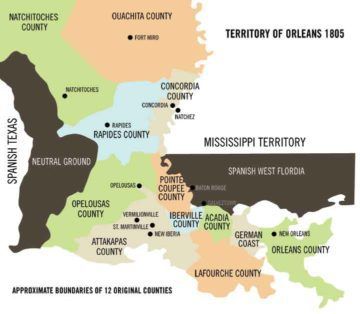
Territorial legislature meeting in New Orleans this week in 1804, voted to create twelve “counties” in Louisiana. They were: Orleans, Baton Rouge, Feliciana, St. Helena, St. Tammany, Natchitoches, Rapides, Ouachita, Concordia, Madison, Iberville, and Pointe Coupee. These entities would not be recognized as “parishes” until the new constitution of the State of Louisiana went into effect in 1812; and over the years, they would all be divided and re-divided into smaller parishes.

April 8, 1972
The first Ponchatoula Strawberry Festival was held this weekend in 1972. The festival board was organized in 1971 and started planning for the first festival to be held in April 1972. The location of the festival comprised of the first block of North Sixth Street and had only eleven booths. The first annual parade made its way through Ponchatoula with sixty-five units from all over the state. The festival was co-sponsored by the Ponchatoula Jaycees and the Ponchatoula Chamber of Commerce and attracted 15,000 festivalgoers. By 2017, the festival would attract more than 300,000 visitors during its three-day run and become the largest attraction in Southeast Louisiana after Mardi Gras.

April 9, 1682
Today in 1682, Robert Cavalier Sieur de La Salle arrived at the mouth of the Mississippi River in Plaquemines Parish (or one of the passes, anyway) and claimed all lands drained by the river for France, giving it the name La Louisiane, in honor of Saint Louis and Louis XIV. LaSalle had been born in Rouen in 1643 and had been the key figure in France’s exploration and settlement of Canada and the Great Lakes Region. In February 1682, he travelled along the Illinois River and arrived at the Mississippi River in February 1682, before continuing to the mouth. After returning to France, he organized an expedition to settle and secure the claim at the mouth of the Mississippi. That expedition went disastrously off-course, arriving at the coast of Texas in 1685, where LaSalle was murdered by his crew.

April 9, 1942
Lake Charles State Senator Jesse Knowles of Lake Charles (1919-1985) was beginning to learn the art of survival today in 1942 as he was one of 60,000 or more American and Filipinos who were forced onto the infamous Bataan Death March. The march was characterized by severe physical abuse and wanton killings, and was later judged by an Allied military commission to be a Japanese war crime. Knowles was held in a number of prison camps for 1,228 days. Returning to Lake Charles after the war, he was elected to the Louisiana House of Representatives in 1960, and in 1964, he was elected to the first of four terms in the Louisiana State Senate.

April 10, 1834
When a fire was reported at the home of Marie Delphine Macarty LaLaurie (pictured) today in 1834, rescuers responded to the fire at home at 1140 Royal Street. In the kitchen, they found a 70-year-old emaciated cook chained to the stove. As the cook later admitted, she had started the fire on purpose. In the attic, seven more slaves were bound and showed evidence of cruel, violent abuse over a long period. LaLaurie’s house was subsequently sacked by an outraged mob of New Orleans citizens. She escaped to France with her family. Over the years, Madame LaLaurie’s depraved treatment of slaves had been obvious to her neighbors. In one instance, she had chased a 12-year-old girl through the house with a whip and up onto the roof, where the girl ran to the edge and tumbled to her death.

April 10, 1864
Union gunboats on the Ouachita River reached Monroe today in 1864, the day after bloody battles had been fought at Mansfield and Pleasant Hill in Northwest Louisiana. In order to deny reinforcements to the Rebel army, the gunboats opened fire on the city of Monroe, destroying dozens of buildings in the blocks closest to the river. The courthouse, jail and railroad station were destroyed, along with forty rail cars and five locomotives belonging to the Vicksburg, Shreveport and Texas Railroad. The railroad’s bridge over the Ouachita River, which had been built in 1859, was also destroyed and would not be replaced until 1882.

April 11, 1965
The Plain Dealing Dogwood Festival was cancelled today in 1965. It had all started so well. In On March 23, 1950, an editorial in the Plain Dealing Progress implored local citizens to celebrate the beauty of local dogwood trees, as was being done in nearby Palestine, Texas. The idea took hold, and on March 23, 1951, the first festival opened with a preview party with Governor Earl K. Long in attendance. it was a huge success
with more than 15,000 visitors from 25 states attending. The festival prospered until the mid-1960’s, when local loggers began clearcutting of timber in the forests along the Dogwood Drive route. Losing the main attraction and leadership issues led to the festival’s cancellation in 1965 and ’66. It resumed in 1967, but “… it never regained its original splendor,” according to one local source. Arts, crafts, food and entertainment became the primary focus points until the last festival was held in 2003.

April 11, 1963
Today in 1963, the New Orleans Public Service, Inc. (NOPSI) announced that it would ask the New Orleans City Council to approve a $4.2 million plan to replace the dilapidated forty-year-old Canal Street streetcar line with “clean, modern, air-conditioned busses.” One of the advantages of the plan was that it would consolidate the old Canal Street, Canal Blvd. and West End lines into one continuous route, eliminating time-consuming transfers at the corner of Canal Street and Canal Blvd. “Our objective in this proposal is simply to serve the city with the best possible transit at reasonable fares,” said NOPSI President Clayton L. Nairne. Streetcars would return to Canal Street in 2004.

April 12, 1989
Today in 1989, Blaze, a highly-fictionalized film that chronicled former Gov. Long’s relationship with stripper Blaze Starr, began principal photography in Baton Rouge. Paul Newman played Long in the film, which is set principally in 1959-60, the last two years of Long’s life and final, turbulent term as governor. Lolita Davidovitch played the title role. Director Ron Shelton told the press that one of the films challenges was that, “Paul Newman’s better looking than any 63-year-old man in the world and, in his last year, Earl Long was worse looking that any 63-year-old man in the world.” Blaze received modest critical praise and opened in ninth place at the box office on its opening weekend.

April 12, 1944
11,500 Easter eggs were “hunted” at the East Louisiana State Hospital in Jackson this week in 1944. 4300 patients participated in the festivities and were later treated to 260 gallons of ice cream, 4500 cookies and 385 pounds of candy arranged by the dietary department of the hospital. The East Louisiana State Hospital was created by the Louisiana Legislature in 1847 and commenced operations in 1848, originally known as the “State Insane Asylum.” The location was chosen because Jackson is situated in an upland well-drained location that is relatively free of disease-bearing mosquitoes, which plagued asylums in New Orleans. Today, hospital provides more than 500 psychiatric beds. (I’m sure the resemblance between the “state insane asylum” and the law school featured on April 5th is purely coincidental.)

April 13, 1915
Katharine Drexel, a Catholic nun possessing a substantial inheritance from her father, banker-financier Francis Drexel, founded and staffed many institutions throughout the United States in an effort to help educate and evangelize Native Americans and African Americans in the 19th and 20th centuries. Her plans were to establish a high school in New Orleans on a site previously occupied by Southern University. On April 13, 1915, Harry McEnerny, serving as Drexel’s agent, purchased property at the universsity’s current site for $18,000. The Louisiana Department of Education officially recognized Xavier University as a four-year college on March 19, 1928, with the first degrees awarded that spring. Katherine Drexel would be canonized as a saint in 1960, and Xavier would become America’s only Catholic HBCU and the first to be established by a saint.

Easter Sunday, April 13, 1873
The Colfax Massacre, the largest racial massacre in U. S. history, broke out today, Easter Sunday, in 1873. This event marks the largest racial massacre in U.S. history. Southern Whites saw recently freed people as threats to Democratic hegemony. In the wake of the contested 1872 election for governor and local offices, a group of white Democrats overpowered Republican freedmen and black state militia defending the
Grant Parish courthouse in Colfax. Estimates of the number of dead have varied, ranging from 62 to 153. Three whites were killed, but the number of black victims was difficult to determine because bodies had been thrown into the river or removed for burial.

April 14, 1915
Today in 1915, Booker T. Washington (pictured) spoke at the Arcade Theatre in Lake Charles. At the time, he was on a multi-city tour of Louisiana. He had stopped in Baton Rouge to give his blessing to new buildings at Southern University. In New Orleans, children had been let out of school a day earlier to hear Washington speak at the Burns Arena, just off Canal Street. In Gibsland, he spoke to an enormous crowd at Coleman College. The Guardian-Journal advertised the event in advance: “Booker T. Washington… is advertised to speak at Gibsland next Friday, the 16th… All of his writings and public speeches have been sound, containing wholesome advice to his race… It is of our understanding that Washington was born of slave parents, and was without any special advantages to begin with, but as led on by his genius,”

April 14, 1825
The most popular man in America this week in 1825 might have been a Frenchman, Gilbert de Motier, Marquis de Lafayette. Honoring the fiftieth anniversary of the American Revolution and his own participation in it, Lafayette returned to his adopted country visiting every state during a thirteen-month visit. On April 10th, he landed in New Orleans and was treated to five days of balls and receptions in his honor. On the 16th, he paid a one-day call in Baton Rouge, where he was feted at a reception and led a parade up Second Street (which was renamed in his honor) to the recently completed Pentagon Barracks to review the troops.

Good Friday, April 15, 1927
It had been raining for months, but this was the day that the Great Flood of 1927 threatened to wash away New Orleans. Fourteen inches of rain fell over the city that day. The pumps failed, but–miraculously–the levees held. Realizing that the situation might not last, the decision was made to set off forty tons of dynamite on the levee at Caenarvon in lower St. Bernard Parish. More than 10,000 people were displaced as 250,000 cubic feet of water per second gushed through the hole in the levee. Most never be compensated for their loss. In this photo, Mrs. D. P. Achen of Braithwaite and her two children are comforted by a Red Cross nurse in the aftermath. But New Orleans was safe–until the next flood.
April 15, 1957
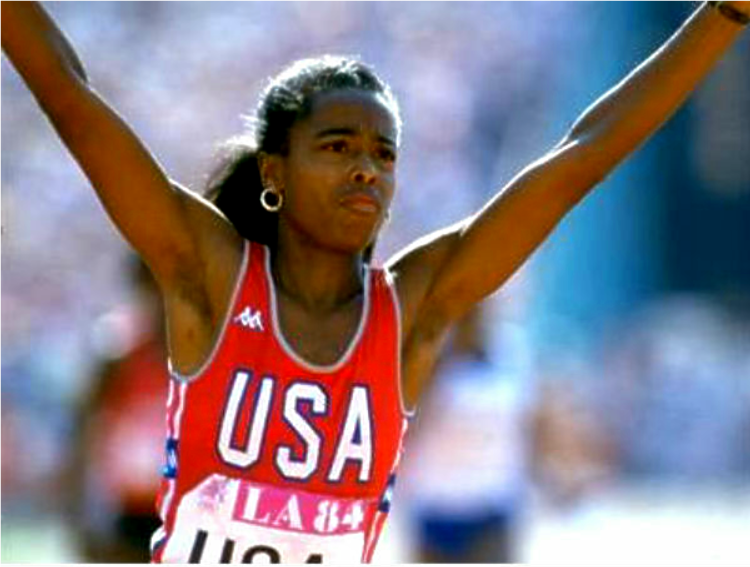
Shreveport’s Evelyn Ashford born today in 1957. During the course of her career, she would win four gold medals and one silver medal in Olympic competition. Had the United States not boycotted the Moscow Olympics in 1980, her total might have been higher. Her first medal came in Los Angeles Olympics of 1984, where she took the gold for the 100-meter dash in 10.97 seconds, the first woman to run the race in less than eleven seconds. In 1988, she would take the silver in the 100 meters in Seoul, where she was elected by her team-mates to carry the Stars and Stripes at the Opening Ceremonies.
back to front page