
May 16, 1986
This week in 1986, Northwestern State University in Natchitoches awarded its fourth honorary doctorate in philosophy to 99-year-old Clementine Hunter. She had been born near Marco in Natchitoches in 1885 or 1886 and spoke only French until marriage to her second husband, Emanuel Hunter. Her primitive paintings of people fishing, riding horses, going to school, or burying their dead were first exhibited in public at Northwestern State, but she was not allowed to visit during the gallery’s open hours. She had to view her own art when the exhibit was closed to the public. Later in 1986, Hunter would also receive an honorary degree from Southern University in Baton Rouge.

May 16, 2025
Today in 2025, the antebellum plantation Nottoway burned to the ground near White Castle in Iberville Parish. Many people think that the town of White Castle itself was named for what was considered to be the largest plantation home in the South, but that isn’t the case. (Nor is it true that the town was named for a chain of restaurants that sells tasty burgers.) White Castle derives its name from the Belle Grove Plantation (pictured). Completed in 1857, Be;;e Grove was one of the largest mansions ever built in the Southern United States. At 62 feet high and and 122 feet wide, it had seventy-five rooms spread over four floors, surpassing that of the neighboring Nottoway.Belle Grove was destroyed by fire in 1952.

May 17, 1853
Today in 1853, the City of New Orleans purchased the Presbytère from wardens of St. Louis Cathedral for $55,000. Work on the structure had begun in the wake of the great 1788 fire that destroyed much of the French Quarter. Spanish philanthropist Don Andres Almonester y Roxas financed the rebuilding of the Presbytère, as well as St. Louis Cathedral and the Cabildo, with his own funds. In 1791 Gilberto Guillemard designed the Presbytère to match his other building, the Cabildo, or Town Hall, on the other side of St. Louis Cathedral. The Presbytere served as the home of the Louisiana Supreme Court from 1822 until 1853. After the sale, the Supreme Court moved to the Cabildo, but the Presbytère continued to be used by the City of New Orleans as a courthouse until 1911, when it became part of the Louisiana State Museum.

May 17, 1927
Today in 1927, the Great Mississippi River Flood had already surged through a large part of Iberville Parish and reached Bayou des Glaises between Grosse Tete and Henderson. The levee on the bayou crumbled and the water continued its westward march. At 5:30 on the morning of May 17th, the Atchafalaya River levee at Melville also broke, and water from the two breaks met in the middle of town with “the sound of a thousand freight trains,” sweeping the town away. During the Great Flood, 127,000 square miles were under water as deep as thirty feet. Deaths were certainly in the thousands, but no reliable estimates exist.

May 18, 1965
This weekend in 1965, Iko Iko by New Orleans girl group The Dixie Cups reached Number 1 on the Billboard weekly survey of pop music. The Dixie Cups (Not complaining, but how was this not a trademark infringement?) were recording for Leiber & Stoller’s Red Bird Records in a New York studio. They’d finished “Chapel of Love” and during a break the girls began singing a song they’d learned from their mother called Iko-Iko, a call and response chant of a Mardi Gras Indian tribe. Group member Barbara Hawkins said: “We were just playing around with it during a session using drumsticks on ashtrays. We didn’t realize Jerry and Mike had the tapes running.” Leiber and Stoller later overdubbed bass and percussion along with the drumsticks on ashtrays, released it, and it became the Dixie Cups’ final Top 40 record.

May 18, 1857
Shreveport’s Holy Trinity Catholic Church, the city’s oldest Catholic congregation, purchased the land to build the church this week in 1857. Parish property records indicate that Father Pierre purchased two lots near the northeast corner of Marshall and Fannin Streets for the sum of $900. By 1858, Father Pierre had plans and most of the money to build a brick church 60 by 40 feet and to equip it. In February 1859, Father Pierre would purchased the corner lot to the south of the church for $1000, which would become the location of the present rectory. The current church on the site was built in 1896.

May 19, 1949
Happy birthday, Archie! “Archie Who?” you ask. You wouldn’t be the first. Elisha Archibald Manning III was born in Drew, Mississippi, today in 1949. In 1971, he married Olivia Williams, got himself drafted by the New Orleans Saints, and moved to New Orleans. They had three sons, Cooper, Peyton, and Eli–and the rest is history–or legend, depending on your point of view. In 2025, the Manning family celebrated its 54th year in New Orleans by lending its name to the Manning Family Children’s Hosptial, formerly Children’s Hospital of New Orleans. Manning Family Children’s is the third hospital for children named for members of the family in gratitude for their support. Others are the Peyton Manning Children’s Hospital at Ascension St. Vincent in Indianapolis, and the Eli Manning Children’s Clinics at the University of Mississippi Medical Center in Jackson.

May 19, 1943
Naval Air Station Houma opened today in 1943. To safeguard commercial shipping in the Gulf of Mexico in World War II, LTA Squadron ZP-22, a squadron of dirigibles, began conducting anti-submarine patrols along the Gulf coast. The heart of the base was its hangar, which was over 200 feet high, 1000 feet long and 300 feet wide. It was the largest wooden structure in the world and could house three fully inflated K-class dirigibles. The doors alone weighed 50 tons and were on rails. The unit was decommissioned on September 12, 1944, and although the hangar was demolished after the war, the concrete foundations of this immense building are still visible.

May 20, 1922
Radio station KEEL in Shreveport went on the air this week in 1922 as Louisiana’s second commercial radio station, after WWL in New Orleans which had been licensed two months earlier. While the station has experimented with a number of formats over the decades, none were so beloved as the rock and roll format of the 1950’s and 60’s. In the days before the internet, KEEL’s 50,000-watt station cast a “clear channel” signal across the middle of America, bringing new artists and songs to teenagers and others in thirty states. Managed by Marie Gifford White (pictured), the first woman to manage a local radio station, performances by on-air personalities in the Ark-La-Tex generated big audiences for national and local performers in the 1960s.

May 20, 2001
The fictional North Louisiana town of Bon Temps became the center of the Sookieverse in May 2001. Dead Until Dark, the first novel in the Southern Vampire Series by Charlaine Harris. Also known as the True Blood series, the books developed a detailed mythology and alternate history that approached supernatural beings as real. At the beginning of the series, the existence of vampires had only been public knowledge for a couple of years, and other supernatural beings like werewolves, shape-shifters and faeries were still underground. The series would explode onto the public consciousness when True Blood, loosely based on the books, ran on HBO from 2008-2014.

May 21, 1523
Historians agree that Spanish explorer Hernando de Soto died today in 1523. But where? Consensus among historians claim that he died of a fever in the native village of Guachoya. Historical sources disagree as to whether de Soto died near present-day Lake Village, Arkansas, or Ferriday, Louisiana. De Soto had deceived the local natives into believing that he was a deity, specifically an “immortal Son of the Sun”” to gain their submission without conflict. Some of the natives had already become skeptical of de Soto’s deity claims, so his men were anxious to conceal his death. The actual site of his burial is not known. According to one source, de Soto’s men hid his corpse in blankets weighted with sand and sank it in the middle of the Mississippi River during the night. The photo is how the event is depicted in the frieze of the United States Capitol.

May 21, 1939
The Long Hunt came to an end in Louisiana schools today in 1939 as State School Superintendent T. H. Harris announced that the 1930The Long Hunt by James Boyd had banned from all Louisiana school libraries. Some reviews of the story of Murphree Rinnard, a lone hunter in post-revolutionary days, had described it as a “valuable contribution to the literature of the early days of America.” Harris said, “In parts, it is
indecent and filthy. In my mind, the book is not only wholly lacking in merit, but it probably vicious in its influence upon the young minds of high school boys and girls.”

May 22, 1929
The Wedell-Williams Air Service, Inc., was charted in Patterson today in 1929. James Robert Wedell was a famous 1930s racing pilot and aircraft designer who broke the world record for land-plane speed in 1933 when he clocked 305.33 m.p.h. in a Wedell-Williams aircraft of his own design. Harry Palmerston Williams, a native of Patterson, spurred by the news of the Lindbergh solo flight across the Atlantic in 1927, purchased a similar monoplane from Wedell and learned to fly. The two worked closely together and formed the Wedell-Williams Air Service Corporation in Patterson. Wedell-Williams Air Service, Inc. provided the first commercial airline to fly passengers from New Orleans to Houston Along the way, they won fourteen “distinguished finishes” (top five) in the Thompson and Bendix Trophy races. In the 1930’s, both men would die in separate air accidents, but their legacy lives on at the Wedell-Williams Aviation and Cypress Sawmill Museum in Patterson.

May 22, 1961
Ernie K-Doe’s Mother-in-Law hit Number 1 on the Billboard pop chart today in 1961. By his own admission, Ernest Kador, Jr. was “the most beautiful boy child ever born at Charity Hospital” in New Orleans in 1933. He recorded as a member of the group the Blue Diamonds in 1954 before making his first solo recordings the following year. “Mother-in-Law”, written by Allen Toussaint, was his first and only hit. In later years, he was known for his frequent self-promotion. Catch phrases included “Burn, K-Doe, Burn!” and “I’m a Charity Hospital Baby!” He billed himself as “Mister Naugahyde”, until he was ordered to desist by owners of the Naugahyde trademark.

May 23, 1934
Today in 1934, law enforcement officers and posse members gunned down Bonnie Parker and Clyde Barrow beside the Jamestown-Sailes Highway, eight miles from Gibsland. The Texas-born couple first met in Dallas in 1930 and would begin their crime spree in early 1932. Although they were known for their bank robberies, they generally preferred to rob small stores or rural gas stations. The gang is believed to have killed at least nine police officers and several civilians before they were finally
tracked down and killed by four Texas Rangers and two Louisiana policemen. Thirty-five years after their deaths, their reputation was revived by Arthur Penn’s 1967 film Bonnie and Clyde.

May 23, 1906
After oil had been discovered in Caddo Parish a year earlier, Louisiana’s first gas pipeline went “online” this week in 1906 as natural gas from the Caddo field was made available for domestic consumption in Shreveport. The city’s daily consumption was about 5,000,000 cubic feet. During the latter part of the year several wells were drilled on Pine Island. In December, Producers’ No.1 on Pine Island was making 250 barrels. A site for a pump-station and tank-farm was acquired at Caddo City, and the laying of a 6-in.pipe-line to Pine Island, about 2.5 miles, was begun. Loadingracks were erected on the Kansas City Southern railway. The first car-load of Pine Island crude oil was shipped from Caddo City to the refinery at Port Arthur, Texas, on December 13th. The Caddo field produced 4,650 barrels in 1906. The city erected this monument in 1955 to commemorate the 50th anniversary of the discovery o oil in the parish.

May 24, 1943
Today in 1943, the Associated Press reported that the Veterans of Foreign Wars post in Hammond celebrated the success of its fundraising campaign to send cigarettes to fighting soldiers, sailors and airmen serving overseas. Carl S. Anstead, director of the campaign, said that the campaign had already collected enough donations to send 272,000 packages of cigarettes to servicemen and that donations were still rolling in. Anistead had initiated the campaign by placing “small receptacles” in places of business around Tangipahoa parish. Meanwhile, just north of Hammond, the Defense Department had been using a tract of land for gunnery practice. The extent of the testing would not be known until 2009.

May 24, 1965
In 1927, New Orleans entrepreneur Chris Matulich opened a steak house at 1100 North Broad Street near the Fair Grounds Race Course. It seated 60 people, had no parking lot, and was sold six times in 38 years. But the sixth time was the charm as Ruth Fertel (photo), a divorced single mother who needed money to send her teenaged sons to college, ignored the advice of her banker, lawyer, and friends, and purchased the restaurant in 1965. Today in 1965, Ruth’s Chris Steak House opened for the first time and sold 35 steaks at $5 each . Fertel personally took a hand in every part of the business, and for many years, Ruth’s Chris was the only upscale restaurant in New Orleans with an all-female wait staff. Today, there are over 100 Ruth’s Chris Steak Houses across America.

May 25, 1938
This week in 1938, Jelly Roll Morton, living in Washington, DC at the time, sat down for an extensive series of oral histories with Alan Lomax, who was researching folk life and music for the Library of Congress. Between May 23rd and June 12th in 1938, Lomax recorded Morton’s extemporaneous commentary about his life and career, often punctuated by musical passages at the piano. Born Ferdinand Lamothe into a New Orleans Creole family in 1890, he grew up in a formal musical environment, and whether he actually invented jazz, as he often claimed, is and will always be debatable. He was, however, the first serious jazz composer.

May 25, 2025
Mark Ryan, founder of Daughters & Ryan and owner of L.A. Poche Perique Tobacco Company in Convent, Louisiana, passed away today in 2025. Perique is a type of tobacco known for its strong, powerful, and fruity aroma. It is grown only in St. James Parish. When the Acadians made their way into this region in 1776, a farmer named Pierre Chenet is credited with first turning this local tobacco into what is now known as Perique in 1824. It was considered to be one of America’s first export crops. Perique tobacco was on the verge of extinction in 2005. It was grown on only one farm in St. James Parish, and the last of the 2005 when Katrina hit. After the storm, Mark Ryan bought what was the left and spent the rest of his life bringing the prized tobacco back to prominence.

May 26, 1865
Although Robert E. Lee had surrendered to Grant in Appomattox in mid-April, the Confederates’ Trans-Mississippi in Shreveport was the last Confederate command to surrender today in 1865. When he was captured in Irwinville, Georgia, on May 10th, Confederate President Jefferson Davis was reportedly on his way to Shreveport, then the Louisiana state capital, from where he would try to slip into Mexico and eventually to Europe. While Confederate General Edmund Kirby-Smith would surrender his army and sign the last papers in Galveston on June 2nd, during his own post-war flight to Mexico, Shreveport would be the last place the Confederate flag would ever be sovereign. The building serving as the Louisiana State Capitol in 1865 is pictured.

May 26, 1949
Randall Hank Williams (call him Hank Jr.) was born in Shreveport today in 1949. His mother and father, Hank Sr., were living in Bossier City where he was a regular on the Louisiana Hayride. While mountain climbing in Montana on August 8, 1975, he took a fall that shattered every bone in his face. While convalescing, he would hide the c adopt the damage by adopting the heavy beard and sunglasses look that would become his signature. He was named Country Music Entertainer of the Year in 1987 and 1989, and he would win his first Grammy in 1989, for There’s a Tear in My Beer, an electronic duet with his late father.

May 27, 1863
Today in 1863, the two black regiments of the Louisiana Native Guards were ordered to charge Port Hudson, an important Confederate stronghold. One of the units, the First Louisiana Native Guard (pictured), had been formed by Andre Callioux, a free man of color of New Orleans. Callioux, a wealthy cigar maker, had formed the regiment after the Union Army occupied New Orleans in 1862. Callioux’s “identity with his race could not be mistaken,” for he proudly boasted that he was the blackest man in New Orleans. He died leading his troops into battle at Port Hudson, and he was given a hero’s burial at New Orleans in July, 1863.

May 27, 1923
White Rose, a black-and-white silent fim starring Mae Marsh and Ivor Novello premiered this week in 1923. Legendary film director D. W. Griffith came to south Louisiana to shoot the film based on the story by Irene Sinclair. The Bayou Teche country of Louisiana served as a background and the majority of the scenes were filmed on location at Shadows-on-the-Teche Plantation in New Iberia, Bayou Teche, Franklin, and St. Martinville. The short parade sequence was filmed during Mardi Gras 1923.

May 28, 1861
The New Orleans Mint on Esplanade Avenue, which had been commissioned by Congress in 1835 and had begun operation in 1838, closed this week in 1861, after the outbreak of the Civil War. The red-brick Mint building was designed by William Strickland, a student of the architect Benjamin Latrobe, a disciple of Neoclassicism who had helped design the United States Capitol building. In 1854, the federal government hired West Point engineering graduate Pierre Gustave Toutant Beauregard to fireproof the building, rebuild the arches supporting the basement ceiling and install masonry flooring. During this period, the Mint’s heavy machinery was converted to steam power and a smokestack was built to carry away the fumes. The Mint is now part of the Louisiana State Museum system.

May 28, 1918
John McKeithen, Louisiana’s 49th governor of Louisiana, was born in Grayson, just south of Columbia, today in 1918. After attending college in High Point, North Carolina, and law school at LSU, he served in World War II and returned to Columbia to practice law. After serving as a legislator and as Public Service Commissioner, McKeithen ran for governor in 1964 and defeated former Governor Robert Kennon, segregationist Shelby M. Jackson, and the Ku Klux Klan wizard Addison Roswell Thompson. He was a strong advocate of the Louisiana Superdome, and proposed a constitutional amendment to allow governors to serve successive terms. After the ratification of the
amendment, he was reelected in 1968.

May 29, 1942
Two months after the day that will live in infamy, the War Department ordered the construction of an alien internment camp for Americans of Japanese descent to be built at Camp Livingston, near Alexandria. Construction of the camp, built to hold five thousand internees and their guards, was completed within two months. The first trainload of internees arrived this week in 1942, and during the course of the war, the camp would hold 1200 men of Japanese descent from various parts of the country. Most of the men interned at Camp Livingston had been leaders within their communities and formed their own governing units, held prayer services, and organized their own “internee university” with classes in English, carving, music, Spanish, and farming. In June, 1943, the camp was converted into a prisoner-of-war camp for German and Italian prisoners, and the Japanese-Americans were dispersed to other camps.

May 29, 1940
Broadway took a shot at Huey Long when Louisiana Purchase premiered in New York tonight in 1940. With surprisingly forgettable music and lyrics by Irving Berlin, the story was set in New Orleans and satirized Louisiana politics. The show opened at the Shubert Brothers’ Imperial Theatre on May 28, 1940, and ran for 444 performances. In 1941, the show was adapted for the film Louisiana Purchase, starring Bob Hope and Vera Zorina. Despite unimpressive reviews, the film would go on to earn $2.7 million at the box office (a respectable sum at the time) and early Academy Award nominations for cinematography and Art Direction.
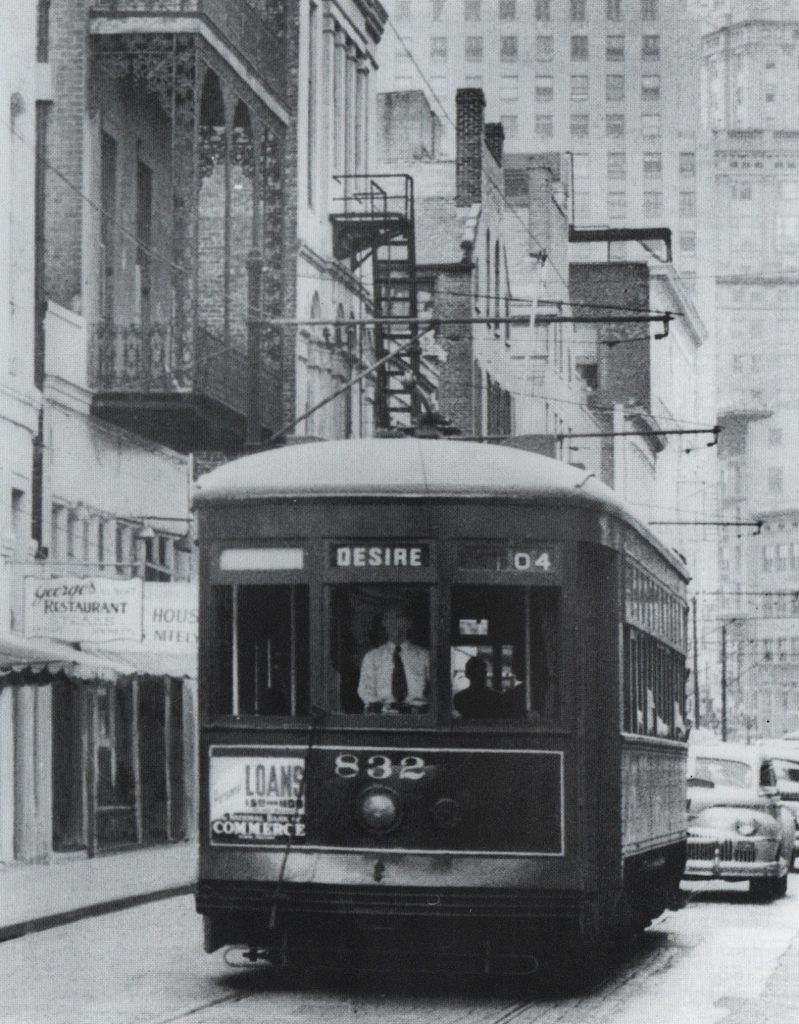
May 30, 1948
Yes, Stella, there was a Streetcar Named Desire, and here she is making her last run today in 1948. That’s conductor Henry Lacour in the photo doing the honors on Car No. 832’s last run. The Desire Line ran through the French Quarter from Canal Street and down Bourbon Street to Desire Street in Ninth Ward, before looping back to Canal along Royal Street. “The big thing about Desire was that it ran the length of the French Quarter,” explains historian and author Ed Branley. “It was the streetcar that people who lived in the quarter used to go places.” Along the route, the streetcar would pass wihin half a block of what was at the time the residence of Tennessee Williams.

May 30, 1861
The New Orleans Mint, which had been commissioned by Congress in 1835 and had begun operation in 1838, closed this week in 1861, after the outbreak of the Civil War. The red-brick Mint building was designed by William Strickland, a student of the architect Benjamin Latrobe, a disciple of Neoclassicism who had helped design the United States Capitol building. In 1854, the federal government hired West Point
engineering graduate Pierre Gustave Toutant Beauregard to fireproof the building, rebuild the arches supporting the basement ceiling and install masonry flooring. During this period, the Mint’s heavy machinery was converted to steam power and a smokestack was built to carry away the fumes.

Memorial Day, May 31, 1998
Today in 1998, the Blue Star Mothers of Louisiana Chapter 1 created the first annual Memorial Day Garden of Flags honoring Louisiana’s Fallen Heroes in the garden of the State Capitol in Baton Rouge. Each year, 11,000 American flags are placed to represent a fallen hero, and the names of the dead are read during a Memorial Day service. The Blue Star Mothers of Louisiana Chapter 1 support each other, their children in the military, wounded veterans in need, and veterans in our area as we promote patriotism. Membership is open to mothers or stepmothers who have sons and/or daughters currently serving, or who have been medically or honorably discharged from the six service branches of the United States, as well as the National Guard, Reserve and the Merchant Marine.

Memorial Day, May 31, 1991
Winnsboro earned its stripes (and stars) as the “Stars and Stripes Capital of Louisiana” today in 1991. Earlier that year, members of the local Veterans of Foreign Wars chapter were searching for a way to help people understand the significance of the American flag from the perspective of a war veteran. They decided to borrow the flags that had been draped over deceased veterans’ coffins as a theme for a Memorial
Day display. The group received seven flags from local families for that first holiday and twenty-five for the following July Fourth. Today, six hundred flags line a two-mile stretch of Highway 15 through Winnsboro.