
May 1, 1933
Today could truly said to be “May Day” in the Webster Parish town of Minden. In February 1933, a major fire burned nearly a quarter of downtown. In April, the largest bank in Minden failed and then, on May 1, 1933, a powerful tornado hit the city causing more than $1.2 million dollars in damage and killing 28 people. The disasters of 1933 placed Minden in a dangerous position as these events took place in the midst of the Great Depression. Things did not turn around quickly for the people of the town, but in 1941, Minden became the home of a large ammunition plant, the Louisiana Ordnance Plant. Over the next 30 years, later under the name of the Louisiana Army Ammunition Plant (pictured here), it would be the main economic engine of the local economy.

May 1, 1911
The first “over water” or “offshore” oil well was drilled in Caddo Lake this week in 1911. After months of hard work and battles with mosquitoes, alligators and moccasins, the Ferry Lake No. 1 oil well was drilled to a depth of 2,185 in Caddo Lake near Mooringsport and began producing 450 barrels of oil a day. It was the first “over water” or “offshore” oil well ever dug. A crew felled cypress trees on the shore and drove the trunks into the lake for pilings for the platform to support the well. A slush pit was also made of wood.

May 2, 1862
When Benjamin Butler, the Union general New Orleanians loved to hate, assumed his command in the Crescent City this week in 1862, he made his headquarters at the still-uncompleted Customs House and Post Office on Canal Street (seen here under construction in the 1850’s. Even though it would not be completed until 1881, it was already the largest building in the country, after the Capitol building in Washington. Work had begun in 1848 with the design of Alexander Thompson Wood. After Wood was replaced as architect in 1850, a succession of eight architects followed, each modifying the original design concept. Due to the shape of the trapezoidal lot bounded by Canal North Peters, Iberville and Decatur Streets, the northwest corner is rounded. The majority of the building is constructed of brick sheathed in gray granite from Quincy, Massachusetts; however, the entablature material is cast iron.

May 2, 1803
Agreement to the terms of the Louisiana Purchase had been reached on April 30th, and the document was signed today in Paris in 1803. At the request of President Thomas Jefferson, French nobleman Pierre Pont de Nemours opened back-channel negotiations to determine Napoleon’s interest in a purchase as a way to defuse potential conflict between the United States and France. The resulting purchase exchanged 828,000 square miles for cash and debt forgiveness totaling sixty-eight million francs, or $15,000,000. The territory included land from fifteen present states and two Canadian provinces. Congress would ratify the purchase on October 19th, 1803, and the handover would be held in New Orleans in December.

May 3, 3500 BC
Today in 3500 BC (or thereabouts), the Watson Brake mound complex in Ouachita Parish, was being built by indiginous people who have yet to be identified. While primarily hunter-gatherers, they planned and organized large work forces over centuries to accomplish the complex mound and ridge constructions. Watson Brake consists of an oval formation of eleven earthwork mounds from three to 25 feet in height, connected by ridges to form an oval nearly 900 feet across. They are older than the Ancient Egyptian pyramids or Britain’s Stonehenge.

May 3, 1862
A rich vein of pure rock salt was founded on Avery Island this week in May 1861. Salt extraction had been conducted on the island for at least several hundred years, but the 1861 discovery would be an unusually rich vein just below the surface, more than three miles long and two miles wide. The mine would produce more than twenty-two million pounds of salt for the Confederacy before Union Colonel W. K. Kimball would seize the island in 1863, burn eighteen buildings, smash the mining equipment and scatter six hundred barrels of salt awaiting shipment. Now operated by the Cargill Corporation, the mine is the oldest in Western hemisphere.

May 4, 1990
At New Orleans Jazzfest today in 1990, the legendary Bo Diddley invited a four-year-old Troy “Trombone Shorty” Andrews onstage to play with him (picture). At the age of four, Andrews started playing a trombone given to him by his brother James “because the family already had a trumpet player”. Andrews’s brother Darnell, also a talented trombone player, would be shot and killed in 1995. Following that tragedy, Trombone Shorty was left in the care of his manager and friend, Susan Lovejoy Scott, who acted in loco parentis, managing and mentoring Andrews as a young musician. In the intervening thirty years of success and awards, he has performed alone and with other famous names throughout the United States and around the world.

May 4, 1943
Mike the Tiger went off to war today in 1943. LSU officials had decided that Mike would be better off at the Audubon Zoo in New Orleans for the duration of the war, and a going away party was held for him on the Baton Rouge campus. Student body president Hugh O’Connor gave the farewell address and Malide Cross, co-ed vice president presented Mike with a purple and gold bouquet. A special lunch box was packed for him by Walter Gorinski and Willie Hill of the L Club, and members of the
student council accompanied him on the train ride to New Orleans. Mike would return to campus in 1945.

May 5, 1821
Napoleon Bonaparte died today on the island of St. Helena off the west coat of southern Africa. Word of his death would take a long time to reach Louisiana, and in the interim, New Orleanians were still plotting ways to get the emperor off the island. One such scheme was hatched at the home of Mayor Girod at 500 Chartres. The idea was hiring the pirate Jean Lafitte to lead a raiding party to rescue Napoleon and bring him to Louisiana. There’s no proof, but it’s said that Mayor Girod even volunteered his house as a permanent home. Long story short–news of Napoleon’s death reached New Orleans, Lafitte was exiled to an island off the coast of Yucatan. The building is seen here in a 1905 photo when it was a grocery store owned by Joseph Labourdette, but it will forever be known as the Napoleon House.

May 5, 1987
Pistol Pete was inducted into the Naismith Basketball Hall of Fame today in 1987. At the time of his death, Peter Press Maravich still held sixteen NCAA records established during his LSU career between 1968-1970. He was the all-time college basketball scoring leader with 3,667 points in 83 games. After his spectacular college career, he played ten seasons in the NBA, earning five trips to the NBA All-Star Game and one league scoring title. As a professional, he had one of the top-ten career scoring averages, 24.2 points per game, in NBA history while playing with the
Atlanta Hawks, New Orleans Jazz, Utah Jazz and Boston Celtics.

May 6, 2014
This week in 2014, the Louisiana House voted for a bill to preserve “chase pen” hunting of foxes as part of Louisiana’s traditional culture. Chase pen hunting is a form of organized hunting or hound training conducted inside a large fenced enclosure. Some times those enclosures can encompass hundreds or thousand of acres. In 1939, the Louisiana Fox Hunters Association held a meet on Driskill Mountain, Louisiana’s highest point, tower 535 feet over the Bienville Parish landscape. According to KTBS in Shreveport, a then-unknown Jimmie Davis played “You Are My Sunshine” for the very first time in front of an audience.

May 6, 1889
Louisiana legend Zatarain’s was founded as a grocery by Émile A. Zatarain, in 1886. At the opening of the Louisiana Purchase Exposition this week in 1889, Papoose Root Beer, Zatarain’s trademarked formulation for the popular drink became a regional favorite across the South. Seasonings with a Creole or Cajun flair were among the first of Papoose Pure’s products expansions. Next they moved into Creole
Mustard and pickled products. In 1963 the family sold the business to James G. Viavant, founder and former owner of the Avondale Shipyards, who took moved Zatarain’s to Gretna and updated the company’s outdated, inefficient packaging technology.

May 7, 1931
“We Live for Those We Love” is a charming sentiment, but on this day in 1931, it was inscribed on the cornerstone that was laid at the New State Capitol. There was no ceremony at the setting of the stone on the west side of the building. Set into the cornerstone was a copper box containing copies of official acts and other documents pertaining to the building’s construction. The box also contains the answer to one of Baton Rouge’s greatest secrets—the location of caskets of the original settlers of Spanish Town whose cemetery was dug up while the Capitol was being built and later re-interred in a secret location.

May 7, 1971
Today in 1971, the National Aeronautics and Space Administration (NASA)
announced today that it was considering seventy sites in nineteen states for assembling, testing and launching the proposed space shuttle vehicle that was scheduled to begin space flights in 1981. Eventually, NASA would announce that the shuttle’s external tanks would be manufactured at the Michoud Assembly Center in eastern New Orleans. On June 29, 1979, ET (External Tank) 1 which flew on the first shuttle flight on April 12, 1981, rolled out of the facility. By the end of the shuttle program in 2011, 136 tanks would be produced, ending with the flight-ready tank ET-122, which flew on STS-134.

May 8, 1886
The history of Coca-Cola is a somewhat murky one, but it’s generally agreed that it was “introduced” in Atlanta today in 1886 by a pharmacist named John Stith Pemberton, and first put into bottles in Vicksburg by Joseph B. Biendenharn in 1894. After that, things get complicated. While not the site of the first Coca-Cola bottling plant as some claim, there’s still plenty of room for Monroe in Coca-Cola lore. In 1913, Biedenharn moved to Monroe and began producing Coca-Cola at a small bottling plant that he purchased there. In time, he and his brothers William, Harry, Lawrence, Herman, Ollie, and Albert and sister Katie acquired franchises to bottle Coca-Cola in Shreveport and elsewhere. The home he built in Monroe is now the Biedenharn Museum on Riverside Drive in Monroe.

May 8, 1956
Today in 1956, Cincinnati cowboy Roy Rogers visited with fans at the foot of Convention Street in Baton Rouge, one of the last stops on his power boat cruise of the Red and Mississippi Rivers from Denison, Texas to New Orleans. The Yellow Jacket Boat Company of Denison, partially owned by Rogers, sponsored the trip. Along the way, Rogers and his wife, Dale Evans, stopped in Shreveport, where Evans visited children at the Confederate Memorial Hospital, and Alexandria, where they enjoyed an evening at the Hotel Bentley. The tour would conclude in New Orleans on May 9th, where five thousand fans waited in the rain to greet the star.

May 9, 1828
Composer and pianist Louis Moreau Gottschalk was born in New Orleans this week in 1828. Recognized as a prodigy at an early age, he was taken to Paris to study, but was rejected by the Paris Conservatoire. He gained access to the establishment in other ways, but more importantly, he composed Bamboula (Danse Des Nègres) and La Savane, which established him as a genuinely American composer, and not a mere imitator of the European written tradition.His works were a major artistic statement as they carried a legacy of music of enslaved African people in a romantic music context, and as such they were also precursors of jazz.

May 9, 1944
Jimmie Davis was inaugurated as Louisiana’s 47th governor today in 1944. James Houston Davis (seen here at his 100th birthday party in 1999, surrounded by former governors Dave Treen, Edwin Edwards, Buddy Roemer, and current Governor Mike Foster) had been born near Beech Springs in Jackson Parish in 1899. He received his bachelor’s degree in history at Louisiana College and his master’s degree from LSU in 1927. His master’s thesis, was titled Comparative Intelligence of Whites, Blacks and Mulattoes. Davis was elected in 1938 as Shreveport’s public safety commissioner and in 1942 to the Louisiana Public Service Commission. He had recorded You Are My Sunshine in Shreveport in 1940 and enjoyed nation-wide popularity as he prepared to run for governor in 1944.

May 10, 1918
The Baptist Bible Institute was renamed the New Orleans Baptist Theological Seminary this week in 1918. The Southern Baptist Convention had founded the institution during the 1917 convention meeting in New Orleans. The institute’s purpose was centered on missionary work, and initially established as gateway to Central America. It started in the Garden District on land purchased from Sophie Newcomb College and and later relocated to the current location in the heart of Gentilly. Missions and evangelism have remained the core focus of the seminary. In 1953, it relocated from Washington Avenue in the Garden District to a more spacious campus designed by Louisiana architect Hays Town in the Gentilly neighborhood.

May 10, 1978
This week in 1978, the New York Apples and the New Orleans Sun Belt Nets of the World Tennis Association but on a show at the Louisiana Superdome. Before a disappointing crowd of 1400, the match featured a near upset of Billie Jean King by transgender pioneer Renee Richards. When the Nets had been playing in Cleveland, Arthur Ashe had been a member of the team and played mixed doubles matches with Richards. When asked about the experience later, Richards said, “You couldn’t get
any more mixed than we were!” The 1978 season would be the first and last season for the Nets in New Orleans.

May 11, 1988
Today in 1988, the Cabildo on Jackson Square in New Orleans was badly damaged in a fire that destroyed the cupola and the entire third floor. The original seat of the Spanish government was destroyed in the Great New Orleans Fire of 1788. It was rebuilt between 1795 and 1799. It was the site of the Louisiana Purchase transfer ceremonies late in 1803, and continued to be used by the New Orleans city council until the mid-1850s. The building’s main hall, the Sala Capitular was the seat of the Louisiana Supreme Court between 1868 and 1910, the Cabildo. It was the site of several landmark court cases, including Plessy v. Ferguson in 1892.

May 11, 1819
This week in 1819, the shallow-draft steamboat James Monroe, captained by James A. Paulfrey, reached the Ouachita Parish seat of Miro on the Ouachita River. Two weeks later, the town would change its name to Monroe to honor the feat. Fort Miro had been established in 1782, when the Spanish Governor at New Orleans sent Don Juan Filhiol to establish a post along the Ouachita River. By 1790, this trading post, called Ft. Miro, had evolved into a community of forty-nine families. After the Louisiana Purchase in 1803, Ouachita Parish was established March 31, 1807, with Ft. Miro as the parish seat.

May 12, 1980
“Sssnakes alive!” read the headline of the article in the newspaper today in 1980 as Dan Vicknair, manager of the LaPlace Snake Farm, posed for a photo with the sixty-five alligators then in residence at the farm (photo by Ronald LeBoeuf). Sometime between 1948 and 1952, C. C. “Mac” McClung established the snake farm alongside US 61, but for many years before he settled in Louisiana, he operated a traveling snake show, sometimes with a carnival and sometimes on his own. When working by himself, he devoted most of his time to lecturing about snakes in schools. The “LaPlace Snake Farm” quickly became Louisiana’s most spine-chilling/disgusting roadside attractions and lasted into the 1980’s. Over the years, more than a few visitors left the farm thinking that the place was one direct hurricane hit from sending hundreds of cobras, rattlesnakes, and alligators slithering into the streets of LaPlace.

May 12, 1984
The 1984 Louisiana World Exposition opened to the public today in 1984. One hundred years after New Orleans had hosted its first world’s fair, the fair opened in downtown New Orleans with the theme, “The World of Rivers—Fresh Waters as a Source of Life”. Although seven million guests would visit the fair, it was not enough to recoup the $350 million investment, giving the fair the distinction of being the only exposition to declare bankruptcy during its run. But visitors who attended the fair would not be disappointed as they flocked to the Aquacade, the Jazz and Gospel Tent, the Fulton Street Market and other attractions.

May 13, 1846
The United States formally declared war on Mexico on May 13, 1846, following skirmishes between U.S. and Mexican troops in a disputed border region. Some of those skirmishes can be traced back to Fort Jesup in Sabine Parish. Fort Jesup had been established in 1822 by future President Zachary Taylor to provide protection for native tribes and American settlers on what was then the western border of the United Mostly, however, the troops engaged in road building, not combat. During the Texas Revolution, American volunteers were mustered at Fort Jesup before entering Texas. The army regulars at Fort Jesup were also sent into Texas in 1845 to counter the Mexican army upon Texas statehood. Led by Zachary Taylor, one can argue that Fort Jesup started the Mexican American War

May 13, 1864
Ninety percent of the city of Alexandria was burned by Union forces today in 1864. The Union army had occupied the city in the spring of 1863 and decided to torch the city before abandoning it. When soldiers approached the Catholic church, Father J. B. Bellier stood at the front door, rapier in hand, and told them grimly that he’d kill the first soldier who should attempt to apply the torch. Bellier had been trained in the French army before entering the priesthood and when the soldiers saw that they would have to kill the priest in order to set fire to the church, they left.

May 14, 2014
This week in 2014, the Louisiana legislature passed Senate Concurrent Resolution (SCR) 122, recognizing the Kaffie-Frederick General Mercantile Store of Natchitoches as Louisiana’s oldest general store and commended them for for 150 years of service to the Natchitoches community. Established in 1863, it’s the oldest general store in Louisiana. Harris and Adolf Kaffie had emigrated to the United States in the middle of the Civil War and somehow made their way to Natchitoches, where they peddled dry goods door-to-door until they could afford to open their own store. Byby 1893, the brothers paid $1616.29 for the land and construction of a building on the Front Street lot where the store still stands.

May 14, 1845
Louisiana’s first revised constitution since achieving statehood in 1812 went into effect this week in 1845. In an era when the Jacksonian concept of the ascendancy of the common man was prevalent, the new constitution would include the creation of the office of superintendent of public education and efforts to encourage the legislature to establish free public schools. Alexander Dimitry is first to hold the position of superintendent of education, and the first free public school in the state
had opened in New Orleans in 1842. Only twenty-six students were enrolled at the beginning of the term, but that number would swell to over a thousand before a year had passed. (The pictured version shows that even as late as 1845, important documents were being printed in French.)

May 15, 1975
LSU-Shreveport graduated its first class of 223 four-year students in a ceremony at Shreveport’s Municipal Auditorium today in 1975. Almost forty years earlier, efforts to establish a branch of LSU in Shreveport began in 1936 when the Caddo Parish Police Jury passed a resolution for the school. More than than thirty years would pass before a two-year school was authorized by the legislature. Fearing loss of enrollment, other North Louisiana universities blocked the efforts to become a four-year college until Act 66 of 1972 was signed into law by Governor Edwin Edwards. Today, LSUS boasts 25 undergraduate degree programs, 13 master’s degree programs, and a Doctorate of Education in Leadership Studies.
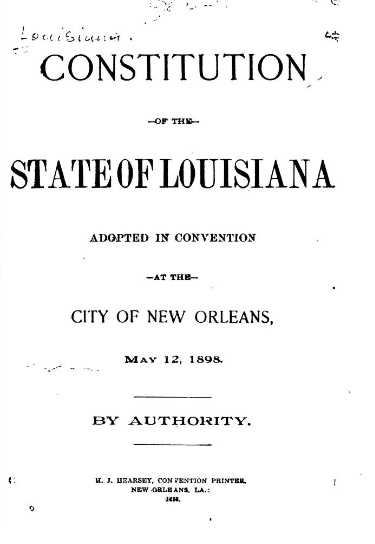
May 15, 1898
Another day, another constitution. Fifty-three years and three constitutions after the Constitution of 1845 went into effect (see May 14), the Constitution of 1898 would go into effect this week in 1898 in a very different time. The new constitution included the infamous “Grandfather Clause” which allowed those who were able to vote before 1867 and those whose father or grandfather could vote before 1867 to skip the literacy tests and poll taxes that were also part of the new constitution. No blacks could vote in Louisiana before 1867, so the intent of the law was clear. The Supreme Court would rule the clause unconstitutional in 1915.