
We’re having some summer fun this week and celebrating “Louisiana in Movies.” Enjoy!
June 16, 1960
Today in 1960, sexual blackmail was in the air in Baton Rouge and Clinton as Desire in the Dust, starring Raymond Burr, Joan Bennett and Martha Hyer was being filmed in the area. Even though the film would win a Golden Globe in 1961, one review summed it up as “another of those claptrap novels of demented, devious and oversexed Southern families that Yankees love to project upon the denizens who live below the Mason-Dixon line.” If the idea of Raymond Burr sex scenes isn’t enough to put you off the move, there’s also a horse-riding vixen who cools off by taking a dip wearing nothing but a Merry Widow, a dotty matron who throws graveside birthday parties for her deceased son, and other high jinx.

June 16, 1934
It was called the Central America Hurricane, but it came ashore in Louisiana over Berwick Bay today in 1934 and inflicted significant damage on the central area of the state. The worst-hit area from the storm was Honduras, though other parts of Central America were affected. In Louisiana, the storm killed six people, including two children who were killed when they were swept off a makeshift raft in the heavy seas. Abbeville, New Iberia and Lafayette registered significant damage. In Baton Rouge, electric power was cut, windows were blown out at the new State Capitol and the LSU Campanile, and 20,000 acres of corn were destroyed.

We’re having some summer fun this week and celebrating “Louisiana in Movies.” Enjoy!
June 17, 1959
The Horse Soldiers, directed by John Ford and starring John Wayne and William Holden (but mostly John Wayne) premiered at the Strand Theater in Shreveport today in 1959 The film was loosely based on Harold Sinclair’s 1956 novel of the same name, which in turn was based on the historic 17-day Grierson’s Raid and Battle of Newton’s Station in Mississippi during the Civil War. Exterior scenes were filmed in Natchitoches Parish along the banks of Cane River Lake, The film company built a bridge over the Cane River for the pivotal battle scene, and many locals were hired as extras.

June 17, 2008
In June, 2008, Freddie and Dianna Cooks purchased the Bloom’s Arcade in downtown Tallulah. Bloom’s Arcade was built by “Uncle Mertie” Bloom of Caldwell in 1927 and is believed to be the first indoor mall in the United States. Prior to its purchase by the Cooks, the building had been an empty blight for almost twenty years. But it would be reborn as Bloom’s Apartments, a project of the Brownstone Group, a construction firm
specializing in the renovation of historic buildings and new construction apartments. The Brownstone Group worked with the city to create a cultural district in Tallulah that allowed them to apply for historic and low-income housing tax credits.

We’re having some summer fun this week and celebrating “Louisiana in Movies.” Enjoy!
June 18, 2015
Today in 2015, the remake of The Magnificent Seven with Denzel Washington, Chris Pratt, and Ethan Hawke was being shot in Baton Rouge, St. Francisville, Zachary, Greensburg, Nottoway Plantation, and primarily in Jackson, where where production designer Derek Hill created the town of Rose Creek. While the remake didn’t make anyone forget Yul Brenner or Steve McQueen, the film, directed by Antoine Fuqua, received mixed reviews, as exemplified by the consensus of Rotten Tomatoes that, The Magnificent Seven never really lives up to the superlative in its title – or the classics from which it draws inspiration – but remains a moderately diverting action thriller on its own merits.”

June 18, 1895
Legendary LSU Band Director Castro Carazo was born in San José, Costa Rica today in 1895. Carazo, the son of the chief justice of supreme court of Costa Rica, opted not to follow his father into the law and opted to study music in Barcelona. Eventually, he would become the music director at the Roosevelt Hotel. According to legend, he was conducting an orchestra in the Blue Room, when he was approached by Huey Long who said, “Come with me. You’re the new band director at LSU.” He took the gig and moved to Baton Rouge, where his collaborations with Long included Long’s theme song, Ev’ry Man a King.

We’re having some summer fun this week and celebrating “Louisiana in Movies.” Enjoy!
June 19, 1966
After seeing a still of himself in The Wild Angels, an outlaw biker movie, this week in 1966, Peter Fonda got the idea for an updated Western on motorcycles instead of horses that would become Easy Rider. Filming would start later that year at sites including New Orleans and other locations in Louisiana. The restaurant scenes with Fonda, Dennis Hopper, and Jack Nicholson were shot in Morganza. The men and girls in the scenes were Morganza locals. In order to inspire more vitriolic commentary from the local men, Hopper told them the characters in the film had raped and killed a girl outside of town. The scene in which Fonda’s and Hopper’s characters were shot was filmed on Louisiana Highway 105 North, just outside Krotz Springs, and the two men in the pickup truck, Johnny David and D.C. Billodeau, were Krotz Springs locals. The film was released (belatedly) in the summer of 1969.

June 19, 1838
In June 1838, Fr. Thomas Mulledy, a leader of the Jesuit community in Maryland and a recent president of Georgetown University in Washington, DC, agreed to sell 272 African American men, women, and children to Henry Johnson and Jesse Beatty of Louisiana. The articles of agreement identify the people by name and set out the terms of the sale. At Georgetown, slavery and scholarship were inextricably linked. The college relied on Jesuit plantations in Maryland to help finance its operations, and slaves were often donated by prosperous parishioners. Most of the slaves from the 1838 sale were placed on plantations in West Baton Rouge and Iberville Parishes.

We’re having some summer fun this week and celebrating “Louisiana in Movies.” Enjoy!
June 20, 2016
The girls were having fun this week in 2016 as Regina Hall, Tiffany Haddish, Jada Pinkett Smith, Queen Latifah, Larenz Tate, and five thousand extras attending the Essence Fest in New Orleans were making Girl’s Trip look like a true joyride. In the film’s most famous scene, Smith’s character ziplines down the Bourbon Street (with un-hygenic results). If you’ve never been to Bourbon Street and thinking this is something you definitely want to do on your own trip to New Orleans–get over it. The zipline “ain’t der no more” because it never was there. The scene was specifically created for the movie. Sorry.

June 20, 1905
Lillian Florence Hellman was born in New Orleans today in 1905. During most of her childhood, she spent half of each year in New Orleans, in a boarding home run by her aunts, and the other half in New York City. She studied for two years at New York University and then took several courses at Columbia University. As a playwright, Hellman had many successes on Broadway, including The Autumn Garden, Toys in the Attic, Another Part of the Forest, The Children’s Hour and semi-autobiographical The Little Foxes. She adapted The Little Foxes into a screenplay for a 1941 film which starred Bette Davis and received an Academy Award nomination.

We’re having some summer fun this week and celebrating “Louisiana in Movies.” Enjoy!
June 21, 1982
Today, this week and this month in Baton Rouge in June 1982, Richard Pryor and Jackie Gleason were filming The Toy. Pryor stars as a janitor at a department store owned by a businessman Gleason. The owner tells his son that he may have anything in the toy department, and so naturally, the kid chooses the janitor, who gets paid to spend a week with the boy. The city was called “Bates” in the film, and several locations were used, including One American Place, the State Capitol and the Exxon Refinery, which sported a sign reading “Bates Refinery”. The critics hated the movie, but it would earn over $50 million in the United States. It would also win an award for newcomer Scott Schwartz, best known as “Flick”, the kid who didn’t believe his tongue would stick to the flagpole in A Christmas Story.

June 21, 1981
“I pledge allegiance to the flag of the state of Louisiana and to the motto for which it stands: A state, under God, united in purpose and ideals, confident that justice shall prevail for all of those abiding here.” In June of 1981, the Louisiana Legislature approved the state’s official Pledge of Allegiance. If you didn’t know that Louisiana had a Pledge, or if you thought it sounded like it had been written by a bunch of third-graders, you’re right. Mrs. Chris Murphee and her class of third graders at Jefferson Terrace Elementary in Baton Rouge wrote the pledge as a class project and submitted it to the legislators.

June 22, 1942
Grambling State and New York Knick all-time great Willis Reed was born in the Lincoln Parish community of Dubach this week in 1942, and he grew up on a farm in nearby Bernice. Reed showed athletic ability at an early age and played basketball at West Side High School in Lillie. He attended Grambling State University, where he amassed 2,280 career points, averaging 26.6 points per game and 21.3 rebounds per game during his senior year. Reed was inducted into the Naismith Memorial Basketball Hall of Fame, and in 1996, he was voted one of the “50 Greatest Players in NBA History.”

We’re having some summer fun this week and celebrating “Louisiana in Movies.” Enjoy!
June 22, 2012
This week in 2012, Beasts of the Southern Wild, a unique look at the apocalypse, and maybe an allegory of Katrina, opened in New York and Los Angeles today, before going wider release the following week. The film starred six-year old Houma native Quvenzhané Wallis, who had beaten out 4000 other young people for the part when she’d been five. Her performance earned her an Academy Award nomination for Best Actress, making her the youngest nominee in the category and the first born in the 21st century. She would go on to appear in 12 Years a Slave and the 2014 remake of Annie. Her name, “Quvenzhané, combines the first syllables of her parents’ first names and “Quven”, and an alteration of the Swahili word jini meaning ‘sprite’ or ‘fairy’.

St. John’s Eve, June 23, 1860
Today in 1860, the party was over for legendary New Orleans vodou queen Marie Laveau (pictured). Fearing unrest among slaves and free people of color in the last tense months before the outbreak of the Civil War, New Orleans Mayor John T. Monroe, who was in his first week on the job, outlawed Laveau’s long-running seance on Bayou St. John, which had been tradition among Laveau and earlier queens for generations.
Little is known with certainty about the life of Marie Catherine Laveau. She was a mix of uniquely New Orleans blend of African, Native American and white cultures and was reputed to be the wealthiest black woman in New Orleans.

June 23, 245 Million, BC
Now that it’s officially summer, think cooling thoughts. For example, on this date in 245 million, BC, Baton Rouge occupied a position on the super-continent of Pangaea that was squarely on the equator. Earth was reeling from a mass extinction called the end-Permian event. The die-off had wiped out most life on Earth, including most land plants. The planet was baking, and life at the Equator struggled to survive. Pangaea started breaking up about 175 million years ago, and over the eons, Florida and the Yucatan Peninsula drifted apart, forming the Gulf of Mexico. As recently as 40,000 years ago, the some Baton Rougeans might still have enjoyed Gulf-front property.

June 24, 1964
A ruling by Federal Trade Commission (FTC) to print warning on cigarette packages a victory for Dr. Alton Ochsner. Ochsner, former chief of surgery at Tulane and founder of the Ochsner Foundation Hospital in Jefferson Parish. With his colleagues Michael DeBakey and Paul DeCamp, he wrote of the parallel between the sale of cigarettes and the incidence of bronchogenic carcinoma in 1952. In 1964, he advocated for the immediate implementation of warning labels on all cigarette packs and advertisements. His views put him in opposition to the American Medical Association, which joined the tobacco industry in opposing label warnings when they were approved by the FTC today in 1964.

June 24, 1955
New highway numbering signs were going up all over the state as the state highway renumbering system went into effect this week in 1955. the first state highways were originally numbered in 1924, after the creation of the the Louisiana Highway Commission had been created in 1921. Most states relegate the construction/ maintenance of local farm-to-market roads to local authorities, but over the years, the number of state highways steadily increased to the point where the state was building and maintaining local roads in a much higher proportion to other states. By 1955, it had become necessary to renumber all routes based on an A-B-C system of route classification: A was primary, B secondary, and C farm-to-market. Although the 1955 renumbering removed a large number of highways from state jurisdiction, Louisiana remains in the top ten of all states in the percentage of local roads for which the state bears responsibility.

June 25, 1868
To say that Louisiana was readmitted to the Union after the Civil War today in 1868 can be misleading. During the war, Congress had never acknowledged the rights of the Southern states to secede in the first place, so what did it mean to be “readmitted?” Essentially, it meant that states agreed to Reconstruction and could again send representatives to Congress. So when Louisiana, Alabama, Florida North and South Carolina were readmitted today in 1868, Republicans John S. Harris (left) who owned the largest cotton plantation in state, and William P. Kellogg (right), a port official in New Orleans, became Louisiana’s first U. S. Senators after the Civil War.

June 25, 2008
Louisiana’s legislature proclaimed the Sazerac to be the official state cocktail this week in 2008. Around 1850, Sewell T. Taylor sold his New Orleans bar, The Merchants Exchange Coffee House, to become an importer of spirits, including a brand of Cognac named Sazerac-de-Forge et Fils. Meanwhile, Aaron Bird began serving the “Sazerac Cocktail”, made with Sazerac Cognac imported by Taylor, and allegedly with bitters being made by a local apothecary, Antoine Amedie Peychaud. Before his death in 1889, Handy recorded the recipe for the cocktail, which made its first printed appearance in William T. “Cocktail Bill” Boothby’s The World’s Drinks and How to Mix Them.

June 26, 1998
Car Wheels on a Gravel Road, Lucinda Williams’s breakthrough album was released this week in 1998. Williams was born in Lake Charles in 1953, the daughter of poet and literature professor. After her parents divorced, Lucinda moved with her father to faculty positions in Mexico, as Baton Rouge; New Orleans; Jackson, Mississippi; and Utah, before settling at the University of Arkansas in Fayetteville. Williams never graduated from high school but was accepted into the University of Arkansas. She showed an affinity for music at an early age and was playing guitar at 12. Her first live performance was in Mexico City at 17. Twenty-seven years after releasing her first album in 1971, Car Wheels on a Gravel Road, would prove to be her big mainstream breakthrough. It was voted as the best album of 1998 in The Village Voice and ranked Number 98 on the 2020 revision of Rolling Stone’s 500 Greatest Albums of All Time.

June 26, 1973
Everybody’s worst impressions of Louisiana were confirmed this week in 1973 when Live and Let Die, the eighth film of the James Bond franchise (and the first to star Roger Moore) was unleashed on an unsuspecting public. Pot-bellied sheriffs, voodoo priestesses, sinister jazz funerals, swamp creatures of unusual size–Live and Let Die had it all. It was released during the height of the blaxploitation era, and many blaxploitation archetypes and clichés are depicted in the film, including derogatory racial epithets like “honky”, black gangsters, and pimpmobiles. It was set in African American cultural centres such as Harlem and New Orleans, as well as the Caribbean Islands.

June 27, 1879
This week in 1879, the Mississippi River Commission was created to plan for and ameliorate the effects of flooding in the Mississippi River Basin and to establish deep-water navigation in the lower Mississippi Valley. Today, the Lower Mississippi has become the largest port in the nation, based on tonnage. Collectively, the lower Mississippi ports include 256 miles of deep-draft navigable channels where each year, 10,700 vessels transport over 420 million tons of cargo. Individually, the ports on the lover river include the Port of South Louisiana, the Port of New Orleans, the Port of Plaquemines, and the Port of Baton Rouge.

June 27, 1957
Today in 1957, the hurricane named Audrey reached peak sustained winds of 125 mph and moved ashore in Cameron Parish. The storm caused unprecedented destruction across the region as damage from the surge alone extended 25 miles inland. The rough seas killed nine people offshore after capsizing the boat they were in. Further inland in Louisiana, the storm spawned two tornadoes, causing additional damage. The hurricane also dropped heavy rainfall, peaking at 10.63 inches near Basile. In the United States, Audrey killed at least 416 people, though the final death total may never be known. Damage totaled $147 million, and it was the fifth-costliest hurricane in the United States since 1900.

June 28, 2013
The Louisiana Sports Hall of Fame in Natchitoches was dedicated today in 2013. The first formal discussion came in a 1950 meeting of the Louisiana Sports Writers Association. Three charter members of the Hall were selected in 1959– LSU football All-American Gaynell Tinsley, boxing great Tony Canzoneri and baseball slugger Mel Ott – were enshrined during the 1959 Ark-La-Tex Sports Award Banquet in Shreveport. While plaques to 41 Hall of Fame honorees and conducted induction ceremonies for the shrine members each year, there was no permanent display beyond plaques and portraits at Prather Coliseum on the Northwestern State University campus in Natchitoches. In the late 1990’s and early 2000’s Governors Mike Foster and Kathleen Blanco advanced the idea of the permanent home for the hall of fame that opened in 2013. Today, it is part of the Louisiana State Museum.

June 28, 1863
Today in 1863, the Union-held Fort Butler (pictured in the aftermath) at the confluence of Bayou Lafourche and the Mississippi River in Donaldsonville was successfully defended against a Confederate attack in the Second Battle of Donaldsonville. Union forces had occupied the city a year earlier, and in June, 1863, Confederates under Brig. Gen. Jean Alfred Mouton attempted to retake the fort. The Confederates were progressing toward the fort when the Union gunboat, USS Princess Royal, came to the garrison’s aid and began shelling the attackers. Key to the successful defense of the fort and the Union victory were free men of color and fugitive slaves who fought as soldiers on behalf of the Union. (Apropos of nothing, why did the United States of America have a gunboat named the U.S.S. Princess Royal?)

June 29, 1973
External Fuel Tank 1 (ET -1) rolled off the assembly line at the Michoud Assemby Facilty (MAF) in New Orleans today in 1973. ET-1, seen here on Space Transportation System-1 (STS-1) was the first orbital spaceflight of NASA’s Space Shuttle program. The first orbiter, Columbia, launched on April 12, 1981, and returned on April 14, 1981.136 tanks were produced throughout the Space Shuttle program, ending with the flight-ready tank ET-122, which flew on STS-134, rolled out on September 20, 2010. Michoud, acquired by NASA in 1961, is one of the largest manufacturing plants in the world with 43 environmentally controlled acres under one roof.

June 29, 1967
Screen siren Jayne Mansfield met a gruesome death tonight in on a lonely road near Slidell. Mansfield had been in Biloxi for a nightclub appearance. Mansfield, her attorney Sam Brody, their driver Ronnie Harrison, and three of Mansfield’s children were traveling to New Orleans in Stevens’ 1966 Buick Electra 225. At approximately 2:25 a.m., on U.S. Highway 90 west of the Rigolets Bridge, the Buick crashed at high speed into the rear of a tractor-trailer that had slowed behind a truck spraying mosquito fogger. The three adults in the front seat were killed instantly. The children, asleep in the rear seat, survived with minor injuries.
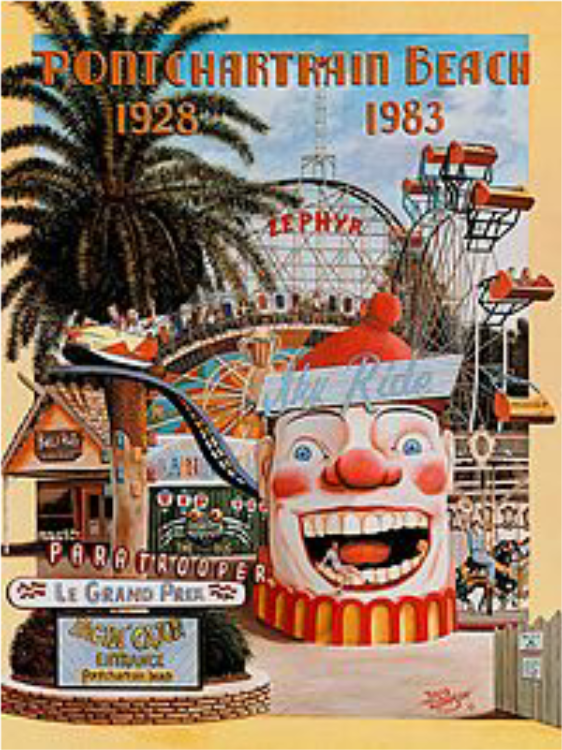
June 30, 1928
Pontchartrain Beach opened today in 1928. The amusement park on the New Orleans Lakefront was founded by Harry J. Batt, Sr., grandfather of actor Bryan Batt, and later managed and owned by his sons, Harry J. Batt, Jr. and John A. Batt. When the park opened, there was another amusement resort called Old Spanish Fort, just across Bayou St. John. The park included a beach with a large art deco style bathhouse and swimming pools and amusement rides including the Zephyr, the Zephyr Junior, Smoky Mary, the Wild Maus, Musik Express, Log Ride, the Ragin’ Cajun, the Bug, Paratrooper, Scrambler, Calypso, Ghost Train, bumper cars, carousel and Ferris wheel.

June 30, 2011
When the Danyang–Kunshan Grand Bridge in China opened today in 2011 and claimed the title of “World’s Longest Bridge”, the Pontchartrain Causeway (seen here on Opening Day, August 30, 1956) said, “Not so fast.” While the total length of the Chinese bridge is 102.4 miles, only 5.6 miles span open water, as opposed to 23.8 miles over open water for the Causeway. As a result of the controversy, the Guiness Book of World Records revised its text to make both bridges winners. The Danyan-Kunshan Grand Bridge is listed as “World’s Longest Bridge” and the Causeway is the “longest bridge over water (continuous).”