

July 1, 1912
Today in 1912, the legislature approved the state flag that we know today. For the previous fifty -one years, from 1861 until 1912. After secession in 1861, the legislature of the new Republic of Louisiana adopted a flag with thirteen stripes alternated red and blue stripes with white stripes, and the upper left-hand corner featured a pale yellow star on a red background. Officially, the flag would remain in use until the end of the Civil War, but by the end of 1861, the familiar blue flag with pelican and state motto of “Union, Justice, Confidence” was already put into unofficial use. It would be named the official state flag in 1912.

July 1, 1862
More than two months after the Union Army took New Orleans in April 1862, this morning’s Times-Picayune featured a long front-page open letter from Confederate Governor Thomas O. Moore to the people of the occupied city. His letter attacked the occupiers of the city and entreated residents to hold them at arms’ length, offering no trade, assistance or other interaction. “There cannot be a war for arms and a peace for trade between two peoples at the same time. We cannot exchange our corn, cotton and cattle for their gold.” Bold words, but they would be increasingly disregarded as the war wore on.

July 1-3, 1995
This was why New Orleans built an air-conditioned stadium. The inaugural Essence Fest was held in New Orleans on July 1-3, 1995. Originally created to celebrate the 25th anniversary of Essence Magazine, the festival–now known as the “ESSENCE Festival of Culture® Presented By Coca-Cola® – New Orleans” has grown to become what the magazine describes as “…not just a stage for the biggest names in entertainment; it’s a melting pot of voices, a harmonious convergence of art, activism, and empowerment.” During the first three-day festival in 1995, over 150,000 would flock to the Superdome to see and hear headliners Luther Vandross, Aretha Franklin, Patti LaBelle, Gladys Knight, B.B. King, and Anita Baker, as well as other performers including Boyz II Men, Aaliyah, Mary J. Blige, The Isley Brothers, and Maze featuring Frankie Beverly.

July 2, 1941
Miss Margaret Reed, head librarian for East Baton Rouge Public Library announced the plans of libraries around the state to assist the war effort today in 1941. In Baton Rouge, the parish library would open a branch at the Baton Rouge air base at Harding Field to serve the soldiers. In Natchitoches Parish, the library would open the library on Sunday afternoons to serve soldiers visiting the town from four nearby camps. The Bossier Parish library provided assistance to soldiers at the Barksdale air base who were setting up the base library. Libraries across the state would order additional books about blueprint reading, electrical wiring and automotive mechanics.

July 3, 1925
Shreveport’s Strand Theatre opened today in 1925 with a production of the comic opera, The Chocolate Soldier. In May, 1923, the Shreveport Times announced that a new 2,500-seat opera house would be built at a cost of $750,000. Ground was broken in October 1923, and construction last nineteen months. Part of the Saenger Theater chain, the “Million-Dollar Theatre“ was air conditioned, and in the early days had its own full-time orchestra on staff. The theatre boasted a 939-pipe Robert Morton “Golden Voice” pipe organ. The theater remained open until the late 1970’s. In December of 1984, The Strand re-opened to the sounds of the Shreveport Symphony Orchestra, and in 1980, Governor Edwin Edwards designated name it the Louisiana State Theater. (Patience, Jennings. Your Strand Theater is coming next week.)

July 3, 1898
When Daniel Henry Holmes died today in 1898, the department store he’d founded in New Orleans a half century earlier was the largest store in the South. D. H. Holmes was born in Ohio in 1816. Orphaned at age two, he was raised by his brother Sam in Cincinnati and clerked in dry goods store owned by Eugene Levassor, learning business methods and the French language. In 1841, he opened his own store on Canal Street in New Orleans. In 1989, the chain of department stores he built would be sold to Dillards. His original Canal Street store would eventually become a hotel.

July 4, 2026 Happy Fourth of July!
if you’re in Acadiana today, there’s a good chance that you’re planning to go the the tradiional celebration of the Fourth in Erath. August Erath was a Swiss immigrant who became mayor of a Louisiana community, but not the one that bears his name. He came to New Orleans in the 1860’s and would find work as a bookkeeper for breweries. In 1876, he moved to New Iberia and started a brewery in that town. He eventually bought property where the town of Erath now stands and authorized a railroad to be built through his land.Once the railroad was built, Erath bought land along the route in the southeastern portion of Vermilion parish, and he had a plan drawn for a town, complete with a plaza and railroad station. He began selling lots for his planned town, and soon the community came to be called Erath in his honor, even though he never actually lived there.

July 4, 1843
The namesake of McNeese State University was born on the Fourth of July today in 1843. John McNeese was born in New York and came south to attend Tulane University. After the Civil War and a recuperation in Texas, he returned to Louisiana in 1873, opening a singing and writing school in Calcasieu Parish. In 1888, he was elected secretary of parish School Board and parish superintendent where he inaugurated night school for adults and a central high school for the parish. The Lake Charles Junior College was established in 1939, and renamed for McNeese when it became a four-year institution in 1970.

July 5, 1927
This week in 1927, Morgan City power plant supervisor James Leboeuf was shot to death and his body weighted down with angle irons in Lake Palourde. Upon the discovery of the body, Mrs. Ada Banner Leboeuf (seen here on her wedding day) and her lover, Dr. Thomas E. Dreher, confessed that they planned the killing, but claimed that the shots were fired by James Beadle, the doctor’s handy man. Beadle was sent to the penitentiary for life, were hanged in the St. Mary Parish prison on February 1, 1929. Mrs. Leboeuf was the first white woman legally executed in Louisiana. It’s said that while awaiting her execution, Ada had a rocking chair brought into her cell, along with unlimited visitation rights and freshly ironed dresses.

July 5, 2003
Act 607 was signed by Governor Kathleen Blanco this week in 2003, establishing the Natchitoches Meat Pie as Louisiana’s Official State Food. In a food state like Louisiana, that’s saying something, but the meat pie is up to the challenge. It is similar to a Spanish picadillo beef empanada, but the use of wheat flour as an ingredient is significant. While corn is grown locally and is a staple of both Spanish and Native American food, wheat was probably brought in on the annual supply convoy over El Camino Real de los Tejas (the Old San Antonio Road) or sourced from Europe along the Red River.

July 6, 1987
It’s hard to believe that as recently as 1987, alligators were feared to be going extinct and were protected under the federal Endangered Species Protection Act of 1967. But today in 1987, they were removed from the list to take their chances along with the rest of us. A species that had survived for almost 250 million years had shrunk to approximately 100,000 Louisiana gators by the late 1950’s. In 1962, the state made it illegal to hunt them, and population rebound was soon underway. Today, the alligator population is closing in on four million, soon to surpass the number of human residents in the state.An LSU AgCenter study found that in 2019, alligator farmers created over $90 million in farm-gate value, and effects from their spending led to a total contribution of $235 million to the Louisiana economy. So, chomp on, gators! Stay out of the road, and we’ll try not to run over you.

July 6, 1965
This week in 1965, Miss Louisiana was crowned in Monroe for the first time. Maud Allison Price had represented Louisiana at the 1922 Miss America Pageant as Miss New Orleans. There would be no “Miss Louisiana” until 1933, and no Miss Louisiana pageant until 1947. In 1965, the Monroe Junior Chamber of Commerce sponsored the pageant, where Lynda Ferguson of Shreveport, representing Centenary College, took the prize and would go on to finish in the Top Ten in Atlantic City. Over the years, Louisiana has provided four first runner-ups in the MIss America Pageant, but it is the only southern state never to have a Miss America.

July 7, 1884
This week in 1884, a statue of New Orleans philanthropist Margaret Haugherty was unveiled in New Orleans. It was the first publicly erected statue of a woman in the United States, the first monument to an American female philanthropist, and the only known statue to a baker. Haugherty (Hawk-r-ee) had been born in Ireland. During the forty-seven years prior to her death in 1882, she became known as the “Angel of the Delta,” “Mother Margaret,” “Margaret of New Orleans,” the “Celebrated Margaret”, “Head Mame”, and “Margaret of Tully.” She opened up four orphanages in the New Orleans area.

July 7, 1898
This week in 1898, New England investor F. T.Roth spoke to the New Orleans business community at the Cosmopolitan Hotel about the city’s role in the aftermath of the war that was ongoing with Spain in Cuba. “Why the war, it is a moral certainty that Spain will be driven from the islands. It is just as certain that the United States, even if we do not occupy the islands with our standing army, will have something to say in the ruling of them.” He encouraged businessmen to be ready to supply whatever an occupying army might need in Cuba and to establish regular, if not daily steamship service to Havana.

July 8, 1988
Today in 1988, Governor Edwin Edwards signed into law a bill passed by the legislature that you won’t likely see in any other state. Specifically, SB 188 permitted riders in the parade of the Zulu Social Aid and Pleasure Club of New Orleans to bean parade onlookers with a coconut. Sadly, the privilege didn’t last. In 2010, Daisy Palmer, a retired Orleans Parish public school teacher, was struck on the left side of her head, while she was looking for the next float in succession of the parade. As the result of the subject incident, Mrs. Palmer sustained personal injuries which included a laceration of the forehead at the eyebrow, bleeding, as well as treatment for anxiety, depression, a loss of interest in Mardi Gras, and nightmares of coconuts striking her. Throwing coconuts from float was again prohibited.

July 8, 1994
Louisiana’s first astronaut Jim Halsell, Jr., was launched into space aboard the shuttle Columbia today in 1994. Halsell was born in 1956 in West Monroe, attended West Monroe High School and the Air Force Academy, and received masters degrees in management from Troy University and in space operations from the Air Force Institute of Technology. Selected by NASA in January 1990, Halsell became an astronaut in July 1991. In 1994, STS-6 flew the second International Microgravity Laboratory and conducted more than 80 experiments focusing on life sciences research in microgravity. In 2017, Halsell would be charged with reckless murder in the traffic deaths of two Alabama teenage girls.

July 9, 1869
Today in 1869, South Carolina became the 28th state to ratify the 14th Amendment to the U. S. Constitution, marking the moment the amendment officially became valid. Earlier that same day, Louisiana had become the 27th state to ratify the amendment pertaining to the legal status of formerly enslaved people. Its provisions established a broad definition of national citizenship and guaranteed all persons due process and the equal protection of the laws, significantly expanding the scope of federal power to protect individual rights.

July 9, 1982
Kenner witnessed what was at the time the second most deadly crash in U. S. aviation history today in 1982. Pan Am Flight 759 had just lifted off from New Orleans International Airport in a thunderstorm when it crashed into the Roosevelt subdivision adjacent to the airport. All 145 souls on the flight and three local residents were killed. The National Transportation Safety Board determined the probable cause of the accident was a microburst-induced wind shear during the liftoff. Seven of the dead were members of the Baton Rouge family of cemetery owner Percy Hood who were on their way to a family funeral in Las Vegas.

July 10, 2026
This Saturday, you too can be chased through the streets of New Orleans by girls with fungo bats. At the 2007 Mardi Gras, Mickey Hanning, self-titled “El Padrino” (The Godfather) , and friends were talking about ways to emulate the Festival of San Fermin in Pamplona, Spain, when the idea of the San Fermin in Nueva Orleans was born. Each July, the “El Encierro” (the bull run), features skaters from roller derby leagues around the world instead of bulls. Other events include “El Txupinazo,” known as the opening ceremonies, “La Fiesta de Pantalones” (the pants party), and “El Pobre de Mi” (poor me), also known as the closing ceremonies. The three-day party features local restaurants, prizes, and Hemingway look-alike contest.

July 10, 1964
Today in 1964, a group of African American men in Jonesboro founded the group known as The Deacons for Defense and Justice to protect members of the Congress of Racial Equality (CORE) against Ku Klux Klan violence. Most of the “Deacons”, led by Earnest “Chilly Willy” Thomas (pictured) and Frederick Douglas Kirkpatrick, were veterans of World War II and the Korean War. The Jonesboro chapter organized its first affiliate chapter in Bogalusa, led by Charles Sims, A.Z. Young and Robert Hicks. The national attention that the Deacons garnered also persuaded state and national officials to initiate efforts to neutralize the Klan in that area of the Deep South.
July 11, 2025
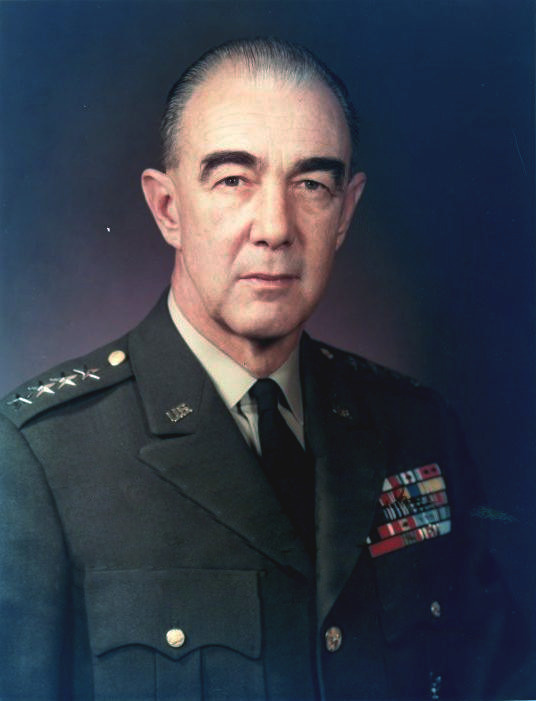
Today in 2025, the 309-square-mlle Fort Polk in Vernon Parish near Leesville was named in honor of General James H. Polk (pictured). Fort Polk was originally named for Confederate General Leonidas Polk, and construction began in 1941. Thousands of wooden barracks sprang up quickly to support an Army preparing to do battle on the North African, European and Pacific fronts. In 2023, the fort’s name was changed to Fort Johnston, honoring Sergeant William Henry Johnson, a World War I veteran from the New York National Guard unit known as the “Harlem Hellfighters”. Today in 2025, the outpost renamed again in honor of James H. Polk (not Leonidas), a four-star general who served as Commander in Chief, United States Army Europe from 1967 to 1971.
July 11, 1943
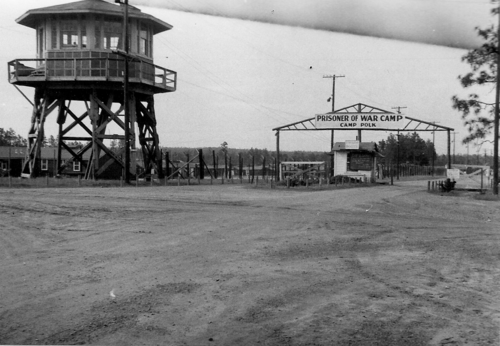
Speaking of Fort Polk (see above), the first prisoners of war from Erwin Rommel’s Afrika Corps began arriving at Fort Polk near Alexandria during World War II this week in 1943. While primarily a training facility, Fort Polk would also house prisoners in a large fenced-in compound in the area now encompassing Honor Field, Fort Polk’s parade ground. The POWs picked cotton, cut rice, and cut lumber, and they would also help to sandbag the raging Red River in the summer of 1944. Prisoners were not forced to work, and some refused. Those who worked earned scrip for their labor, with which they could buy such necessities as toothpaste or snacks at their own Post Exchange.

July 12, 1939
With the release of Gone With the Wind and The Wizard of Oz, 1939 would be a big year for movies. In Jennings, it would be an even bigger year as the historic Strand Theater opened today with East Side of Heaven, starring Bing Crosby. (Not Der Bingle’s best work.) Designed in the Moderne architectural style by the firm Favrot, Reed, and Fred, the three-story brick building features a stucco-covered facade with vertical pilasters, recessed panels, and a prominent marquee, originally seating 575 patrons in a segregated auditorium with 375 seats on the main floor and 200 in the balcony for African American audiences. It flourished until television showed up in the 1950’s, and closed in the 1970’s. In the early 1990’s it was acquired by the City of Jennings and refurbished in time for the February 1, 1993 premiere of Passion Fish, which had been filmed in the area. Today, the Strand serves as the cornerstone of the art scene in Jennings.

July 12, 1934
Piano sensation Harvey Lavan “Van” Cliburn Jr. was born in Shreveport today in 1934. At age three, he began taking piano lessons from his mother, who had studied under Arthur Friedheim, a pupil of Franz Liszt. When he was six, his family moved the family to Kilgore, Texas. At the age of 23, he won the Tchaikovsky Piano Competition in Moscow in 1958. Prior to announcing the winner, the judges asked permission of the Soviet leader Nikita Khrushchev to give first prize to an American. “Is he the best?” Khrushchev asked. “Then give him the prize!” Cliburn returned home to a ticker-tape parade in New York City.

July 13, 1923
Today in 1923, C. E. Woolman moved to Baton Rouge to join the extension department of Louisiana State University at Baton Rouge as an agricultural sciences instructor who travelled out to farms to pass on the latest techniques. He lived in a house which might providentially be described as an “airplane bungalow” on North Sixth Street, three blocks from the LSU Experimental Farm, which was, at the time, located at the site of Arsenal Museum. Woolman would later move to Monroe and start a crop dusting service that would eventually become Delta Air Lines. Today, C. E. Woolman Drive, better known as the drop off lane at Baton
Rouge Metropolitan Airport is named in his honor.

July 13, 1983
Having previously offered the job to shrimp and crabs, Governor Dave Treen signed legislation designating the crawfish as the State Crustacean this week in 1983. Crawfish have been consumed for centuries by Native Americans and in many parts of Europe, but commercial sale of crawfish in Louisiana only began in the late 1800s. At that time, supplies were harvested from natural waters throughout the southern region of the state. The first record of a commercial crawfish harvest in the United States was in 1880 from the Atchafalaya Basin in Louisiana. In 1950, the Louisiana Legislature gave $10,000 to the Wildlife and Fisheries Commission to fund studies of the life history of crawfish in small ponds.

July 14, 1898
What would become the University of Louisiana-Lafayette was originally named the Southwestern Louisiana Industrial Institute and created by legislation that was enacted today in 1898. State Senator Robert Martin, for whom the university’s administrative building is named, authored this legislation. Several towns competed to be the site of the new school; Lafayette was chosen by virtue of a donation of 25 acres of land by the Girard family. The town also put up $8,000 and offered a ten-year property tax to supplement state appropriations. By 1899, the Board of Trustees was established. In 1900 construction began and Dr. Edwin Stephens was named president. Classes began in 1901 with 100 students. At 27, Stephens was among the youngest college presidents in the nation, yet he had a vision for the campus. He planted a grove of live oaks, the Twentieth Century Oaks, along Johnston Street and University Avenue in the first year of the century.

July 14, 1913
On this 124th anniversary of Bastille Day in 1913, no community in America had more reason to be grateful to the French than Monroe. Six sisters of the Franciscan Missionaries of Our Lady, a Franciscan order headquartered in Calais, had come to Louisiana to minister to the healthcare needs of the state. On July 14, 1913, the order opened St. Francis Sanitarium in Monroe (pictured). In 1923, the order would open Our Lady of the Lake Sanitarium in Baton Rouge; in 1949, Our Lady of Lourdes Hospital in Lafayette would open; and in 2000, St. Elizabeth’s Hospital in Gonzales would open its door.

July 15, 1968
While we’re talking about semiquincentennials this month, the Young Men’s Businessmen’s Association of New Orleans presented an idea to the community to commemorate the city’s 250th birthday in 1969. Their proposal was a wrought iron ornamental gate at the corner of Bourbon and Canal Streets. Although there have been occasions over the years when such a gate would have served a very useful purpose, the gate of 1968 was not built due to concerns that it would block larger vehicles from entering the historic street.

July 15, 1897
Louisiana’s 46th governor, Sam Houston Jones, was born today in 1897. After earning his degree from the LSU law school, Jones served in the Army in WWI and was discharged in 1919. He would serve at the constitutional convention of 1921 and be appointed assistant district attorney in 1925. He ran for governor in 1940 as an “Anti-Long” and was elected in the wake of the Louisiana Hayride scandals. During his term, he established the state civil service and benefited from growth of industry and increased revenues during World War II. In 1948, he would run for governor again and lose to Earl K. Long.