October 1, 1907
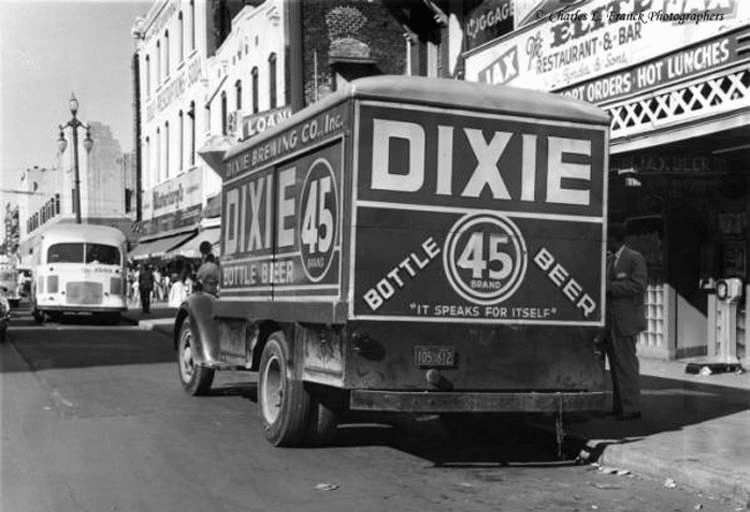
What better way to kick off the month of Oktoberfest than saluting the iconic Dixie Brewery in New Orleans which opened this month in 1907. The first commercial brewery in New Orleans was opened in 1852 by Swiss immigrant Louis Fasnacht. The Fasnacht brewery did not survive the Civil War, but in 1869, recent German immigrant George Merz opened a brewery that would be the first with air-conditioning. In 1907, Merz’s son, Valentine, built the brewery at 2401 Tulane Avenue, and brand their product Dixie Beer. Hurricane Katrina would temporarily doom Dixie, but in 2017, Saints owner Tom Benson announced plans to rebuild the brewery and resume production.
October 1, 1893
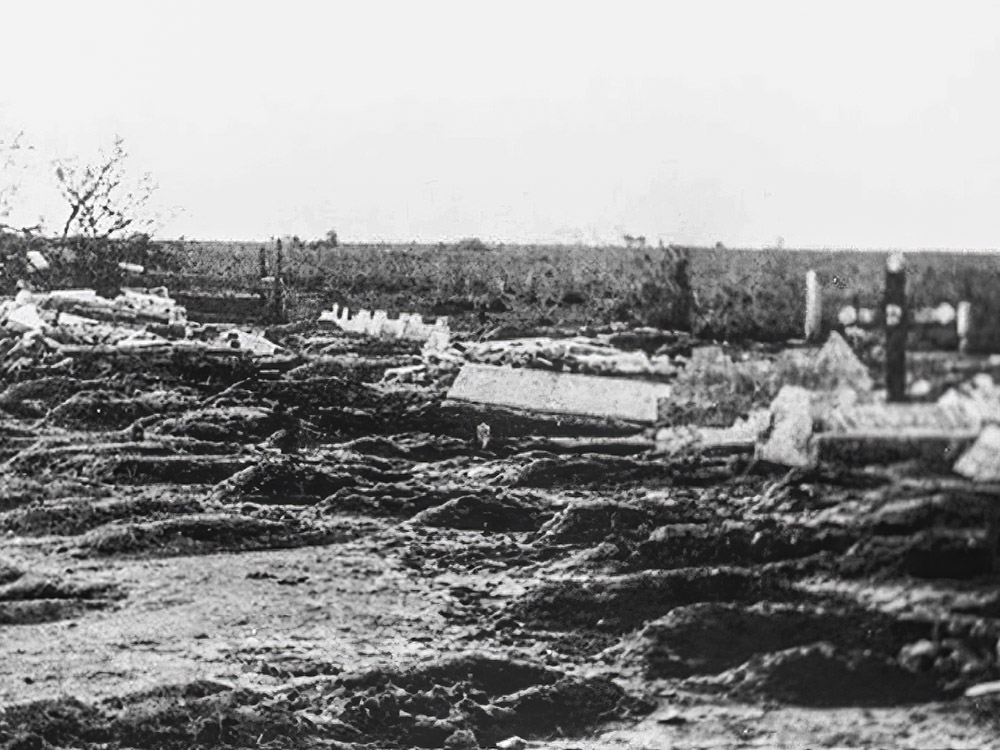
Louisiana’s deadliest hurricane, the Cheniere Caminada hurricane in Louisiana (known elsewhere as the Hurricane of 1893) made landfall in Lafourche Parish today in 1893. With winds exceeding 130 mph winds and a storm surge of sixteen feet, the Category 4 hurricane made landfall first in Louisiana, and then again the next day as a slightly weaker hurricane near Ocean Springs, Mississippi. In Louisiana, the community of Cheniere Caminada, a bustling seafood port just west of Grand Isle, was wiped off the map and all but 696 of the town’s 1471 souls perished. This photo shows the unmarked graves where victims were buried where they were found. Survivors would find their way to other communities in South Lafourche Parish and even further afield. Today, the site of the town is commemorated by a historical marker on LA 1 near the Cheniere Caminada cemetery.

October 2, 1898
Happy Birthday, David Butler! Well known in the town of Patterson for his audaciously decorated home and lawn, Butler fashioned whimsical, brightly painted assemblages from salvaged roofing tin to become one of the twentieth century’s best-known and most widely collected self-taught artists. His bestial forms and anthropomorphic shapes, whether mounted as whirligigs in his yard or affixed to the exterior of his house, ranged in size from modestly scaled to several feet tall. Born in Good Hope, Butler demonstrated an early propensity for artmaking in the drawings and carvings he made as a child. Skill in working with his hands and a strong spirituality, combined with an eye for color and beautiful form, were important in shaping his singular artistic vision.

October 2, 2015
The Four Winds Tribe, Louisiana Cherokee Confederacy hosted its inaugural ‘Culture Crafts and Powwow’ at the Mowad Civic Center in Oakdale today in 2015. It was described as an opportunity to learn about Native American traditions, tribal customs and heritage through song and dance with crafts, demonstrations and concessions. The Four Winds Tribe has an interesting history in Louisiana. In the wake of the Indian Removal Act of 1830 and the infamous Trail of Tears that resulted in the deaths of 15,000 of the 100,000 Native Americans from the southeastern United States, many members of the Cherokee, Choctaw, and Muscogee Creek tribes decided that the “Neutral Ground’ between American Louisiana and Spanish Texas was as far west as they wanted to go. They stayed in built their communities in what we now know as Allen, Beauregard, Calcasieu and Vernon Parishes. They were recognized as an official tribe by the State of Louisiana in 1997.

October 3, 1964
Hurricane Hilda came ashore in St. Mary Parish today in 1964. Hilda was the most intense hurricane of the 1964 season, but most of the deaths associated with the storm due to tornadoes. One tornado near Larose killed twenty-two people and injured 165 others. No other tornado in the state resulted in deaths, though multiple twisters in the New Orleans metropolitan area caused extensive damage to several automobiles and buildings and injured five. At Erath, a 125-foot high water tower succumbed to Hilda’s strong winds and collapsed (pictured) onto an adjacent town hall where civil defense personnel were operating, killing eight and injuring six.

October 3, 1907
“Man goes bear hunting. Man shoots bear.” Must be one of the “dog bites man” stories that nobody talks about. Five years after Teddy Roosevelt made headlines for going to the Mississippi Delta and refusing to shoot a bear that had been “baited” for him (thus giving rise to the legend of the “Teddy Bear”), he came to Louisiana and shot a bear that wasn’t chained to a tree. This week in 1907, Roosevelt, accompanied by Edward McIlhenny of Tabasco and Avery Island fame and businessman John M. Parker, who would later serve as governor from 1920-1924, went bear hunting in East Carroll and Madison Parishes. It took thirteen days, but at last, Teddy was able to write to his son, Kermit, ““At last today I killed my big she bear—202 lbs. It was my thirteenth day; now everything is pure pleasure. The dogs had her up for nearly three hours, while we galloped on horseback and ran on foot up and down the outside of the dense canebrakes in which the chase took place, at different times all of us were thrown out.”

October 4, 1884
Today in 1884, philanthropist Paul Tulane made a $1 million gift to the University of Louisiana in New Orleans. In recognition, the school would be renamed the Tulane University of Louisiana in his honor. The Medical College of Louisiana had been founded in 1834, in response to the fears of smallpox, yellow fever, and cholera in the United States. It was second medical school in the South and the first west of the Alleghenies. In 1847, the legislature designated the school as the University of Louisiana, a public university, and the law department was added. The university would close during the Civil War and struggle after it reopened in 1865.

October 4, 1941
Howard Allen Frances O’Brien, better known by her pen name, Anne Rice, was born in New Orleans in 1941. A writer of Gothic fiction, erotic literature, and Bible fiction, she is best known for writing The Vampire Chronicles. Rice spent much of her early life in the city before moving to Texas, and later to San Francisco. She was raised in an observant Catholic family but became an agnostic as a young adult. Rice began her professional writing career with the publication of Interview with the Vampire in 1976. In 1994, much of the film based on the novel would filmed in Louisiana. Unlikely vampires Tom Cruise and Brad Pitt would shoot scenes in New Orleans, Oak Alley Plantation, and elsewhere.

October 5, 1961
Apparently, someone decided that the Sabine River was enough of a barrier between Louisiana and Texas, so Governor Jimmie Davis and Texas Governor Price Daniel posed for awkward photos at the groundbreaking of the Toledo Bend Dam today in 1961. The $60 million project had been in the planning stages for twelve years. Three years after the groundbreaking, construction of the dam, spillway, and power plant began in 1964. The closure section of the earthen embankment was begun in October 1966, and the power plant was completed in the early part of 1969. The Toledo Bend Project was constructed primarily for the purposes of water supply, hydroelectric power generation, and recreation. Toledo Bend is the nation’s only public water and hydroelectric project undertaken without federal funding.

October 5, 1821
The Academy of the Sacred Heart, the second oldest institution of learning west of the Mississippi River, officially opened its doors today in 1821. It was founded under the direction of Saint Philippine Duchesne. It officially opened on October 5, 1821. It had five boarding students, and as ienrollment grew, the school’s facilities expanded. A three-story brick building was added in 1831 and a chapel was added in 1851. In 2006, Sacred Heart opened a boys division, Berchmans Academy. In 2006, the administration decided to rename the institution that runs both the Academy of the Sacred Heart and Berchmans Academy to Schools of the Sacred Heart, Grand Coteau. In 2025, the academy closed its boarding school program for girls. Currently, the school is the oldest, continually running member of the Network of Sacred Heart Schools in the world.

October 6, 1937
The first Crowley Rice Festival, now the International Rice Festival, was held in Crowley this weekend in 1937. The “father” of the Louisiana rice industry was Joseph Henry Fabacher, who had been born in New Orleans in 1858. Fabacher’s father had not been successful in the rice business, but Joseph would encourage innovations including constructing water reservoirs, growing “upland rice” on higher land than the low-lying marshes, and digging deep water wells to irrigate the crops. When the
Midland-Eunice Railroad was completed in 1894, Fabacher built a warehouse next to the tracks and opened his rice storage and shipping business transporting rice by railroad to mills in Eunice and Crowley.

October 6, 1792
Louisianians got to see a professional stage production for the first time this week in 1792, when the Theatre de la Rue Saint Pierre (seen here in 1906 photo) opened opened its doors. Baron Joseph Delfau de Pontalba, best known for trying to deprive his daughter-in-law (who would later build the apartment buildings that bear the family name) to write to ex-governor, Esteban Miró: “Two of the male actors are tolerable, the others bad; the actresses are fit to be run off with a broom to their backs. The theatre is small, but quite pretty…. There are twelve loges in the theatre which are all rented at $200 to $300 each per year, and they are reserved a month before the opening. The amphitheatre seats are 6 esaclins each, and the pit and gallery 4 each.

October 7, 1995
Eddie Robinson, Sr., notched his 400th career win today when Grambling State defeated Mississippi Valley State, 42-6. Coach Rob had been born in Jackson, Louisiana and was a star quarterback at McKinley High School in Baton Rouge. He took a job in a Baton Rouge feed mill before learning of an opening for a coach at Louisiana Negro Normal and Industrial Institute, later to become Grambling State University. In fifty-six years of coaching at Grambling State University, he became the
winningest coach in NCAA Division I history. He retired in 1997 with 408 wins, 165 losses and 15 ties and was inducted into the College Football Hall of Fame.

October 7, 2023
Today in 2023, the ribbon was cut on the brand new Louisiana Civil Rights Museum inside the Ernest M. Morial Convention Center in New Orleans. It would open to the public the following day. This 5,000-square-foot exhibit features multimedia videos, oral histories and a state-of-the-art Dreamcube, which immerses visitors in two significant moments in Civil Rights history: the 105-mile march from Bogalusa to Baton Rouge and the desegregation of New Orleans schools. Organized around three fundamental rights — the right to assemble, the right to education, and the right to vote — the exhibition provides an accessible framework for exploring Louisiana’s long history of activism and its enduring influence on the nation.

October 8, 1963
Today in 1963, Sam Cooke and his wife, brother and manager tried to check into the Holiday Inn in Shreveport, and were turned away, despite having a reservation. He was told that the hotel was “closed” and that he should take his business to a black-owned motel. Upon leaving, Cooke’s manager claimed that the horn on the singer’s car “got stuck”, causing a disturbance. They were later arrested for disturbing the peace. In December of that year, he would record A Change Is Gonna Come about the experience, and he sang the song for the first time on The Tonight Show with Johnny Carson in February 1964.

October 8, 1917
This week in 1917, the New Orleans City Council voted to criminalize prostitution in the city’s Storyville District where prostitution had been against the la but not punishable since 1871. Houses of prostitution were ordered to be shut down by November 12th. In the same month, voters in Caddo Parish voted to shut down decriminalized prostitution in Shreveport’s St. Paul’s Bottom neighborhood, seen here in the 1920’s. This area, bounded by Christian Street to the west, Hunter and Fannin Streets to the south, Common Street to the east, and the Texas and Pacific Railroad tracks to the north. This area had tolerated prostitution since 1903 and was home to about forty registered brothels. Shreveport’s red light district was far larger than that of any other similar-sized city in the nation. Huddie William Ledbetter, later known as Lead Belly, spent his formative years as a young blues musician in the clubs of St. Paul’s Bottoms and commemorated his coming of age with the song Fannin Street.

October 9, 1946
The first Yambilee was held in Opelousas today in 1946. The Yambilee Festival, which was discontinued in 2012, was started by J.W. “Bill” Low and Felix Dezauche. According to J.W. Low, the raison d’être of the festival was to “assist and encourage the advancement of the material prosperity and progress of the State of Louisiana, Southwest Louisiana and St. Landry Parish by stimulating local and national interest in Louisiana farm produce, particularly Louisiana Sweet potatoes.” The first Louisiana Yambilee festival queen was Jean Horecky of Church Point. There were 2 Co-Mr. Yams, Jack Herbert and Alfred Lagrange, both from Opelousas.

October 9, 1893
Today in 1893, up to 74 Chenier area families had found lodging along the Harvey Canal in Westwego following the hurricane that had devastated Cheniere Caminada hurricane on October 1st. (See 10/1). Eventually, the refugee population would grow to 126 families. Cheniere Caminada families knew the area well, as the canal was the route that local fishmen had taken to sell their product to restaurants and groceries in New Orleans. An entrepreneur named Pablo Sala had purchased the old Zeringue Plantation on the West Bank (pictured) and was working to develop it as a residential community at the time of the storm. He offered the Cheniere refugees generous terms, and over the years, they would give the West Bank a lasting Cajun presence not in evidence in the rest of the New Orleans area. Westwego’s population would nearly triple between 1893 and 1899, with much of that increase directly or indirectly attributable to the hurricane.

October 10, 1980
The legislature has proclaimed Dubach to be the Dogtrot Capital of the World. Having little to do with dogs or trotting, a dogtrot, also known as a breezeway house, dog-run, or possum-trot, is a style of house that was common throughout the Southeastern United States during the 19th and early 20th centuries. It is essentially two structures under a single roof with a breezeway down the middle where it might be possible for a dog to trot. There are said to be fewer than ten authentic dogtrot houses remaining in Louisiana, and today in 1980, the Absalom Autrey house in Dubach, a dogtrot built in 1849, was placed on the National Register of Historic Places. This, of course, was sufficient reason for the legislature to proclaim Dubach the Dogtrot capital.

October 10, 1829
Louisiana Governor Pierre Derbigny died in office today in 1829, three days after being thrown from a carriage in Gretna. He’d been born in Laon, France on June 30, 1767, and came to the United States, living in Pennsylvania, Missouri, Florida, and Illinois, before finally settling in Louisiana. He served in the state House of Representatives, as secretary of state, and as a member of the Louisiana Supreme Court. During his term as governor, several New Orleans navigation companies were authorized, the state’s levees and bayous were developed, a New Orleans gas light company was integrated, and attempts were made to mend political rifts between the French and English.

October 11, 1975
The long-running Saturday Night Live debuted tonight in 1975. (At the beginning, it was called NBC Saturday Night, because at the time, ABC had a show called Saturday Night Live with Howard Cosell.) Among the members of the original SNL cast was New Orleans native Garrett Morris. Garrett Isaac Morris He’d grown up in the Gert Town neighborhood and sang in his church-choir before heading off ton New York to train at the Juilliard School of Music. After graduating from Dillard in 1958, he performed with The Belafonte Folk Singers and recorded South African Freedom Songs with Pete Seeger. Morris (seen here with Bill Murray) was a member of the SNL cast from 1975 to 1980. After leaving SNL, he appeared on The Jeffersons, The Jamie Foxx Show, 2 Broke Girls, and Martin.

October 11, 1925
Elmore Leonard, Jr., was born in New Orleans today in 1925. Leonard’s father, Elmore, Sr., was a location scout for General Motors, prompting the family to move frequently before eventually settling in Detroit. Leonard had his first success in 1951 when Argosy Magazine published the short story “Trail of the Apaches”. In 1985, his breakout novel, Glitz was published. Among his best-known works are Get Shorty, Out of Sight, Swag, Hombre, Mr. Majesty, and Rum Punch (adapted as the movie Jackie Brown). Leonard’s writings include short stories that became the films 3:10 to Yuma and The Tall T, as well as the FX television series Justified. He died in suburban Detroit in August, 2013.

October 12, 1964
The original “Bridge to Nowhere” was dedicated today in 1964, after being opened to traffic two months earlier. Prior to the opening of the bridge, only ferry boat operations carried traffic across the Mississippi River between Baton Rouge and New Orleans. It was planned that the Sunshine Bridge would be part of a larger highway project called the Acadian Throughway, which never got off the ground. As the region has grown, the bridge has become a key link between I-10 and the Bayou Teche area. It was proposed that this bridge be named after Governor James Davis. Davis, however, asked that his name not be put on the bridge.

October 12, 1903
This week in 1903, the the Shreveport Times reported that “Shreveport stands a fair show of having a large vehicle factory erected within her limits providing the proper inducements are offered the owners of the proposed plant.” The center of Louisiana’s nascent automobile industry was the town of Cedar Grove, now the Cedar Grove neighborhood of Shreveport. In 1903, Colonel F. W. Blees of the Blees Carriage Company, Macon, Missouri, came to Shreveport to look over a Cedar Grove site for an automobile plant. Col. Blees died before the plant could be built, but in 1917, the Louisiana Motor Car Company built Bour-Davis automobiles in Cedar Grove until the company’s bankruptcy in 1921. A replica of a 1921 Bour Davis “S-21” is currently on display at the Louisiana State Exhibit in Shreveport.

October 13, 1976
The first Zwolle Tamale Festival was held in the Sabine Pairsh community this weekend in 1976. You’d think that it would have created because of its clever alliteration, but in fact, tamales have been a staple of Northwest Louisiana for centuries. Zwolle tamales trace their origins to the Zwolle-Ebarb area’s Choctaw-Apache Tribe. That community—descended from the Adai, Lipan Apache, and Choctaw peoples, as well as people indigenous to Mexico, French traders, and Spanish soldier-settlers—blended into a distinct local culture with unique food influences.

October 13, 1902
Today in 1902, Arnaud Wendell Bontemps was born in Alexandria. A librarian, editor, essayist, teacher, and an outstanding author of both adult and children’s fiction. Nicknamed “Arna” by his maternal grandmother, Bontemps was the author or editor of more than thirty books about the lives and dreams of African Americans. Bontemps’ work provides insight into the everyday lives of black Americans. He worked with Langston Hughes to edit The Poetry of the Negro (1949) and The Book of Negro Folklore (1958). Bontemps wrote 100 Years of Negro Freedom (1961) and edited Great Slave Narratives (1969) and American Negro Poetry (1963), which was a popular anthology. He compiled his poetry in Personals (1963) and also wrote an introduction for a previous novel, Black Thunder, when it was republished in 1968. He died on June 4, 1973, at his home in Nashville.

October 14, 1951
This week in 1951, State Land Registrar Lucille May Grace, filed objections to the candidacy of gubernatorial candidate Hale Boggs, alleging that he had been a member of the Communist Party. Boggs and Plaquemines Parish political boss Leander Perez had quarreled for two decades, so it would be no surprise when candidate Grace, at the instigation of Perez, made the accusation against her opponent Boggs. The bitter fight between the candidates would assure the election of Robert Kennon in 1952. Grace had been the first woman elected to statewide public office in Louisiana. She succeeded her father when he died in office and was elected in her own right six times.

October 14, 1982
This week in 1982, most people in Gonzales probably didn’t even know that Norway had a king, and if they did, they certainly didn’t expect to see him in their hometown. But there he was. Olaf V, Europe’s oldest reigning monarch, visiting the Ascension Parish city today to dedicate the recently refurbished Norwegian Government Seaman’s Center. Governor Dave Treen was on hand at the center, where the miniature golf course had been covered up to provide a reception space. The governor compared the adventurous spirit of the people of Louisiana to the Vikings of old and presented the king with a print of Shadows-on-the-Teche and a proclamation.

October 15, 1956
Today in 1956, a new law went into effect that made it illegal for black and white players to compete or practice together in both amateur and professional sports. The law had been enacted during the 1956 legislative session over the objection of civic leaders in New Orleans, where the Mid-Winter Sports Association sponsored the Sugar Bowl football game on New Year’s Day and the Sugar Bowl basketball tournament. The city’s business leaders appealed to the legislature for an exemption, but were soundly rejected. They next appealed unsuccessfully to Governor Earl K. Long to veto bill. As a result of the bill, three northern teams promptly withdrew from the Sugar Bowl basketball tournament. The law would finally be voided by a federal appellate court in January, 1958, when boxer Joseph Dorsey, Jr. (pictured), filed suit, stating the the law restricted his economic opportunities and denied him equal justice under the law.

October 15, 1890
Today in 1890, New Orleans Police Chief David C. Hennessy (pictured) was shot and killed. He had been a popular figure in the city, and the pressure to catch his killers was intense. On March 13, 1891, six of the nineteen men who were arrested and charged with his murder were found not guilty of the charges. On the next day, hundreds of citizens rallied at the statue of Henry Clay on the Canal Street, marched to the city jail and lynched eleven of the nineteen men who had been indicted for the murder. The incident was the largest known mass lynching in U.S. history.