
September 16, 1964
New Orleans reveled in the grip of Beatlemania today in 1964. At their only concert in New Orleans, the Fab Four played before a capacity crowd of 12,000 at the City Park Stadium. During the show, a group of teenagers, estimated to be around 700 and mostly girls, broke through police barricades and rushed toward the stage. 225 city policemen spent twenty minutes reestablishing control, often tackling the teenagers and hustling them off to a roped-off area away from the stage. Police Sergeant Ray Aldrich said he and Patrolman Roger Leon Cabella administered spirits of ammonia to approximately two hundred young girls who had collapsed from the excitement.

September 16, 2025
The 2025 sugar cane season started one year ago today and wrapped up in mid-January. Why the oddly specific date? According to the American Sugar Cane League in Thibodaux, sugar farmers want their neighbors to know that the harvest season is underway and that they should be on the lookout for slow-moving or turning trucks and trailers hauling cane to the mill. The League says that two millions tons of granulated sugar–enough to fill half the Louisiana Superdome–worth more than $1.5 billion will be produced in more than two dozen mills in the state during the season. In recent years, Pointe Coupee Parish had led all parishes in sugar production.

September 17, 1925
C. E. Byrd High School in Shreveport was dedicated today in 1925 with a a speech from Caddo School Superintendent Clifton Ellis Byrd, who said the having the school named for him was the proudest day of his life. When he died five months later, his body was put on display at the school and students were marched by to have a look at him. Some students were affected more than others. Shortly thereafter, one student who’d complained that he had come to her in her dreams and told her he would never allow her to leave “his” school was found dead in the school’s swimming pool. Shortly thereafter, the pool was filled in and converted to a gym. Later, a Junior ROTC student was found shot to death in the sub-basement or “catacombs” of the school. His cause of death could not be determined, as no gunshot residue was found on his hands and it was determined that the angle of the gunshot ruled out the ability of the young man to shoot himself. Since time, there have been sightings of a young woman and a young man in cadet attire walking the halls.

September 17, 2015
This week in 2015, scientists at LIGO (Laser Interferometer Gravitational- Wave Observatory) Livingston facility near Denham Springs made the first observation of gravitational waves originating from a pair of merging black holes using the Advanced LIGO detectors. The observation was announced to the public in February 2016, and at that time, the researchers confirmed two more detections of gravitational wave events. Albert Einstein had predicted the existence of gravitational waves in 1916 in his general theory of relativity. In 1992, the National Science Foundation selected sites in Hanford, Washington, and Livingston, Louisiana, for sites of national laboratories for detecting waves and the LIGO Livingston facility opened in 1999.

September 18, 1919
This month in 1919, Norman “Cap” Saurage started selling Community Coffee to Baton Rouge grocers. In the early 1900’s, he had opened the Full Weight Grocery Store near the Standard Oil Refinery in North Baton Rouge. He started grinding coffee for his customers, and made his coffee available to other grocery stores in 1919. Demand for the coffee increased to the extent that in 1924, Saurage left his grocery business to focus on coffee. In 1946, the “Community Coffee Mill” opened a new plant equipped with the latest coffee roasters. Community was named the Official State Coffee of Louisiana in 1998.

September 18, 2026
As summer comes to an end, let’s spend a moment to remember how people spent their summers in the late 1800’s and early 1900’s. City dwellers, especially those in low lying cities like New Orleans looked to the country for more salubrious environments. Relief was thought to be found in St. Tammany Parish, where pine forests released medicinal balsam and electricity in the atmosphere could “purify the air by destroying malignant microscopic organisms,” as the Picayune put it in 1900. Hotels and rooming houses sprang up like pine trees in places like Mandeville, Covington, and especially Slidell, which billed itself as the Capital of the Ozone Belt well into the 20th century.

September 19, 1955
This week in 1955, there were over twelve hundred entries in a city-wide contest in Baton Rouge to name the new street that would connect 33rd Street in the north with Stanford Avenue in the South, but Mrs. Julie C. Cusachs of St. Ferdinand Street won the $100 prize offered by City-Parish councilwoman Mildred DuBois. The winning entry was “Acadian Thruway”. Mrs. Cusachs, a native of Natchitoches Parish, said she submitted the name because she’d just completed a course in Louisiana history while working on a master’s degree at LSU, and that she thought the word “Acadian” connected with local heritage and that “Thruway” sounded “modern.” At the Catholic Life Center on Acadian Thruway and Hundred Oaks Avenue, you can see one of the city’s most interesting artworks, “History of the Diocese of Baton Rouge” by Adalie Brent (photo).

September 19, 2008
Fort Proctor near Shell Beach in St. Bernard Parish was added to the National Register of Historic Places this week in 2008. Also known as Fort Beauregard or Beauregard’s Castle, the fort stands on the shore of Lake Borgne just north of the mouth of Bayou Yscloskey. When it was built in the 1850s, it was intended to be part of the fortifications protecting water routes towards New Orleans. Due to delays caused by hurricane damage and then the outbreak of the Civil War, the fort was never garrisoned. By the end of war, improvements in artillery had made the design of the fort obsolete.

September 20, 1973
Singer Jim Croce and five others perished in an airplane crash in Natchitoches today in 1973. In the middle of his Life and Times tour and the day before his single “I Got a Name” would be released, Croce and pilot Robert N. Elliott, musician Maury Muehleisen, comedian George Stevens, manager and booking agent Kenneth D. Cortose, and road manager Dennis Rast died when their chartered Beechcraft E18S
crashed into a tree, while taking off from the Natchitoches Regional Airport. Croce had just completed a concert at Northwestern State University’s Prather Coliseum in Natchitoches and was flying to Sherman, Texas, for a concert at Austin College.

September 20, 2022
(Covid (yuck) is too important not to talk about, so I’m just going to pass along information without commentary–other than that it was tragic. It happened, it sucked, and with any luck we all learned something from it. The wounds are still fresh, and at this point,nobody has any political points to make that are going to convince anyone else of anything. So please don’t feel compelled to comment unless you have a specific memory of the experience.) This week in 2022, Louisiana stopped reporting Covid data to Johns Hopkins University. The final count at that time was that 1,573,910 cases of the virus had been confirmed in Louisiana, and there were 18,766 confirmed deaths of personsa with Covid. 14,518,065 tests had been conducted, of which 7.82 percent had been positive. 6,930,093 doses of vaccine had been delivered in the state, and 2,558,088 (58.4 percent) of the population were considered to be fully vaccinated.

September 21, 1901
Today in 1901, nine months after the historic discovery of oil at Spindletop Hill in Texas, Louisiana’s first successful commercial oil well was drilled ninety miles to the east near Jennings. The first Jennings well, drilled by W. Scott Heywood who’d struck black gold at Spindletop, would produce 7,000 barrels per day on the Jules Clements farm near Jennings. Local investors had formed the Jennings Oil Company and hired Heywood, who recognized that natural gas seeps found nearby were similar to the conditions at Spindletop. The investors wanted to abandon the project after Heywood had drilled to 1000 feet without success, but Heywood persuaded them to keep drilling.

September 21, 1779
Today in 1779, the Spanish Governor in New Orleans, Bernardo de Galvez, sensed that the British fort at Baton Rouge, was ripe for taking. The British, who had held Fort New Richmond since 1763, were defending the fort with only about four hundred men and a few old cannon. Galvez led fifteen hundred troops up the river and arrived in Baton Rouge on September 19th. Galvez set up his artillery on a Native American burial mound on North Boulevard at the site of what is now Town Lawn and starting shelling the fort on September 21st. After an extended bombardment (image) and the death of one British soldier, Colonel Alexander Dickson struck the fort’s colors and surrendered not only Fort New Richmond, but also Fort Panmure in Natchez.

September 22, 1853
As summer–and the yellow fever season–came to an end today in 1853, 12,000 New Orleanians–ten percent of the city’s population–had succumbed to the disease. Back in May, a twenty-seven year-old German immigrant named Johannes Kein had been the first to die with the dubious honor of becoming Patient Zero in the city’s most devastating outbreak of yellow fever. Kein’s diagnosis had shocked the local community as it came two full months before “yellowjack” usually broke out in the city. As there had been relatively few outbreaks in the preceding five years, locals had been lulled into believing that the most steps it had taken to clean up the streets and drain the swamps had licked the disease for good. Between May and an unseasonably cool early October in 1853, 30,000 people had contracted the disease.

September 22, 1929
Chris “Red” Cagle appeared on the cover of Time Magazine today in 1929. A native of Merryville in Beauregard Parish, Christian Keener “Red” Cagle first starred at the Southwestern Louisiana Institute (now UL-L) from 1922 to 1925, where he earned a degree in arts and sciences and scored 235 points from touchdowns, extra points and field goals, a school record that lasted until 1989. In three years at West Point, he had been a three-time All-American, and in 1929, he was about to begin the first of five seasons for the New York Football Giants, running from 1930 to 1934. The following year Cagle became a co-owner of the new Brooklyn Dodgers NFL franchise, for which he also played, selling his stake upon his retirement in 1934.

September 23, 1978
Happy birthday, Captain America! Anthony Dwane Mackie was born in New Orleans today in 1978, He attended Warren Easton Sr High School and the New Orleans Center for Creative Arts (NOCCA) before graduating from the high school drama program at the North Carolina and entering the Julliard School in New York. He found work in the theater in New York for several years before being cast as “Papa Doc” in 2002’s 8 Mile. From there, he would go on to roles in Million Dollar Baby, Spike Lee’s She Hate Me, Half Nelson, Crossover, and We Are Marshall, The Hurt Locker, and The Adjustment Bureau. In 2014, an aging Steve Rogers (Chris Evans) passed Captain America’s shield to the Falcon (Mackie). A television series, The Falcon and the Winter Soldier, followed the evolution of the Falcon into “Cap”,which culminated on the big screen in 2025 with Captain America: Brave New World.

September 23, 1895
Today in 1895, the Industrial Institute and College of Louisiana that would later become Louisiana Tech held its first classes with six faculty members and 212 students from 22 parishes. After fire destroyed Ruston College in 1894, the legislature passed legislation to establish the Industrial Institute and College of Louisiana. The original skills to be taught at the industrial institute included telegraphy, stenography, drawing, industrial applications of designing and engraving, needlework, and bookkeeping. As it would be the only state college north of Natchitoches, admission standards were lenient. Students needed only to be fourteen years of age and to be able to read, write, speak and spell with “tolerable correctness.”

September 24, 2005
Hurricane Rita, the fourth-most intense Atlantic hurricane ever recorded and the most intense tropical cyclone ever observed in the Gulf of Mexico, came ashore today in 2005. Rita made landfall between Sabine Pass, Texas and Holly Beach, Louisiana with winds of 120 mph, and its storm surge inundated low-lying communities along the entire coast, worsening effects caused by Hurricane Katrina less than a month prior, such as topping the hurriedly repaired Katrina-damaged levees at New Orleans. Parishes in Southwest Louisiana suffered from catastrophic-to-severe flooding and wind damage. Rita’s damage totaled about $12 billion, and as many as 120 deaths in four U.S. states were directly related to the storm.

September 24, 1881
Today in 1881, the St. Tammany Farmer ran a poem in its pages called “The Legend of Abita,” by someone named ‘Rehnle,’” whose identity remains a mystery 130 years later. “The Legend of Abita” tells the tale of a young Spanish nobleman from New Orleans named Henriquez (of course he would be) who meets a Choctaw princess named Abita in a village on the north shore of Lake Pontchartrain. They fall in love and marry, but when he takes his bride back to the city, her health begins to decline. Only by returning to the healing waters across the lake will save her. She reluctantly consents, is soon healed, and lives happily ever after. The residents name the spring with wonder and rename it for the princess. One day, the town of Abita Springs would become famous for its healing waters. (As for Henriquez, it’s said that he started experimenting with craft brews, but that’s another story.)

September 25, 2006
All the King’s Men, the third screen version of Robert Penn Warren’s Pulitzer Prize-winning novel, released this week in 2006. The film about a populist politician named Willie Stark, a character based on Louisiana’s own Huey P. Long was filmed on locations in Baton Rouge, including the State Capitol, and in Thibodaux and on a plantation near Jeanerette. The film starred Sean Penn as Stark, along with Jude Law, Kate Winslet, James Gandolfini, Patricia Clarkson and Anthony Hopkins. Critics questioned the casting of Penn in the central role and pondered why the three prominent British actors in the cast hadn’t bothered to leave their accents at home.

September 25, 1862
Today in 1862, the Union Commander in New Orleans, Benjamin Butler required all white Louisiana residents over the age of eighteen to swear allegiance to the government of the United States or face a fine or imprisonment at hard labor. It was only one of the several indignities that “Beast” Butler would inflict on the recalcitrant Rebels of New Orleans. He shut down the Times-Picayune when it displeased him; Episcopal churches were closed when priests refused to pray for Abraham Lincoln; and he ordered that any “lady” found to be disrespecting Union soldiers was to be treated as “as a woman of the town plying her avocation.”

September 26, 1986
The Marsalis Mansion on River Road in the Shrewsbury community of Jefferson Parish closed its doors today in 1986. It was a victim of its own success. In 1943, Ellis Marsalis, Sr., already a successful businessman, purchased a chicken barn in the Shrewsbury community of Jefferson Parish and converted it into a forty-room motel with swimming pool, restaurant, and lounge, and was one of the only motels open to African Americans traveling to New Orleans at the time of Jim Crow segregation laws. Over the years, guests would include Reverend Martin Luther King Jr., Thurgood Marshall, Ray Charles, and others. After the motel closed in 1986, it was demolished in 1993.

September 26, 1911
The town of Pollock was formally chartered today in 1911. Members of the Choctaw tribe roamed this area of Grant Parish when white settlers moved in and established the village of Oction. In 1889, Jay Gould, business tycoon and railroad magnate, built Iron Mountain Railroad through the area, and in 1892, he built Big Creek Lumber Company, the largest pine sawmill in the world at the time. He hired Captain John William Pollock as the first manager of the sawmill. The town we now call Pollock sprang up. In 1906, the bustling town and prosperous mill burned. James F. Ball then purchased the remnants of the sawmill and renamed it Iron Mountain Lumber Company.

September 27, 1917
Impressionist Hilaire-Germain-Edgar Degas died in Paris today in 1917. After establishing himself as a painter of classical subjects, race-track scenes and dancers in the 1860s, he traveled to New Orleans to visit his mother’s family and arrived in October 1872. He would stay in the city for five months and lived at 2306 Esplanade with his brothers, René and Achille, and their uncle and cousins. The most famous of his New Orleans paintings was New Orleans Cotton Office, which he painted at his uncle’s office. He drew many studies of his relatives while he was in New Orleans, and many would be completed after his return to Paris.

September 27, 1997
Justin Wilson Looking Back: A Cajun Cookbook, by Rosedale’s Justin Wilson was published this week in 1997. In 1971, few people could name a television chef not named Julia Child when Wilson brought his unique brand of humor and culinary skills to public television in The Cajun Chef. He began his adult career as a safety engineer: “Way back when I first started as a safety engineer, I took myself pretty seriously, and I found I was putting my audiences to sleep. So having lived all my life among the Cajuns of Louisiana, and having a good memory for the patois and the type of humor Cajuns go for, I started interspersing my talks on safety with Cajun humor.” And in 1971, he parlayed that into The Cajun Chef, brought such catch phrases as “I’m glad for you to see me!” and “I gar-on-teee!” The show ran off and on into the 1980’s. Wilson passed away in Baton Rouge in 2001 at age 87.

September 28, 1868
The Opelousas Massacre, which would ultimately result in the murder of more than 200 African American and twenty-five whites, began today in 1868. Emerson Bentley, 18, a white schoolteacher had come to Louisiana after the Civil War. After publishing an article urging blacks to remain loyal to the Republican Party, he was severely beaten by three white men. After the assault, he fled back to Ohio, and reports circulated that he had been killed. When African Americans marched in protest, twenty-nine black prisoners were captured. On September 29th, twenty-seven of the captured prisoners were taken from the prison and executed, sparking anti-black violence that continued for weeks.

September 28, 1965
This weekend in 1965, the “Wildest Show in the South,” the Angola Prison Rodeo was first held at the Louisiana State Penitentiary. It was America’s first prison rodeo, and according to one observer, the event got its start when “they’d just back pick-ups into a field and go out and play around on horses.” The rodeo opened to the public in 1967, and over the years, it has expanded into a 10,000-seat arena surrounded by a fairground-like craft market. Money raised by the rodeo has financed Baptist seminary classes at the prison, funerals for inmates, educational programs and maintenance of the prison’s six chapels.

September 29, 1935
“The Killer” was born in Ferriday today in 1935. Jerry Lee Lewis, iconic singer-songwriter, musician, and pianist, made his first recordings in 1956 at Sun Records in Memphis. Crazy Arms sold 300,000 copies in the South, but it was his 1957 hit Whole Lotta Shakin’ Goin’ On that shot him to fame worldwide. He followed with Great Balls of Fire, Breathless and High School Confidential. Throughout his life, he has been famous for his relationships with his first cousins, nightclub-owner Mickey Gilley and
evangelist Jimmy Swaggert. One cousin who might not have helped his career was his 13-year-old cousin Myra Gale Brown, who he married in 1957.

Septmeber 29, 1915
The New Orleans Hurricane of 1915 roared ashore today in 1915. It was the fourth most deadly hurricane in the state’s history, after Katrina, Audrey, and the Last Island Hurricane. Rita in 2005 would become Number 5 on the list. Levee overtopping along Lake Pontchartrain resulted in the flooding of much of western New Orleans. Parts of Carrollton were submerged under as much as 8 feet of water due to the levee failure, and much of this inundation remained for up to four days as the city’s drainage system slowly drained the floodwaters.Roofs were blown off buildings and the Presbytère on Jackson Square lost its cupola. The clock on St. Louis Cathedral stopped at 5:50pm, the height of the storm. in Leeville, Golden Meadow, qnd Cut Off, Louisiana, 100 houses were demolished, and the communities of Breton and St. Malo were erased from the map.

September 30, 1915
When local voodoo priestess Julia Brown died in the town of Frenier in St. John the Baptist Parish, threatening to take the whole town with her. she passed this week in 1925, her grave hadn’t even been filled when a hurricane devastated the town, wiping it off the map. Frenier was once known as Schlösser, after Martin Schlösser, an early German immigrant in the early 1800’s. When the railroad came in 1854, the Schlosser and his neighbors were able to sell sauerkraut to restaurants and grocers as far away as New Orleans and Chicago. On September 29, 1915, the Category 4 New Orleans Hurricane of 1915 (see 9/29) came ashore near Grand Isle and killed most of the residents of the town, including 25 who died (and are buried in the cemetery, pictured) after the collapse of the roof of the railroad depot where they had sought shelter.
September 30, 1962
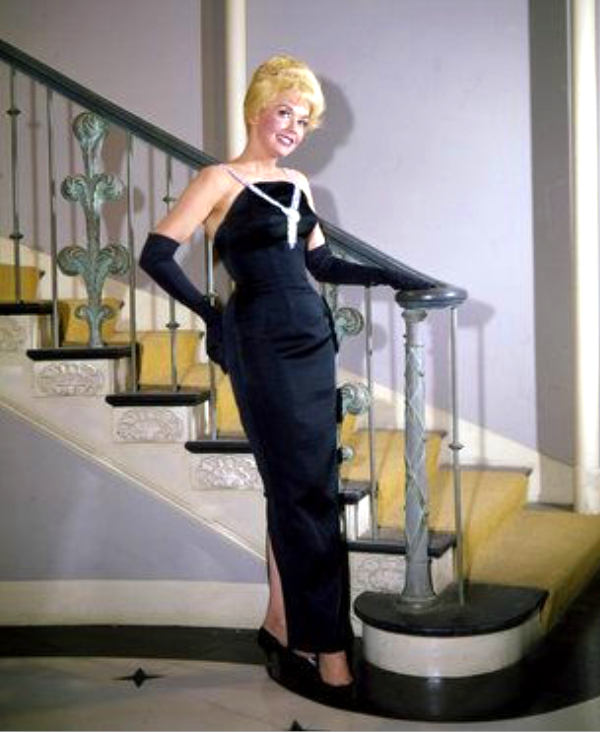
First episode of The Beverly Hillbillies aired this week in 1962, featuring Baton Rouge’s Donna Douglas as the exuberant Ellie Mae Clampett. Douglas was born Doris Ione Smith in Pride and attended St. Gerard Catholic High School. She won both the “Miss Baton Rouge” and “Miss New Orleans” contests in 1957 and moved to New York City to pursue a show business career. She was featured as the “Billboard Girl” on NBC’s The Steve Allen Show in 1959, and parlayed the appearance into television jobs that led New York photographers and newspaper reporters to award her the “Miss By-Line” crown, which she wore on CBS’s The Ed Sullivan Show.