
November 1, 1966
There was a time when you might have heard the name of David F. “Dave” Dixon (picture) spoken so often on All Saints Day that you might have thought he was a saint himself. Or a least a Saint. In the early 1960’s, he sold his successful plywood business and started his new business–bringing a National Football franchise to New Orleans. After cajoling Bears owner George Halas and Colts quarterback Johnny Unitas to bring their teams to Tulane Stadium for an exhibition game in 1963 that was attended by more than 50,000, his work began in earnest. After countless letters and telephone calls to NFL Commissioner Pete Rozelle and every politician above the rank of dogcather, he efforts were finally rewarded on All Saints Day in 1966 when Rozelle stood before a press conference at the Pontchartrain Hotel and announced that a new franchise, to be known as the Saints, would begin play in 1967.

November 1, 1847
Evangeline, A Tale of Acadie, by Henry Wadsworth Longfellow, was published in book form today in 1847 by William D. Ticknor & Co. Over the last 175 years, the poem has become a staple of Louisiana culture. The town of St. Martinville even erected a statue beneath an appropriately majestic live oak tree along Bayou Teche. (There’s also an unfortunate looking bust of Longfellow nearby. See photo.) Same tree? Probably not. Longfellow never visited Louisiana, and his poem doesn’t mention an oak tree. However, in 1907, St. Martinville native Felix Voorhies published Acadian Reminiscences: The True Story of Evangeline. In the judge’s story, Evangeline and Gabriel are replaced by Emmeline and Louis. They have a heartbreaking scene beneath a majestic oack tree next to the bayou. Today, it’s more likely that over the decades, Louisianias have immortalized Emmeline, not Evangeline.

November 2, 2002
At the inaugural Louisiana Book Festival in Baton Rouge today in 2002, James Lee Burke received the 2002 Louisiana Writer Award for his enduring contribution to the “literary intellectual heritage of Louisiana.” Lieutenant-Governor Kathleen Blanco presented the award to Burke, who had been born in Houston and spent most of his childhood along the Texas-Louisiana Gulf Coast. At various times he worked as a truck driver for the U.S. Forest Service, a newspaper reporter, a social worker on Skid Row in Los Angeles, and a land surveyor in Colorado. He taught at five different colleges before getting on the tenure track in creative writing at Wichita State University during the 1980s.

November 2, 1906
In Sicily, November 2nd is observed as “U juornu re muorti”–the Day of the Dead. (In the US, it’s sometimes referred to as All Souls Day.) One of the great traditions of the day is consuming round loaves of bread known as muffulettos. In 1906, Sicilian immigrant Salvatore Lupo began selling sandwiches at his Central Grocery on Decatur Street in New Orleans, using the bread as a foundation for a sandwich featuring cold cuts, cheese and olive salad. Today, Lupo is credited as the creator of the muffuletta, and Central Grocery is still selling them.

November 3, 1970
It wasn’t always this way. Today, Walmart is the largest employer in Louisiana, but today in 1970, the retail giant was opening its twenty-third store and the first in Louisiana in Ruston’s Northpark Mall Shopping Center. The store would remain open until June 21, 1994, when it would be closed and renovated to become the Walmart Supercenter 23. Louisiana’s second Walmart would open in Minden in 1974. As of late 2025, more than 36,000 Louisianians were working at the company’s 137 retail units and two distribution centers in the state.

November 3, 1933
Days after the dedication of the “Long-Allen” bridge over the Red River between Shreveport and Bossier City, several hundred people gathered at the bridge to watch a group of about twenty-five men, including State Representative Rupert Peyton, tear down the sign bearing the names of Huey Long and Governor O. K. Allen. Charges had been filed against ten men, but later dropped for lack of evidence. Long said that it made his public enemies sick to have to look at a bridge with his name on it, “and I’m glad it makes them sick.” Public Safety Commissioner promised that the new steel signs would be practically indestructible.

November 4, 1999
The Block Is Hot, the debut album of 17-year-old rapper Lil Wayne was released this week in 1999. Lil Wayne was born Dwayne Michael Carter Jr. was born in 1982 and spent his first few years in the Hollygrove neighborhood of Uptown New Orleans. He was discovered by hometown rapper Birdman in 1993 and signed with his record label, Cash Money Records, at age eleven. The Block Is Hot debuted at number three on the Billboard 200 and was later certified platinum by the RIAA in December 1999, less than a month after its release. The album earned Carter a 1999 Source magazine nomination for “Best New Artist.” Today, Lil Wayne is often regarded as one of the most influential hip-hop artists of his generation, as well as one of the greatest rappers of all time.

November 4, 1965
Today in 1965, the Louisiana Intracoastal Seaway Association (LISA) proposed a 12-foot levee spanning the Louisiana Gulf Coast from the Pearl River in the east to the Sabine River in the west—as a byproduct of widening and deepening the Intracoastal Canal to a depth of forty feet behind the levee. The New Orleans engineering firm of Waldemar Nelson and Company said that the project would involve moving enough earth to create a levee on the windward side. Governor John McKeithen endorsed the $500 million plan. LISA touted the “unlimited” economic impact of the plan, stating that the Louisiana coastline would become “one big port.”

November 5, 1956
This week in 1956, Bluebery Hill by New Orleans legend Fats Domino peaked at Number 1 on the Billboard R&B chart, and at Number 2 on the Hot 100 chart. The song had been fist performed by Gene Autry in the film The Singing Hill in 1941, and over the decades, it has been covered by “artists” as diverse as Led Zepplin and Vladimir Putin. Antoine “Fats” Domino, Jr., was born in New Orleans in 1928, and five of his records released before 1955 sold over a million copies and were certified as gold
records. He had thirty-five records in the Top 40.
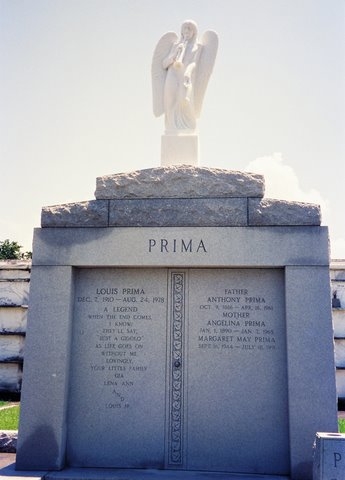
November 5, 1956
The Wildest!, New Orleans native Louis Prima’s “raunchy mix of demented gibberish, blaring sax, and explosive swing, which rocked as hard as anything released at the time.” (And this was one of the GOOD reviews!) was released this week in 1956. His mash-up of “Just a Gigolo/I Ain’t Got Nobody” was the album’s first track. Prima touched on various genres throughout his career-jazz, swing, big band, and jump blues. He performed frequently in Las Vegas and occasionally appeared in films, including a memorable turn as King Louie in Disney’s Jungle Book. (Writers had originally written the role for fellow New Orleanian Louis Armstrong, but Uncle Walt had personally vetoed the idea of Armstrong playing an ape.) At his death in 1978, he was buried in Metairie Cemetery in a gray marble crypt topped by a figure of the Archangel Gabriel with a trumpet (photo). The inscription on the crypt’s door reads: “When the end comes, I know, they’ll say, ‘just a gigolo’ as life goes on without me….”

November 6, 1954
Today in 1954, Elvis Presley recorded the one and only commercial endorsement of his 42-year life. On the Louisiana Hayride radio program, he sang, “You can get them piping hot after 4 p.m., you can get them piping hot, Southern Maid Donuts hits the spot, you can get them piping hot after 4 p.m.” The iconic Southern Maid Donuts began in the Dallas area in 1937 as a flour company that still serves companies nationwide. The first Southern Maid Donut store in Shreveport was opened by Bruce Jones at Texas and Lakeshore in 1941 and, shortly thereafter, moved to its longtime facility at the corner of Greenwood Road and Hearne. This photo-let’s call it “How Flour Becomes a Doughnut”-was apparently inspired by the ever popular “How a Bill Becomes a Law” drawing.

November 6, 1915
The first “State Fair Classic” football games-plural-where played in Shreveport today in 1915. The games were played on the grounds of the Louisiana State Fair, and in one game, a crowd of 20,000–a recond for the Southwest at that time–watched LSU defeat Arkansas. In the second game, Louisiana Industrial (now Louisiana Tech) defeated the Louisiana Normal Demons (now Northwestern State–why would anybody give up a great name like “Louisiana Normal Demons”?), 20-7. These two teams had also played in the first college football game at the state fair in 1911, but at the time, it was just called the “State Fair Game.” For many years to follow, Louisiana Tech and Northwestern State would play in the State Fair Classic on the first weekend in October, but as with many of the good things about college football, money killed that off, too.

November 7, 1944
The original “Black Panthers,” the 761st Tank Battalion saw action for the first time in World War II today, fighting across across France, Belgium, and Germany for 183 consecutive days in 1944-1945, helping break the Siegfried Line and fighting in the Battle of the Bulge as part of General Patton’s Third Army. The”Black Panthers” was the first African American tank unit to enter combat in World War II. The battalion had been activated on April 1, 1942, at Camp Claiborne, Louisiana, utilizing M4 Sherman medium tanks and M5 Stuart light tanks. During their service in the European Theater of Operations, they captured towns like Morville-les-Vic and Tillet, and were among the first American forces to link up with Soviet forces in Austria.

November 7, 1848
Zachary Taylor was elected President of the United States today in 1848. Taylor had been born in Barboursville, Virginia, and received his education through tutors and practical experience. He received an officer’s commission in the army in 1808 and was sent to Louisiana for the first time. Throughout the remainder of his life, he would consider Baton Rouge a permanent home. While he was away with the army, Mrs. Taylor would help to establish the Episcopal chapel, which later became St. James Church. In 1848, he would become the first of three Presidents to be elected to the office without ever holding another political office.

November 8, 2004
Patrick Filburt Taylor, founder and CEO of the independent oil company Taylor Energy Company and creator of the Taylor Opportunity Program for Students (TOPS), passed away this week in New Orleans. Apparently, the Texas native also had a keen interest in statuary. Over the years, Taylor and his wife Phyllis donated to, participated in and supported a statue of Louisiana native John A. Lejeune statue at Annapolis; the “Iron Mike” statue at the National Museum of the Marine Corps in Quantico, Virginia; the “Molly Marine” statue at the National Museum of the Marine Corps and in New Orleans; the John McKeithen Statue at the Superdome in New Orleans; and the Ronald Reagan Statue on the Ronald Reagan Highway in Convington (pictured).
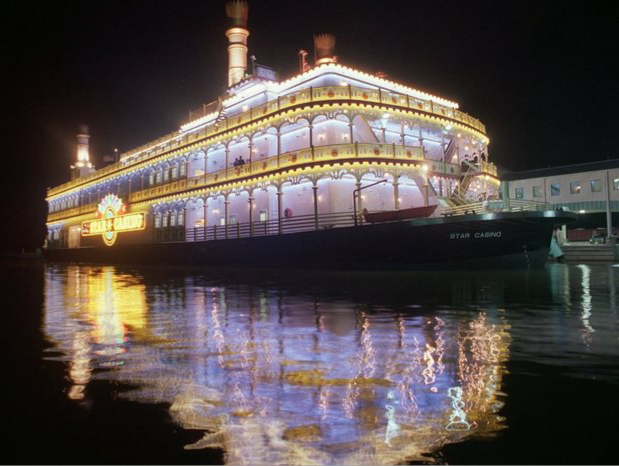
November 8, 1993
The Star Casino on Lake Pontchartrain in New Orleans launched a new era of gaming today in 1993. The legislature had required that the riverboat casinos ply the navigable waters, conducting two-hour cruises away from the dock. Soon, vessel captains throughout the state began to cite weather, tides and water obstacles as impediments to sailing, and state troopers were assigned to see that the laws were enforced.
Eventually, the legislature lifted the requirement that vessels sail in 1996. Boats would be permitted to remain dockside permanently but still had to be on water. But the changes permitted capital reinvestment into new property designs abandoning the traditional riverboat template.

November 9, 1974
Gitchi gitchi, ya-ya da-da! LaBelle’s Lady Marmalade, produced by New Orleans legend Allen Toussaint and recorded at his SeaSaint Studios on Clematis Street was released this week in 1974. It would be the last Number One for Toussaint whose fifty-plus career had also included Java, Mother-in-Law, Working in the Coal Mine, Southern Nights, and Right Place, Wrong Time. Toussaint was born in New Orleans in 1938 and grew up in the Gert Town neighborhood. His first recording was in 1957 as a stand-in for Fats Domino on Domino’s record I Want You to Know, on which Toussaint played piano and Domino overdubbed his vocals.

November 9, 1923
This week in 1923, construction began on the Memorial Tower at LSU. In December 1920, in the wake of the War to End All Wars, the LSU Reveille had published a letter to the editor from physician H. S. Joseph, encouraging the university to create a memorial to fallen soldiers on its new campus in South Baton Rouge. Joseph and others recommended a clock tower, perhaps with chimes. Writer Peter Soderbergh has said that students at the “Ole War Skule” were delighted by the the magnificent simplicity of the design “and chanted, We want chimes!” They got chimes. Schlieder of New Orleans donated eighteen of them, and they were installed in time for the dedication of the new campus on April 30, 1926. Today, Memorial Tower stands as an iconic symbol of the university and its commitment to those who made the ultimate sacrifice for our country.

November 10, 1960
Bon Marche Mall opened in Baton Rouge today in 1960. Rather than rhapsodize about how great Bon Marche was (and it was), let’s remember all the great Louisiana malls we’ve moved on from over the years:
Baton Rouge–Bon Marche Mall (D. H. Holmes, Maison Blanche, Sears); Cortana Mall (Goudchaux’s, Sears, JC Penney); Corporate Square (I. H. Rubenstein, Todd Garland); Kenner–The Esplanade (D. H. Holmes, Maison Blanche)
Marrero —Belle Promenade (D. H. Holmes, JC Penney)
Monroe–(Twin Cities Mall (Montgomery Ward, Selber Brothers);
New Orleans-New Orleans Centre (Lord & Taylor, Macy’s), The Plaza at Lake Forest (D. H. Holmes, Maison-Blanche, Sears)
Shreveport–South Park Mall (Dillards, JC Penney, Montgomery Ward)
Lots of good times….

November 10, 1885
The North, Central and South American Exposition opened today in 1885 on the same site and in most of the same buildings that had been used at the Cotton Centennial World Exposition which had closed six months earlier. The Exposition would run until March 31, 1886, and it encountered difficulties from the start. The weather was very bad, and it was clear that the opening should have been postponed until the spring. A debt of $250,000 had been accumulated by January, and there did not seem much prospect that receipts from admissions at the exposition would suffice to meet it. The site was later redeveloped as Audubon Park.

November 11, 1939
Even the NCAA called it “The Wildest Game in College Football History,” and it still holds more single-game records than any other game in NCAA history (photo). On a Shreveport day when 3.8 inches of rain fell from the sky, the Centenary Gentlemen kicked it off against the Texas Tech Red Raiders… and kicked it…and kicked it. SEVENTY-SEVEN punts. Texas Tech alone would have more than a mile in punting yardage. Here’s how the 77 punts went down–42 were returned (of the ones returned, 14 were fumbled, and six of those were lost); 19 went out of bounds; 10 were downed; one went into the end zone for a touchback; four were blocked, and one was fair caught. The game ended with 30 yards of total offense (31 for Centenary, -1 for Texas Tech) and a 0-0 score. Surprisingly, Centenary would wait eight years after this game to give up football altogether.

November 11, 1977
Today in 1977, Ernest N. “Dutch” Morial was elected to become the first African American mayor in New Orleans. He was born in New Orleans in 1929 and came to prominence as a lawyer fighting to dismantle segregation. After unsuccessful electoral races in 1959 and 1963, he became the first black member of the Louisiana State Legislature since Reconstruction when he was elected in 1967. During his term as Mayor, several major projects, including Canal Place, the Jax Brewery, and the Almonaster-Michoud Industrial District in New Orleans East were started, and Freeport-McMoRan, Pan American Life Insurance, ExxonMobil and others added new towers to the skyline. Morial died in 1989.

November 12, 1812
Today in 1812, Calvary Baptist Church in Bayou Chicot was established. The church’s pastor, Rev. Joseph Willes, became the first Protestant pastor to give a sermon west of the Mississippi River. They called him The Apostle to the Opelousas; however, Joseph Willis lived an intriguing life before he was ordained as the first Baptist preacher west of the Mississippi River and eventually became known as the “Father of the Baptist Religion in Louisiana.” He had been born in 1758, the son of the owner of the Virginia plantation where Joseph and his mother were enslaved. How he was manumitted and how he got to Mississippi by 1798 is unknown, but at that time he crossed into Louisiana and began to preach. Amid trials and persecutions, he preached the gospel in the Opelousas country, alone and unremunerated, expending a little fortune in the effort. In 1812, with the assistance of visiting ministers from Mississippi, he organized a church at Bayou Chicot, the first west of the Mississippi.

November 12, 2001
This week in 2001, In November, the headquarters of the Louisiana Department of Revenue moved into new digs at the LaSalle Building on North Third Street in downtown Baton Rouge. The LaSalle building was one of several mammoth projects announced by Governor Mike Foster in 1999 to consolidate much of Louisiana state government in Baton Rouge into a Capitol Park near the State Capitol Building. Included in the project are the Claiborne Building, which will house the Division of Administration and other agencies, and the Galvez Building, which will house the Department of Environmental Quality. The construction at Capitol Park would fuel the dynamic growth of downtown Baton Rouge.

November 13, 1989
Prominent Chinqupin hairdresser Truvy and her customers, M’Lynn, Weezer and Clairee hit the big screen this weekend in 1989 when Steel Magnolias was released in theaters. The film was adapted from Natchitoches native Robert Harling’s 1987 Off Broadway play of the same name. The story is based on Harling’s experience of the death of his sister, Susan Harling Robinson, in 1985 due to complications from Type 1 diabetes. He changed his sister’s name in the story from Susan to Shelby, and the movie would be filmed in Natchitoches in the summer of 1988 with Dolly Parton, Shirley MacLaine, Julia Roberts and several local residents in the cast.

November 13, 1963
The Storz Broadcasting Company was established today in 1953 by Todd Storz of Lincoln, Nebraska. Storz had created a radio format called “Top 40,” that reached its apex at Storz’s New Orleans station, WTIX-AM. TIX 690 was legendary–and still is. It dominated the airwaves from the 1950s through the 1980s, and was and is known its high-energy, iconic jingles, and “Chime Time,” In addition to providing “the soundtrack of your life” to Louisianians of a certain age, “The Mighty 690” played a key role in bringing African-Americans into the rock and roll culture. In the words of TIX legend Bob Walker, “In the ’50’s when vanilla radio stations around the country were playing dreary and sanitized music like Tutti Frutti by Pat Boone, WTIX was playing it by Little Richard. When others played Earth Angel by the Crew Cuts, we were playing it by the Penguins. They played I Hear You Knocking by Gale Storm while we played it by New Orleans’ own Smiley Lewis. They played I’m Walkin‘ by Ricky Nelson, and we played it by our own Fats Domino!”

November 14, 1947
The first producing offshore oil well out of sight of land was completed today in 1947 in the Gulf of Mexico forty-three miles South of Morgan City. Vessels were needed to provide supplies, equipment, and crew quarters for the drilling site, where the gradually sloping Gulf of Mexico reached only about 18-feet deep at the drilling site. The well was spudded on September 10, 1947. The biggest hurricane of the season arrived a week later with winds of 140 mph. The platform was evacuated during the hurricane, but damage was minimal, and drilling promptly resumed. On November 14th, the Kermac No. 16 well came in at 40 barrels per hour.

November 14, 1947
Stanley Dural, Jr. , beter known as Buckwheat Zydeco, was born in Lafayette today in 1947. An accordionist and zydeco musician. He was one of the few zydeco artists to achieve mainstream success. He was born in Lafayette, one of thirteen children. He acquired his nickname as a youth, because, with his braided hair, he looked like the character Buckwheat from Our Gang/The Little Rascals movies. His father, a farmer, was an accomplished amateur traditional Creole accordion player, but young Dural preferred listening to and playing rhythm and blues.Dural became proficient at the organ and piano as a teenager, and by the late 1950s he was backing Joe Tex, Clarence “Gatemouth” Brown and others on the organ, and Little Richard, Fats Domino, and Ray Charles on piano. When he signed with Atlantic Records in 1992, he became the first zydeco musician ever to sign with a major record label. Between 1985 and 2010, he was nominated for five Grammys and won once.

November 15, 1824
What Louisiana governor would spend the least time in office? P. B. S. Pinchback, at thirty-five days would be a good guess, but the winner is Henry Schuyler Thibodaux at twenty-eight days would be your winner. Thibodaux was born in Albany, New York, in 1769 and came to the Bayou Lafourche district of the Spanish colony of Louisiana in 1790. He would serve in the legislature of the territory, justice of the peace, delegate to
the constitutional convention, state senator and president of the senate before succeeding Thomas B. Robinson as governor today in 1824. In 1838, the town of “Thibodeauxville” in Lafourche Parish would change its name to honor him.

November 15, 1928
From Kingfish: The Reign of Huey P. Long, by Richard D. White, Jr.: “It was lunchtime and a crowd of visitors attending a bottlers convention filled the plush lobby of New Orleans’s Hotel Roosevelt. A group of Orange Crush salesmen were relaxing in the hotel grill after finishing their fried oyster sandwiches when they heard yells and scuffling outside the door. Rushing into the lobby, they were surprised to see an elderly overweight gentleman grappling with a younger man on the marble floor. Many of the onlookers recognized the two men fighting. The older gentleman was J. Y. Sanders, sixtyish and the former governor of the state, and the younger was the red-haired Huey P. Long.” Emerging from a luncheon at the hotel today in 1928, Sanders spotted Long across the lobby and called him a liar. Long rushed the former governor, and the two rolled on the floor before taking the fight into the elevator. Later, both men would claim victory in the fight. Apparently, the only losers were good manners and common sense.