
New Years Day, January 1, 1935
The Tulane Green Wave defeated the Temple Owls, 20-14, in the first Sugar Bowl game at Tulane Stadium in New Orleans today in 1935. The game had been the brainchild of Colonel James M. Thomson, publisher of the New Orleans Item, and Sports Editor Fred Digby. The Mid-Winter Sports Association of New Orleans was formed in 1934 to formulate plans for an annual New Year’s Day football classic. The Association selected Tulane and unbeaten Temple to play in the first game, after considering Columbia and Colgate to represent the East for his proposed football game. 22,206 fans watched Temple take a 14–0 lead before Tulane came back to win.

New Year’s Day, 2025
2025 got off to the worst possible start at 3:15 this morning, when Shamsud-Din Jabar, an American citizen from Texas drives a F-150 pickup truck onto a sidewalk around a police car blockading the Canal Street entrance to Bourbon Street and rams into New Year’s revelers, killing 14 people and injuring dozens of others. He crashes into construction equipment. Police officers shoot and kill Jabbar after he opens fire on them and Bourbon Street crowds. The French Quarter had been packed with revelers who had enjoyed a warm evening. In the ensuing hours, the crime and its aftermath would unfold across the media. The Sugar Bowl football game between Georgia and Notre Dame, scheduled to that evening, was postponed to the following day.

January 2, 1860
Today in 1860, the Louisiana State Seminary and Military Academy in Pineville (pictured) held its first day of classes, after being established by the legislature in 1856. The faculty included Superintendent William T. Sherman, and classes were offered in engineering, chemistry, Latin, Greek, English, and mathematics. Classes would be disrupted the following year after the outbreak of the Civil War and resume in 1865. In 1869, fire ravaged the campus and the school was forced to move “temporarily” to Baton Rouge. One hundred years later, LSU would return to Rapides Parish when LSU-Alexandria registered its first students in 1960. In 2001, LSU-A would begin offering four-year degrees.

January 2, 1869
Today in 1869, the first Louisiana Lottery, created by carpetbaggers for a New York gambling syndicate, sold its first tickets. The notorious enterprise was so corrupt that other state governments pushed for changes in postal regulations to keep the lottery from operating by mail. “The people of all the states are debauched and defrauded . . . by the Louisiana Lottery,” President Benjamin Harrison declared to Congress in a special message July 30, 1880. He asked Congress to “purge the mail of all letters, newspapers and circulars relating to the business.” Congress did.

January 3, 1867
Valcour Aime, a St. James Parish sugar planter who was reputed to be the wealthiest man in the South, died this week after contracting pneumonia while attending a Christmas Mass. His will included title to th campus of Jefferson College in Convent, which had been chartered in 1830 and ceased operation prior to the Civil War. His own son had died of yellow fever, so he donated the campus to the Marist fathers, who opened St. Mary’s Jefferson College which lasted until 1927. The property was sold to the Jesuit fathers in 1931, who have since used the facility for retreats based on the Spiritual Exercises of St. Ignatius Loyola. Today, over 5000 laypersons per year make retreats at Manresa.

January 3, 1959
Dr. Momus Alexander Morgus began his Saturday night broadcasts from the House of Shock in New Orleans today in 1959. During breaks in science fiction and horror movies, Dr. Morgus (New Orleans actor Sid Noel) and his trusty sidekicks Chopsley (Tommy George) frequently conducted ill-considered experiments “guaranteed” to make a vast fortune to satisfy the insatiable back rent demands for of Morgus’s landlady Alma Fetish (Janet Shea). Since the original show went off the air in the late 1980’s, Dr. Morgus has taken time from representing Earth before the “Higher Order”, a super-scientific secret society developing higher intelligences throughout the universe, to revive his television career on various outlets.

January 4, 1853
Today in 1853, Solomon Northup finally gained his freedom from slavery by proving that he had been born a free man of color in New York in 1829. In 1841, he had been kidnapped near Saratoga Springs, New York, and “sold south.” Under the name of Platt, he was enslaved on plantations in Rapides and Avoyelles Parish. After he was released, he returned to Glen Falls where he worked as a carpenter until his death in
1863. His memoirs, published in 1853, were made into the film Twelve Years a Slave, which won the Academy Award for Best Picture in 2014.

January 4, 1994
What a rack! Enormous sets of deer antlers are called “non-typicals” in the hunting world, and these certainly provide evidence of that. James McMurray thought the deer he had just shot had a tangle of vines caught up in his rack. It looked like a bush walking through the Tensas National Forest. It wasn’t until the deer was down, and he was standing over it, that he realized that the vines were actually tines. For those who know about such things, the antlers graded out to a score of 281. Currently, there are over a million white-tail deer in Louisiana, and over 200,000 licensed deer hunters.

January 5, 1815
Today in 1815, Captain Henry Miller Shreve’s steamboat Enterprise entered the Red River, sailing as far as Alexandria. Within a few years of this voyage, Shreve would begin clearing the “Great Raft”, a one-hundred-mile long build-up of fallen trees and other vegetation that had impeded navigation of the Red River for over five hundred years. At the beginning of the 19th century, the Raft extended from Campti in Natchitoches Parish to the area around Shreveport. Shreve concluded this work in 1838, having removed the last impediment to navigation on the Red River. For his efforts, the city of Shreveport was named after him.

January 5, 1973
Louisiana’s eleventh and most recent constitutional convention was called to order by Governor Edwin Edward today in 1973. The state had gone a record fifty-two years since the last constitution had been approved in 1921. During 1973 and early 1974, 132 elected and appointed delegates met to work out the language. The new constitution was approved by the voters on April 20, 1974, and became effective on at midnight on December 31, 1974. The convention was chaired by Louisiana House of Representatives Speaker E. L. “Bubba” Henry and met at Independence Hall (pictured) on North Third Street, current site of the Claiborne State Office Building.

January 6, 2005
The Louisiana peach industry took a hit this week in 2005 when the federal Environmental Protection Agency outlawed the use of methyl bromide to control a wide variety of pests in agriculture and shipping. For decades, the rich farmlands of North Louisiana had been famous for the production of juicy and delicious peaches, prompting their celebration at the annual Ruston Peach Festival. The owner of Mitcham
Farms, the largest producer of Ruston peaches, said that the orchard’s production had dropped 20 percent in the ten years following the ruling. Producing trees were starting to die at an earlier age and fruits from still-productive were much smaller than normal.

January 6, 1830
Today in 1830, the state legislature met in Donaldsonville. While the population of New Orleans in 1830 was around 50,000, it was by far the largest urban area in the state as few other settlements numbered more than 1000. But by 1829, “the rest of the state” had become sufficiently populated that its newly-elected Jacksonian representatives in the state legislature were in a position to push back against the dominance of the Crescent City in state politics. Legislation was enacted to move the capital upriver to the Ascension Parish community, away from the sinister Creole influences of New Orleans. As it turned out, at the end of the second year of meeting in Donaldsonville, legislators decided that they missed New Orleans and returned there the following year.

January 7, 1985
Mer Rouge native Lou Brock was elected to Baseball’s Hall of Fame this week in 1985. Brock had become the all-time major league stolen base leader in 1977, when he broke Ty Cobb’s career record of 892 stolen bases, which had been one of the most durable in baseball history. After finishing high school in Mer Rouge, Brock attended Southern University and tried out for the baseball team to secure an athletic scholarship. In his second year as a Jaguar, he hit for a .500 average. Southern won the NAIA baseball championship during his junior year, and “Sweet Lou” was selected for the 1959 Pan American Games.

January 7, 1982
This week in 1982, New Orleans’ oddest couple, Vic and Natly, made their debut in the old Dixie Roto section of the Times-Picayune. They were the creation of Will Bunn “Bunny” Matthews. Bunny grew up in Airline Park and attended East Jefferson High School. After a stint at LSUNO, he began writing for Figaro, the predecessor of Gambit. “I would go out and eavesdrop on people’s conversations, so I’d hear stuff like, at
Schwegmann’s, and that would be the cartoon.

January 8, 1815
Nobody knew it at the time, but the War of 1812 was already over when the Battle of New Orleans was fought today in 1815. The peace treaty had been signed at Ghent in Belgium on December 24, 1814, but by that time a dangerous British army had already been put ashore in St. Bernard Parish and was working its way to the River Road it would take into the center of New Orleans. An American army, under the command of Andrew Jackson and supplemented by local militia, pirates, free men of color and others erected fortifications near Chalmette and turned away the British.
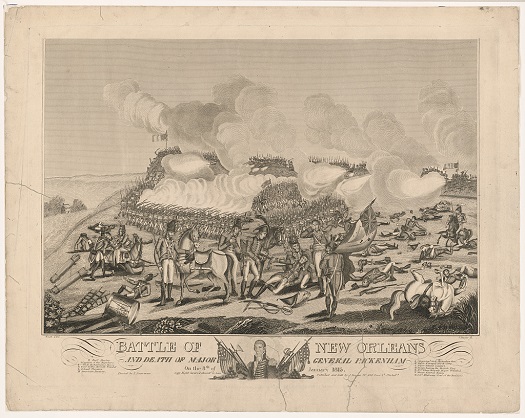
January 8, 1815
They just called it “The Eighth.” The Eighth was a federal holiday in the United States from 1828 until 1861 commemorating the U.S. victory in the Battle of New Orleans in 1815, The Eighth was celebrated widely across the South after the War of 1812. January 8th became an official federal holiday in 1828, following Andrew Jackson’s election as resident and continued as such from that time until the start of the Civil War. As Hallmark Cards, Inc., was not established until 1910, the holiday is now largely forgotten.

January 9, 1867
Lieutenant General John Archer Lejeune, 13th Commandant of the Marine Corps, was born in Pointe Coupee Parish this week in 1867. He earned a B.A. degree at LSU and secured an appointment as a midshipman at the U.S. Naval Academy, from which he was graduated in 1888. During his more than forty years of service with the Corps, he led the famed Second Division (Army) in World War I, and served as Major General Commandant of the Marine Corps from June 1920 to March 1929. Camp Lejeune, North Carolina, now bears his name, and he is often referred to as “the greatest of all Leathernecks.”

January 9, 1840
The cornerstone for Louisiana’s most famous statue was laid today in 1840. Twenty-five years and a day after his most famous battle, former president Andrew Jackson returned to New Orleans to lay the cornerstone in the Place d’Armes as a monument to those who had died in the War of 1812 battle. After Jackson’s death five years later, the Place was renamed Jackson Square in his honor. In 1856, the statue of a horseback-riding Jackson by sculptor Clark Mills was dedicated.

January 10, 1811
The “German Coast Uprising,” the largest revolt of African American slaves prior to the Civil War was finally suppressed by local militia and planters today in 1811. The uprising had originated on the east bank of the Mississippi River in what are now St. John the Baptist and St. Charles Parishes. Between 64 and 125 enslaved men marched from plantations near LaPlace in the direction of New Orleans, collecting 200-500 men
along the way. During their twenty-mile march, the men burned five plantation houses, as well as several sugarhouses, and crops. Two whites and ninety-five blacks were killed in during the course of the two-day march.

January 10, 1942
A month after the bombing of Pearl Harbor, Black soldiers from Camp Claiborne in central Louisiana went to the town of Alexandria on Saturday January 10, 1942, for some R&R. Most of the soldiers were from the North, and on that night, a Black soldier supposedly stepped in front of a car driven by a white woman. The woman called the police, and the shooting started. t was here that, on the night of January 10, 1942, “a white military police officer incited a riot that allegedly resulted in at least 10 and as many as 15 Black soldiers killed and dozens more injured outside of a movie theater in the middle of downtown,

January 11, 1877
This week in 1877, both Democrat Francis T. Nicholls (pictured) and Republican Stephen B. Packard claimed victory in election for governor and were sworn into office. The outcome of the gubernatorial election in November 1876, had been disputed after Nicholls had garnered a majority of 8,000 votes, but the Republican-controlled State Returning Board cited irregularities and declared Packard the winner. The conflict would eventually be resolved as part of the Compromise of 1877. In return for collecting the ten electoral votes needed to elect Republican Rutherford B. Hayes to the Presidency, Hayes recognized the Democrat Nicholls as the winner of the gubernatorial election.

January 11, 1924
James “Slim Harpo” Moore was born in Lobdell today in 1922. on January 11, 1922. He was a self-taught harmonica player and was forced to quit school in the 10th grade after losing both parents. Supporting himself and his family with manual labor, he began to pick up musical gigs and in 1957, he recorded I’m a King Bee under the name “Slim Harpo.” King Bee was a moderate hit, followed by an even bigger hit Raining in My Heart. After Slim’s next two albums bombed, he recorded Scratch my Back which turned into his biggest hit. He died at the Baton Rouge General Hospital on January 31, 1970.

January 12, 2004
Louisiana’s first elected female governor, Kathleen Babineaux Blanco, was sworn into office today in 2004. Blanco had been born in New Iberia, where her grandfather and father had been small businessmen. She attended Mount Carmel Academy and later graduated from the University of Southwestern Louisiana in 1964. Following college, she taught business at Breaux Bridge High School and held several public offices, including a seat in the Louisiana House of Representatives. In 1988, she became the first woman elected to the Louisiana Public Service Commission, and prior to running for governor, she had served as Lieutenant Governor from 1996-2004.

January 12, 1990
This week in 1990, Sylvester Carmouche, 31, was taken into custody phantom fog jockey of the Delta Downs race track, accused of hiding his horse in a fog bank and then rushing to victory. He used heavy fog to hide his horse, Landing Officer, near the top of the stretch for a mile-long race. and remained at that point as eight other horses in the race circled the track, then joined the race as the field approached the final turn. Landing Officer won the race by 24 lengths but later was disqualified because stewards and track officials suspected the horse had not run the entire race. Carmouche was charged with felony theft by fraud and suspended for the remainder of the track’s season.

January 13, 1992
Today in 1992, Melinda Schwegmann was sworn in as Louisiana’s first female lieutenant governor. She was born in Austin, Texas, attended LSU, and completed her bachelor’s degree in education at the University of New Orleans. Her marriage to Public Service Commissioner John F. Schwegmann of Metairie brought her into the worlds of politics and groceries. She served on the Schwegmann Giant Supermarket board of
directors. In the 1991 election, she upset incumbent Republican Lieutenant Governor Paul Hardy by calling herself “a housewife and a nonprofit volunteer.” Some speculated that she benefited from coattails of Democratic gubernatorial candidate Edwin Edwards, who won his fourth term over David Duke.

January 13, 1978
Former U. S. Vice President Hubert Humphrey died in Waverly, Minnesota today in 1978. As a young graduate of the University of Minnesota, he came to Baton Rouge to work toward a master’s degree in political science from Louisiana State University in 1939. Humphrey would later say that his experience shaped his views on civil rights. “Everything you did in Louisiana — study or work — was, in a sense, conditioned by that environment of often corrupt, usually bizarre, southern politics and race relations. Louisiana,” he wrote. “It taught me something about American life that I barely knew in fact or in theory.”

January 14, 1893
Desiree’s Baby, a short story of miscegenation in antebellum Louisiana by Kate Chopin, scandalized America when it was published in Vogue today in 1893. Kate O’Flaherty had been born in St. Louis in 1851, where she attended school before marrying Oscar Chopin and moving to his native New Orleans in 1870 and then to Cloutierville on the Red River near Natchitoches in 1879. From 1889 until 1902, she wrote numerous short stories for children and adults published in magazines such as
the Atlantic Monthly, Vogue, The Century and Harper’s Youth’s Companion. Desirée’s Baby was her best-known work and is still in print.

January 14, 1954
The Acadiana Bicentennial Celebration Association was formed this week in 1954. Celebrations were held throughout the state in 1955, but were centered in St. Martinville. Activities, including publishing a cookbook (pictured) were held to commemorate the expulsion of Acadians from their homeland in Acadia in 1755. They were scattered to many of the Atlantic British colonies as well as some Caribbean islands, France, and Britain. Nearly half of them died during this dispersal. Eventually about 4,000 of them immigrated to Louisiana. While the Acadians were officially banished in 1754, none of the settlers arrived in Louisiana until after the conclusion of the Seven Years War in 1763.

January 15, 1949
Today was moving day for Isabella the Ghost of Northwestern State University in Natchitoches. According to legend, Isabella was a beautiful maiden who lived in the original Bullard mansion on campus. On the eve of her marriage, he was killed in a duel, and she went mad from grief and mourning and plunged a dagger into her heart. Her spirit roamed Bullard mansion, East Hall and the Music Hall until they were torn down. Just before the Music Hall was dismantled, a group of young men, dressed in sheets, coaxed Isabella from the doomed building to her next residence in Caldwell Hall on January 15, 1949.

January 15, 1793
First official marriage in Baton Rouge was recorded today 1793. Don Antonio de Gras and Genevieve Duler of St. John the Baptist Parish. Don Antonio was a native of Majorca, Spain who settled in Baton Rouge in the late 1700s. He was a merchant, shipper, philanthropist, and surveyor. In addition, he amassed significant landholdings in and around the new town. The couple married Baton Rouge’s St. Joseph Catholic Church, which was only fair as he had donated the land on which the church was built. The original name of the church was the Church of the Virgin of Sorrows and later the Church of Our Virgin of Sorrows.