
January 16, 1933
Award winning author Ernest Gaines was born in Ponte Coupee Parish this week in 1933. He was among the fifth generation of his sharecropper family to be born on a plantation that later became the setting and premise for many of his later works. Gaines then spent three years at St. Augustine School, a Catholic school for African Americans in New Roads. At the age of 15, his family left Louisiana in 1948, and in 1956, he published his first short story, The Turtles. Gaines’s works have been taught in college classrooms, translated into dozens of languages and filmed as television and feature films.

January 16, 1817
Over the years, Baton Rougeans have accepted January 16, 1817, as the day that Baton Rouge was incorporated by the State of Louisiana. The truth is that the act passed by the Louisiana Legislature on this day in 1817 did not instruct Governor Jacques Villere or the secretary of state to issue a charter to the town. Instead, it described the method by which Baton Rouge would become an incorporated town—which happened the following year in 1818. Over the years, the act was deemed to be as good as a charter, and the rest was just paperwork. So Happy Birthday, Baton Rouge!

January 17, 2015
Louisiana’s last known living Orphan Train Rider in Louisiana, Alice Kearns Geoffory Bernard, died in Lafayette today in 2015. She was 98 years old and had lived her entire life in Louisiana after being brought to the state in 1919. Between 1854 and 1929, The Children’s Aid Society of New York and The New York Foundling Hospital started collecting resources to help the ever-increasing 250,000 homeless or abandoned children in the city. Believing the children would have a better opportunity to thrive in rural areas, The Orphan Trains brought more than 2,000 children to New Orleans, Morgan City, Lafayette, Opelousas and Mansura.

January 17, 1945
What happened to the ducks? Today in 1945, Major James Brown of the Wildlife and Fisheries Commission called in the Navy and Coast Guard to help look for 35 million missing ducks that had left Canada in October and November and were expected to stop off in Louisiana, to the delight of shooting enthusiasts. According to Brown, “Not five percent remained in Louisiana long enough for the hunter to oil his gun, no one knows where they went. Later, it would be suspected that drought conditions the previous summer and fall had dried up marshes to the extent that the ducks got to Louisiana and just kept going.

January 18, 1823
Today in 1823, one of Louisiana’s smallest parish was created by the legislature when it separated Lafayette Parish from St. Martin Parish. In 1821, Jean Mouton, an early settler in the area, donated land for the construction of a Catholic church, which would become the church parish of St. John the Evangelist of Vermilion. After the creation of the parish in 1823, Mouton made a second land donation to the new community, this time for a courthouse. The settlement of Vermilionville became the new parish’s seat and was renamed Lafayette in 1844 in honor of the Marquis de Lafayette.

January 18, 1962
On January 17, 1962, about 1,000 Southern University students marched to the residence of President F. G. Clark to demand an explanation for why seven students had been expelled in the aftermath of a December protest at the Baton Rouge Courthouse. At the time, he had promised that no expulsions would be forthcoming. At a special convocation the following day, he announced dismissal of the seven student leaders whom he characterized as “vandals and anarchists.” He also announced that the university was closing that same day, that each student would have to apply for re-admission and that none would be allowed to return to class until accepted by the university.

January 19, 1897
The New Orleans Public Library first opened its doors to the public this week in 1897. The system began in 1896 as the Fisk Free and Public Library in a building on Lafayette Square. Abijah Fisk was a merchant who, over fifty years earlier, and left his house at the corner of Iberville and Bourbon Street to the city for use as a library. Subsequent donations had resulted in libraries and collections not completely free and open to the citizenry. An 1896 city ordinance proposed by Mayor John Fitzpatrick combined the Fisk Collection with a new home (pictured here in 1913) that eventually became known as the New Orleans Public Library.

January 19, 1676
Nicolas Chauvin de La Frénière, who established the Opelousas Post in 1720, was born in Montreal today in 1676. During the 17th and 18th centuries, the region between the Mississippi and Sabine rivers was called Opelousas. In 1719, the French Captain Renauld d’Hauterive sent a military exploration team headed by de la Frénière to patrol the area and establish a French presence in the area. “Opelousas Post” became a major trading post and a midway stopping point for travelers between
Natchitoches and New Orleans. Claiming 1720 as its year of founding, Opelousas is Louisiana’s third oldest European settlement, after Natchitoches in 1714 and New Orleans in 1718.

January 20, 2025
Storm Eowyn, also known as the 2025 Gulf Coast blizzard (and frequently referred to as “What the heck was THAT?”) was an unusually strong winter storm and blizzard impacting much of the Gulf Coast of the United States between January 20 and January 22, 2025. This was the first recorded blizzard on the Gulf Coast and the most significant winter storm in the region since 1895. Snow accumulations ranged from 6–12 inches across the coast, and Louisiana recorded its largest single-day snowfall across the state, breaking records that had stood for almost a century.

January 20, 1980
Super Bowl XIV at the Rose Bowl in Pasadena today in 1980, Shreveport native Terry Bradshaw was named Super Bowl MVP for the second year in a row. Bradshaw was born in Shreveport, where he attended Woodlawn High School and led the Knights to the 1965 AAA High School Championship game. After graduation, he attended Louisiana Tech, where most professional scouts considered him to be the most outstanding college football player in the nation. He graduated owning virtually all Louisiana Tech passing records at the time and was drafted by the Steelers. In 1988, he was inducted into the state of Louisiana’s sports hall of fame.
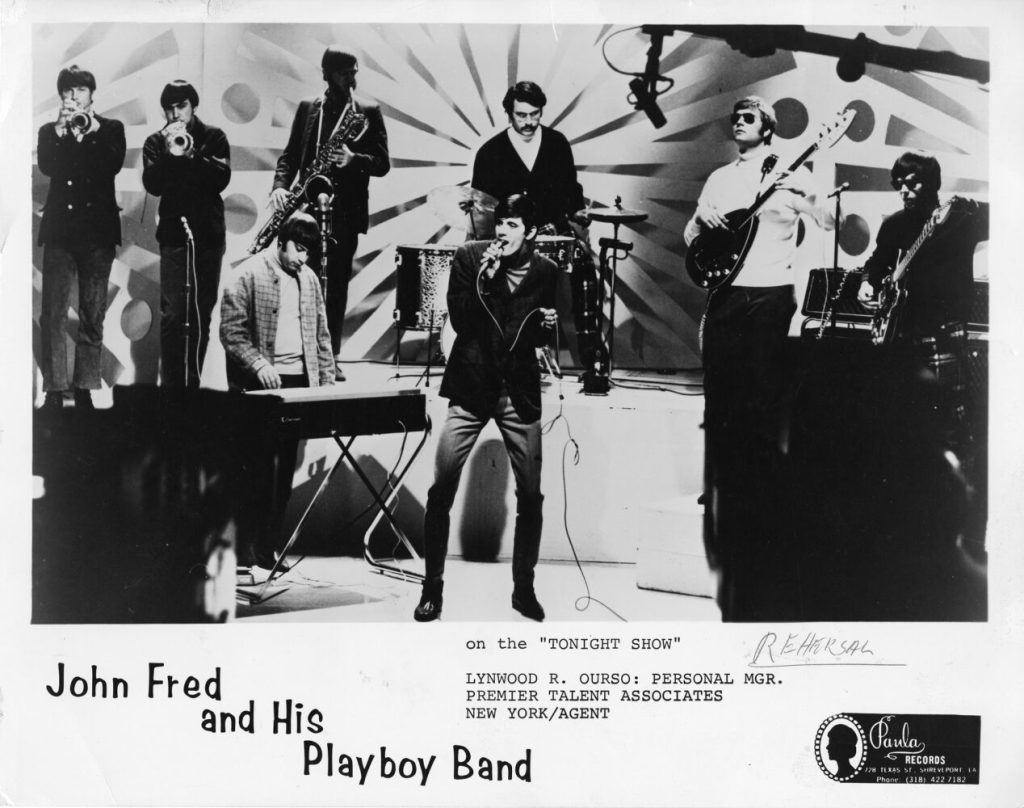
January 21, 1968
Today in 1968, Judy in Disguise (with Glasses) by John Fred and the Playboy Band (pictured) began the first of its two-week stay in the Number 1 slot of the Billboard Top 40 chart. John Fred Gourrier of Baton Rouge formed the band in 1956 when he was 15. Their first hit single was in March 1959’s Shirley. He appeared on Alan Freed’s show, but when Dick Clark asked him to sing on American Bandstand, Fred, who played basketball and baseball at LSU and Southeastern Louisiana University, had to turn him down. He had a game. Fred died in April, 2005.

January 21, 1971
Today in 1971, Dr. Edgar Galloway, Director of the Confederate Memorial Medical Center, finally stopped tilting at windmills and issued a directive to department heads and all hospital personnel permitting female employees to wear pants on the job. His memo set forth standards and policies governing the wearing of pants and specified
details of color, style, and fabric. The issue had emerged in the Shreveport Times when it was noted that the Veterans Administration Hospital and the Medical School had officially sanctioned the wearing of pantsuits. The writer cited an instance when, “Two brave nurses [at CMMC] wore them, were reprimanded and told ‘never again without permission.’”
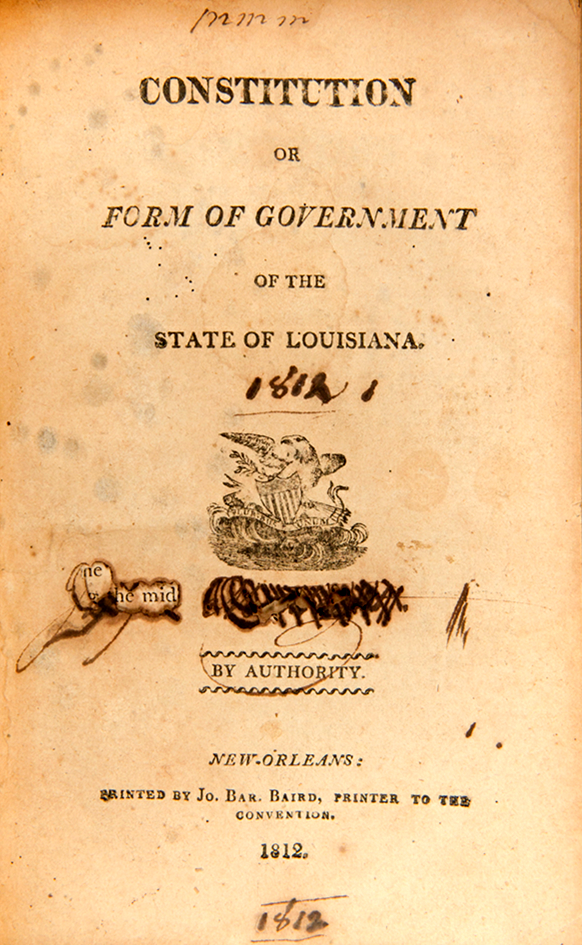
January 22, 1812
Louisiana’s first constitution was enacted by the legislature of the Territory of Orleans today in 1812. W. C. C. Claiborne, governor of the Territory of Orleans in 1811, had called the convention. Based on his earlier experience with developing a constitution for the Commonwealth of Kentucky, he oversaw the development of the document that closely tracked the Kentucky document but differed from it in several areas. The 1812 Constitution was a creature of its time, permitting only wealthy white men who paid taxes could vote. Additionally, candidates for governor would be voted upon, but the legislature would choose from the two who received the most votes.

January 22, 1943
Sherian Grace Cadoria was born in Marksville this week in 1943. Ms.–sorry–Brigadier General Cadoria was the first African-American woman to achieve general officer rank in the regular United States Army on promotion to brigadier general in 1985. She was the highest ranking black woman in the military at the time of her retirement in 1990. Cadoria is a 1961 graduate of Southern University. To other women aspiring to a military career, Cadoria once said, “A woman today has to do more than her male counterpart. Come in knowing that you’re going to have to give two hundred percent effort to get one hundred percent credit. And most of the time you will not get one hundred percent credit.”

January 23, 1849
“Old Rough and Ready,” President Zachary Taylor, had spent his early life in Virginia, Kentucky and Indiana, but as an adult, he considered Baton Rouge to be his home until his election in 1848. While he had been leading an American army in the Mexican American War, his wife Margaret had helped to establish an Episcopal chapel that would become the city’s St. James Episcopal Church. Today in 1849, his Baton Rouge neighbors gathered at his home to wish him well before leaving for Washington the next day to assume his duties as President. He would die in office the following year and never return to Louisiana.

January 23, 1954
Suspicious husbands in Kentwood were watching their wives for signs of waning love this week in 1954, when an ad appeared in the weekly Kentwood News advertising: “For Sale: One husband. Assets: Thirtyish, personable, intelligent, linguist, well-read, ambitious, wonderful father, extremely affectionate. Liabilities: Poor provider. Terms: $75,000 cash.” Newspaper editor Ted Hussar said that there had been no observable fights since the ad was published, but that a lot of husbands weren’t too happy, although the figured it was a joke. “The wife who put it in said she was doing it as a joke,” said Hussar. “But I kinda doubt it. You never know about women.”

January 24, 1805
In 1805, it took an act of Congress (or at least the District of Orleans Legislative Council) to get a divorce. This week in 1805, Louisiana’s first recorded divorce approved by the territorial legislature, signed by C. C. Claiborne, and granted to Captain James and Lydia Stille shortly after Stille had been posted to New Orleans as a captain of artillery. Later that year, James would be sent by Governor Claiborne on “a secret mission Westward.” The act granting the divorces stated that the marriage was fully dissolved and each spouse was “fully authorized” to “contract in matrimony again” whenever “it might feel right.” Divorce would continue to be rare in Louisiana would approve only twenty-four divorces betwee 1805 and 1827.

January 24, 2004
It was a celebration that could only happen in Baton Rouge. This week in 2004, ecstatic LSU and Southern football fans rallied downtown to celebrate LSU’s first BCS Championship over Oklahoma in the Sugar Bowl and Southern’s winning the black national championship with a 20-9 victory of Alabama State in the SWAC Championship Game. Marching bands from both schools performed on the State Capitol steps, coaches and players were presented to the roaring crowd, and coaches Nick Saban and Pete Richardson showed off their trophies. Mayor Bobby Simpson said that 70,000 to 100,000 attended the parade and rally at the ally at Capitol, making it the largest in the city’s history.

January 25, 1837
Today we celebrate the first edition of The Picayune on Wednesday, January 25, 1837. It contained 4 pages, few graphics, and was distributed by two carriers who sold 800 of the 1000 copies that had been printed from the office at No. 38 Gravier Street The following day, January 26, 1837, 2,000 copies were printed and sold. It was the first New Orleans newspaper to sell for less than a dime. A picayune (a Spanish coin) equaled about 6 1/4 cents. George Wilkins Kendall (the writer) and Francis Asbury Lumsden (who handled the business end of this budding business) came to New Orleans in 1835 after working in newspapers in New York and Washington D.C. They sought to reach a broad audience and included lighter news than the other popular newspapers in town. After almost two centuries, the paper announced that it would continue as a newspaper and online news source (http://nola.com) in 2012 (pictured).

January 25, 1962
Federal judges in New Orleans issued a ruling today prohibiting Louisiana officials from enforcing state laws mandating the segregation of bus terminals in Alexandria, Monroe and Shreveport. A similar case concerning Baton Rouge bus and train depots was still in litigation. The judges ruled that segregated facilities violated the 14th amendment to the Constitution and enjoined officials of the Continental Southern Bus Line from taking any measures to segregate facilities. Louisiana Attorney General Jack Gremillion stated afterward that signs segregating the waiting rooms were still posted and that the state would take its case to the United States Supreme Court, but that court refused to hear the case.

January 26, 1861
Following the election of Abraham Lincoln in 1860, a convention of representatives met in Baton Rouge voted 113 to 17 to adopt the Ordinance of Secession, taking Louisiana out of the union. Judge James G. Taliaferro of Catahoula Parish was the most outspoken opponent, warning that secession would bring war, ruin, and decline. Baton Rougeans rushed to the abandoned U. S. Army Garrison on Third Street to run up the Lone Star Flag and the governor called for homes and businesses to put lights in their windows to show their support. On February 4, 1861, the State of Louisiana joined the Confederate States of America.


January 26, 1959
Today in 1959, Mathilda by Cookie and His Cupcakes reached No. 47 on the Billboard Hot 100. Mathilda is recognized as the seminal work of the musical genre known as Swamp Pop. Cookie and His Cupcakes, originally called the Boogie Ramblers, was led by Shelton Dunaway, and included Huey “Cookie” Thierry, Sidney “Hot Rod” Reynaud, Ernest Jacobs, Joe “Blue” Landry, Ivory Jackson (drums) and “Lightning” Mitchell (photo). The band was based in Lake Charles, Louisiana. They followed up with a number of highly regarded but less commercially successful singles in the early 1960s, including Belinda, Betty and Dupree, and Got You on My Mind, which reached the Billboard Hot 100 in May 1963.

January 27, 1730
Today in 1730, French provincial Governor Etienne Perier charged Sieur Jean-Paul LeSeur with the task of tracking down the Natchez Indians who had conducted the Fort Rosalie Massacre in Natchez, Mississippi, on November 28, 1729. The Natchez had destroyed the French settlement, killing nearly all the men and taking hundreds of women and children captive. The Natchez slipped away in the dark of night to the Sicily Island area in present-day Catahoula Parish. In 1731, the French attacked once
again, and members of the tribe went to the Natchitoches area, where many of them were captured in the fall of 1731 and sold into slavery in Saint-Domingue.

January 27, 1960
Today in 1960, the Breaux Bridge Crawfish Festival Association was established. The festival began in 1960 as a spin-off of the Breaux Bridge Centennial Celebration. The Louisiana Legislature had just named Breaux Bridge the Crawfish Capital of the World in 1959. The festival is now known around the country and even the world. Every May, thousands of hungry people flock to Breaux Bridge to celebrate the culture and cuisine of the state’s Cajun and Creole communities. It features crawfish races, live music, and plenty of seafood dishes.

January 28, 1920
The well-intentioned but ill-considered Prohibition Era began today with the ratification of the 18th Amendment to the Constitution, banning the manufacture, transportation, and sale of alcoholic beverages within the United States. Prohibition would become the law of the land this week in January 1920. Theoretically. The law led to interesting consequences in Louisiana. During the thirteen years of Prohibition, octogenarian ladies and teenagers would be arrested for running liquor establishments in the city. The law was tottering toward its eventually repeal in 1933 when Senator Huey Long responded to a question about what was being done to enforce the law. Huey’s reply? “Not a damn thing!”

January 28, 2021
Today in 2021, Olivia Paige Dunne (let’s call her “Livvy”.) made her debut as a collegiate gymnast, scoring what would be a career-high 9.25 on the parallel bars and 9.800 all-around against Centenary in a match at the Maravich Assembly Center. Dunne had been born October 1, 2002, in Westwood, New Jersey. As good as she was in the floor exercises, she’s even better as an influencer. Dunne has been a Sports Illustrated swimsuit model and spokesperson for Vuori athletic wear. Currently, she has a social media following of over ten million.

January 29, 1861
Three days after seceding from the Union, a convention of “The Free and Independent Republic of Louisiana” met at the Lyceum Room on the third floor of the City Hall (now Gallier Hall, pictured) in New Orleans to discuss the course to be followed by the State. Should Louisiana cast her lot in with the Southern States which had already seceded from the Union? They pointed out the serious perils to Louisiana in the event of war, but the leaders paid little heed to this and finally were induced to allow delegates to go to Montgomery uninstructed. The convention named George Williamson as Ambassador of Louisiana to Texas. It also authorized the seizure of the United States Mint and the Customhouse of New Orleans. An official act was passed creating a State Army.

January 29, 1964
Today in 1964, Grand Avenue High School in DeRidder was the site of the highest scoring boys high school basketball game in history, when Grand Avenue beat Cameron Parish’s Audrey Memorial High School by a score of 211 to 29. There is very little available information about the game, but perhaps the score tells you everything you need to know. The game still stands on the list of the biggest blow-outs in sports as the most lopsided high school basketball game. In 2016, Grand Avenue High School alumni and friends gathered at the ‘Match Box’ in DeQuincy to celebrate the
52nd anniversary of the game.

January 30, 1930
Today in 1930, Louisiana’s first state-supported black college system was founded. Southern University had been founded in New Orleans and moved to Baton Rouge in 1914. Southern University was established as a land-grant institution aimed at providing accessible higher education to the African American community. Today, the Southern University System, the only historically black university system in the nation, proudly serves more than 12,000 students annually, consisting of five campuses across the state.

January 30, 1817
St. Martinville was incorporated as Louisiana’s sixth oldest city today in 1817. In the mid-1700’s, Fr. Jean Louis Civrey accompanied Acadian settlers to the Attakapas district and became the first resident curate. In his records, he referred to is new home as “la Nouvelle Acadie”, and his new parish was named “l’Église des Attakapas (Attakapas Church)” and later, “lÉglise St-Martin de Tours (St. Martin de Tours Church).” This is said to be the source of the name St. Martinville. St. Martinville is the parish seat of St. Martin Parish and the home of the world-famous Evangeline Oak.

January 31, 1970
“Busted, down on Bourbon Street. Set up, like a bowling pin.” Those lyrics to the Grateful Dead tune Truckin‘, which appears on the late-1970 album American Beauty, refer to this night in 1970, when members of the group, (including Jerry Garcia in mug shot), its crew and several friends were arrested in a drug raid at a French Quarter hotel. The Dead had just played the first night of a two-night stand to open the now-legendary rock club the Warehouse. Also traveling with, and arrested with, the band was the infamous Augustus Owsley “Bear” Stanley III, known across the American counterculture for cooking up extraordinarily pure and potent LSD — including the substances used at novelist Ken Kesey’s storied Acid Tests. To no one’s surprise, all were released and The Dead played their second scheduled concert the next night.

January 31, 1988
Zachary native Doug Williams was named MVP of Super Bowl XXII today in 1988. Williams attended Cheneyville High School and Grambling State University, where he played for legendary head coach Eddie Robinson. He guided the Tigers to a 36-7 record as a four-year starter and was named Black College Player of the Year twice. He was drafted by the Tampa Bay Buccaneers and led the Bucs to the playoffs three times in four years. Williams was the only starting African-American quarterback in the NFL at that time. Playing for the Washington Redskins in 1988, he led the team to a 42–10 win over the Denver Broncos.