
February 1, 1936
Charlie Chaplin’s classic Modern Times was released this week (2/5) in 1936. In addition to Chaplin as the Tramp, the film also featured a Louisiana favorite–Tabasco Sauce. Tabasco had earlier been seen in an Our Gang movie, but Modern Times would be the iconic elixir’s most famous product placement opportunity to date. Tabasco was first produced in 1868 by Edmund McIlhenny, a Maryland-born former banker who moved to Louisiana around 1840. In the beginning, he used discarded cologne bottles to distribute his sauce to family and friends. When he started selling to the public in 1868, he ordered thousands of new cologne bottles from a New Orleans glass supplier.

February 1, 1944
Today in 1944, Tandy Hannibal Hamilton purchased the small Piccadilly Cafeteria on Third Street in downtown Baton Rouge from the original owner, Thomas J. Costas, for $65,000. Before coming to Baton Rouge, Hamilton and his wife Julia had been living in Kansas City, where he was serving as general manager of a cafeteria chain. Hamilton began building a business in immediately, despite the wartime difficulties imposed by food rationing and equipment shortages. He contacted several friends and associates, some still in the services, encouraging them to join the new operation. Over the course of the next fifty years, Piccadilly Cafeterias, LLC would grow to more than sixty cafeterias in twelve states, including Louisiana locations in Alexandria, Baton Rouge, Covington, Gonzales, Gretna, Lafayette, Metairie, Monroe, and
Shreveport.

February 2, 1874
Rhoda Holly Singleton Mixon died in Tangipahoa this week 1874 and was buried at Tangipahoa Cemetery in the parish of the same name. Other than surviving to the age of 100 at a time when most were lucky to live half so long, perhaps the most markable thing about her life is that she died in the town she’d founded sixty-eight years earlier. Rhoda Holly Singleton had come to Louisiana by wagon train from South Carolina in 1806, Mrs. Mixon purchased six sections of land at the current site of the town of Tangipahoa. She is credited with being the first woman in Louisiana found a community. Tangipahoa would grow, and in 1854, the Illinois Central Railroad would establish rail service to New Orleans and Jackson.

February 2, 1933
Today in 1933, Shreveport-Bossier’s Barksdale Field was named in honor of 2nd Lieutenant Eugene Hoy Barksdale. Lieutenant Barksdale received his wings in Great Britain in 1918 and flew with the British during World War I. He died in 1926 over Dayton, Ohio when testing a Douglas O-2 observation airplane. He was buried with full military honors in Arlington National Cemetery. Bossier Parish had donated land for an airbase in the 1920s. Barksdale Field opened in 1933 and became Barksdale Air Force Base in 1947. Over the years, the base has been home to iconic aircraft such as the B-47 Stratojet and later the B-52 Stratofortress.

February 3, 2012
This weekend in 2012, Madonna was the headliner for the half-time show at Super Bowl XLVI in Indianapolis, but the real entertainers on stage were the Fabulous Dancing Dolls of Southern University who performed with her. The Dancing Dolls have been a mainstay of performances for the Southern University Human Jukebox since 1969, when Isaac Greggs was named band director at Southern. He was adamant that he wanted “a lot of pageantry, excitement, and precision maneuvers.” He also wanted some pretty women to add pizazz to his all-male band. He brought in Gracie Perkins, who was practice teaching at the Southern Lab School, to organize the Dancing Dolls.

February 3, 1913
This week in 1913, New Orleans was first referred to as “The City That Care Forgot” in a nation-wide advertising campaign by the St. Charles Hotel in New Orleans. The phrase has often credited to the 1938 New Orleans City Guide, which connected it to the city’s fame for pleasure seeking. Recently, however, it was noted that the phrase was in wide circulation twenty-five years earlier, occurring most regularly in relation to Mardi Gras. In 1913, anticipating Mardi Gras, a journalist wrote, “the Louisiana metropolis has been called…’The City That Care Forgot,’ and today every aspect will justify that description.”

February 4, 1927
New Orleans’ 4000-seat Saenger Theater opened today in 1927 after three years of construction at a cost of $2.5 million. It would be the flagship of Julian and Abe Saenger’s theater empire and is one a few still in existence. Being New Orleans, there was a parade of thousands formed on Canal Street on opening night. The most expensive tickets could be had for 65 cents. For the cost of admission, patrons were treated to a silent movie, stage play, and music by the Saenger Grand Orchestra. The 2000-pipe theater organ, installed at the theater’s opening, is one of the largest instruments ever built by the Robert Morton Organ Company of Van Nuys, California, and is one of the few Robert Morgan organs in the United States still in the location of its original installation.

February 4, 1883
Rail service between New Orleans and California was established today in 1883 over a series of independent rail lines that would combine in 1885 and become the Southern Pacific Railroad. The portion of the route between San Antonio and Los Angles was called the “Sunset Route” as early as 1874, and eventually the entire route would be called the “Sunset Limited.” It was the second transcontinental railroad route. “The Streamliner with the Southern Accent” was the premier route of the “Espee”, it featured the elegant Audubon Dining car with its striking reproductions and the French Quarter Lounge Car with its white wrought-iron accents.

February 5, 1940
Today in 1940, Jimmie Davis, a native of Beech Springs in Jackson Parish, recorded “You Are My Sunshine” for the Decca record label. The song had been first recorded in August of 1939 by the Pine Ridge Boys of Georgia. “YAMS” would serve as Davis’s campaign song for his successful gubernatorial campaigns in 1944 and 1960. It’s one of the most commercially programmed songs in American popular music and had been covered by so artists representing so may genres that it has lost its original country music cache. In 1941 alone, the song was recorded by Gene Autry, Bing Crosby, Mississippi John Hurt, Wayne King, and Lawrence Welk. In 1977, the legislature would name it as Louisiana’s official state song.

February 5, 1861
Today in 1861, two weeks after Louisiana seceded from the Union, Louisiana Representative John Edward Bouligny made a speech on the floor of the U. S. House of Representatives, declaring his steadfast loyalty to the Union. He would become the only Southern congressman who remained in Washington after his state seceded. He was elected to Congress in 1859 as the only successful Louisiana candidate of the American (Know-Nothing) Party, which was firmly opposed to secession. He would return to New Orleans to stand for reelection after the city was taken by the Union army in 1862 but was defeated. He died in 1864 and was buried in the Congressional cemetery.

February 6, 1933
This week in 1933, the newly opened Barksdale Field in Bossier City was named for Lieutenant Eugene Hoy Barksdale (1896 – 1926), a noted aviator and was a First Lieutenant in the United States Army Air Service and Army Air Corps. Born in Goshen Springs, Mississippi, Barksdale went to England 1917 and received flight training with the Royal Flying Corps. He was posted to No. 41 Squadron RAF, on 31 July 1918, and later became a founding member of the U.S. Army’s 25th Aero Squadron. After the war in 1926, Barksdale was testing a Douglas O-2 observation airplane over Dayton, Ohio, and was unable to recover from a flat spin. He was killed when his parachute caught in the plane’s wing. Today, Barksdale Air Force base is Barksdale is home to the 2nd Bomb Wing, the oldest bomb wing in the U.S. Air Force.
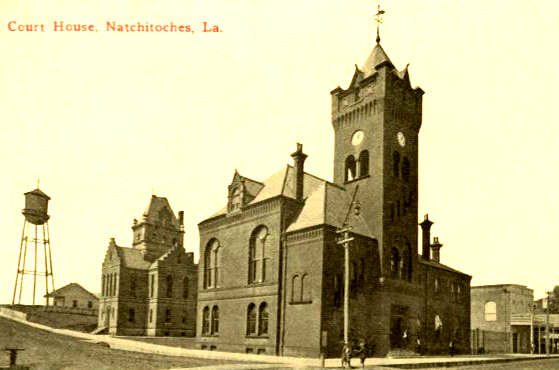
February 6, 1819
The town of Natchitoches was incorporated this week in 1819. French traders had first appeared in the area as early as 1699, and in 1714, Louis Juchereau de St. Denis established the post on the Red River for trade with Spanish-controlled Mexico. Trade and plantation agriculture shaped the city’s early years. The original French settlement lay south of the current town center. As the Louisiana territory became Spanish and eventually American, the town moved north to Front Street. Much of the town’s historic architecture has been preserved. The shifting Red River left Natchitoches behind, protecting it from 20th century development. Natchitoches is the oldest permanently settled community in Louisiana.

February 7, 2026
Happy Sweet Potato Month! The Louisiana Sweet Potato Commission, home of Yamster the Hamster (pictured), says that the most popular Louisiana sweet potato (not really the same thing as a yam, but that’s a conversation for another day), is the Beauregard, which was created at the Louisiana Agricultural Experiment Station in 1987 by Larry Rolston. At the time, the Louisiana sweet potato industry was declining from a lack of varieties that could store well and have resistance to common sweet potato diseases. Beauregard was developed in an effort to combat these widespread issues and became one of the most cultivated varieties, used both for fresh production and commercial processing. Recently the variety has decreased in popularity due to the increased production of the Covington sweet potato which was released in 2009, but Beauregard sweet potatoes are still widely grown throughout the United States.

February 7, 2010
Hell froze over. Pigs flew. Pick a metaphor. Nothing seemed as improbable as the New Orleans Saints winning Super Bowl XLIV over the Indianapolis Colts, 31-17, today in 2010. As impressive as the victory was, it was merely a prelude to the outpouring of joy and relief in New Orleans when it was over. Mayhem was the order of the day in the French Quarter, where the highlight of the madness was a parade of several hundred middle-aged men wearing sequined ball gowns, in honor of the late Saints sportscaster Bernard “Buddy” Diliberto, who had promised to put on a dress if the Saints ever won the Super Bowl.

February 8, 1993
Louisiana State University presented Lady Margaret Thatcher with an honorary degree Monday, almost three years after her ally Ronald Reagan received the same honor. At a special convocation in the Assembly Center attended by about twenty-five hundred people, LSU awarded an honorary doctorate of humane letters to Thatcher, the former prime minister of Great Britain. Thatcher told the crowd that despite the recent fall of communism, the United States, England and other democratic countries cannot relax their guard. “We must not fall into the trap of thinking because communism has collapsed, we’re automatically going to get a successive democracy and successive enterprising economy.”

Ash Wednesday, February 8, 1837
The first Mardi Gras ‘parade’ on Fat Tuesday was held in New Orleans this week in 1837. As the New Orleans Daily Picayune described the scene: “COWBELLION – A lot of masqueraders were parading through our streets yesterday, and excited considerable speculation as to who they were and what upon earth could induce them to turn out in such grotesque and outlandish habiliments. Boys, Negroes, fruit women and what not, followed the procession – shouting and bawling, and apparently highly delighted with the fun, or what is more probable, anxious to fill their pockets with sugar plum, kisses, oranges, &c., which were lavishly bestowed upon them.”

February 9, 2025
Happy Gulf of America Day! In one of his first acts after being inaugurated America’s 47th President, Donald Trump signed an Executive Order stating that the Gulf of Mexico would now be referred to as the Gulf of America and that February 9, 2025, should be designated Gulf of America Day. Will it stick? Who knows. There are lots of examples of different people calling a body of water different things. In the UK, it’s the English Channel; in France, it’s LaManche. Mexicans have already indicated that they’re going along with the idea, and maybe a future president will decide that maybe he or she likes the old name as well.

February 9, 1967
When Mardi Gras was celebrated in Lafayette this week in 1967, a new carnival tradition was born. Master baker and chef Francois Poupart and his wife had immigrated from Bordeaux, France, in the 1960’s and settled in Lafayette, finding themselves at home and frequently speaking their native language with locals. In 1967, the couple founded Poupart’s Bakery and brought a little bit of the old country to their new hometown. Poupart’s is one of the few bakeries to sell a traditional French king cake, or galette de rois, which consists of a layer of thick almond cream
sandwiched between two circular layers of light, flaky puff pastry.

February 10, 1934
Lakefront Airport in New Orleans was dedicated today in 1934. Ten thousand guests turned out for the grand opening of the airport on the New Orleans Lakefront. It was built to be “the Air Hub of the Americas” at a cost of $4.5 million, and was (and is still) considered to be an Art Deco treasure. It was the first major airport in the region and the first combined land and seaplane air terminal in the world. It was named in honor of Abraham Shushan, the president of the Orleans Levee District, who had been instrumental in getting the airport built. In August, 1939, Shushan (pictured at his arrest) and five others were indicted for mail fraud, and it was alleged that Sushan had received $130,500 for his part in extorting exorbitant fees from the government during the construction of the airport. Shushan was convicted today in 1939 and sentenced to thirty months in federal prison on January 2, 1940. Shushan would eventually serve his sentence and be granted a full pardon by President Harry S Truman in 1947. Despite the pardon and the fact that Shushan’s initials were embossed on almost every doorknob and fixture in the building, the legislature still voted to change name to Lakefront Airport. Ironically, Shushan died in 1966–in an airplane crash.

February 10, 1721
The Flute La Baleine anchored at Ship Island, Mississippi in January, 1721, after a ninety-day voyage from France. Parisian prostitutes, who had been rounded up and expelled from the city, were the ship’s primary cargo and they were intended to be married off to French settlers. All such marriages had to be approved by Sister Gertrude of the La Salpetriere Prison, and the first occurred today in 1721. Most of the girls apparently left for New Orleans when the capitol of Louisiana was moved there in 1723. As far as we know, none of the 88 girls were ever charged with a crime in America.

February 11, 1861
Today in 1861, the legislature of the recently seceded state and new Republic of Louisiana adopted their national flag while in session in Baton Rouge, and it was something to see. Its thirteen stripes alternated red and blue stripes with white stripes, and the upper left-hand corner featured a pale yellow star on a red background. Officially, the flag would remain in use until the end of the Civil War, but by the end of 1861, the familiar blue flag with pelican and state motto of “Union, Justice, Confidence” was already put into unofficial use. It would be named the official state flag in 1912.

February 11, 1825
The Louisiana Legislature created Jefferson Parish today in 1825. The Parish originally extended from present day Felicity Street in New Orleans to the St. Charles Parish line. As Orleans Parish grew it annexed from Jefferson Parish such established areas as the Garden District, Lafayette, Jefferson and Carrollton. The present boundary was set in 1874. The parish seat is Gretna, named for named for a small village in Scotland; and the largest unincorporated community is Metaire, it’s
name derived from the French “moitoire”, used to describe a farming relationship where a landowner would lease property for fifty percent of the crops or produce.

February 12, 1910
The Boy Scouts of America were formed this week in 1910, and the first Boy Scout troop west of the Mississippi was founded in 1912 in Lake Charles. BSA Troop 1 of the Calcasieu Area Council was the first troop was led by Scoutmaster Seaman A. Mayo. Today, Troop 1 is Troop 5 of First United Methodist Church of Lake Charles. In March, 1912, Juliette “Daisy” Low would establish the Girl Scouts of America in Savannah, Georgia. The first Louisiana troops would be formed in New Orleans in 1916 and Houma in 1917,

February 12, 1934
NBA Hall of Famer Bill Russell was born in West Monroe today in 1934. William Felton Russell played center for the Boston Celtics from 1956 to 1969. He was the centerpiece of the Celtics dynasty that played for 12 NBA championships and won 11 during his 13-year career. Russell is widely considered to be one of the greatest basketball players of all time. In college, he led the San Francisco Dons, leading them to consecutive NCAA championships in 1955 and 1956. He was a 12-time All Star, and in 1973, he was named coach of the Seattle SuperSonics, the first African-American to coach an NBA team. Shortly after his death in 2022, the NBA retired Russell’s #6 jersey league-wide, making him the only player in NBA history to receive that honor.

Mardi Gras, February 13, 1872
Russia’s Grand Duke Alexei (pictured) visited New Orleans on a visit to America today in 1872. New Orleanians, not to be outdone by foreign royals, created their own sovereign to rule over the city on Mardi Gras. Thus Rex, King of Carnival, appeared for the first time on the streets of the city. Businessman Louis E. E. de la Houssay was the first man to serve as Rex. If Ever I Cease to Love, a quirky tune from the 1870s musical Bluebeard became the official song because it was believed that Alexei was fond of Lydia Thompson, the actress who sang the song in the musical, which was playing in New Orleans at the time of the parade.

February 13, 1899
Today in 1899, Louisiana experienced the coldest day on record. The thermometer would plunge to 16 degrees below zero at Minden-the record for the coldest reading ever taken in the state, and zero degrees or colder was recorded as far south as New Roads. Baton Rouge and New Orleans would record two and seven degrees above zero, respectively, and on the next day, Mardi Gras in New Orleans, the Krewe of Rex Parade was delayed while snow was removed from the route. Later that week, ice floes were seen at the mouth of the Mississippi for the first time in recorded history.

Valentine’s Day, February 14, 2026
Didn’t get roses on Valentine’s Day? Not to worry. A quick trip to the American Rose Garden in Shreveport may be all you need. The Gardens of the American Rose Center, to give the park its full name, is operated by The American Rose Society and has over 20,000 rose bushes of 100 varieties in 65 separate rose gardens on 118 acres of pine forests and woodlands. The gardens have been the home and national headquarters of the American Rose Society since 1974, when the non-profit organization moved from Columbus, Ohio, and before that, from Harrisburg, Pennsylvania. The Society had been founded in 1892 in Harrisburg.

February 14, 1953
Stop me if you’ve heard this before. This week in 1953, the LSU Board of Supervisors voted to approve funding for an addition to the South End Zone at Tiger Stadium–as opposed to building a new campus library. According to an editorial in the Alexandria Daily Town Talk, “Football Beats Reading.” After a rancorous debate, Governor Robert Kennon, an ex-officio member of the board, refused to vote, handing the win to the pro-athletics faction. In the end, LSU Stadium would continue to grow, and the Middleton Library (or whatever they’re calling it now) eventually opened in 1959.

February 15, 1932
96,000 Americans entered the “Why I Like to Buy Groceries at the Piggly-Wiggly” letter-writing contest, but today in 1932, Mr. and Mrs. F. C. Stoops of Park Boulevard in Baton Rouge brought home the bacon and a gift certificate for free groceries with the winning entry. The Stoopses had been residents of Baton Rouge for three years after Mr. Stoops had come to town to take a position at Standard Oil. After opening its first store in 1916, 1932 would be the company’s best year ever, operating 2,660 stores. Five of those stores were in Baton Rouge, including the 1209 North Blvd. location favored by Mr. and Mrs. Stoops.

February 15, 1811
When Congress called the Territory of Orleans to form a Constitution and State Government for Louisiana this week in 1811, the Florida Parishes between the Mississippi and Pearl Rivers were not yet part of the state. In September 1810, American rebels had captured Fort San Carlos in Baton Rouge, effectively ending Spanish rule. The Republic of West Florida was proclaimed but lasted only six weeks until December 10th, when Congress recognized the American Territory of West Florida. Although not originally included in the constitutional call, the West Florida Territory would be incorporated into the state before statehood would be recognized on April 30, 1812.