
August 1, 1934
Today in 1930, Mooringsport native Huddy William Ledbetter, known to posterity as “Leadbelly”, was released from Angola Prison Farm after serving most of his sentence for an attempted homicide conviction. During his sentence he had been “discovered” by folklorists John Lomax and his son Alan Lomax, who had come to the prison and recorded hundreds of his songs on portable aluminum disc recording equipment for the Library of Congress. A prison official later wrote to John Lomax denying that Ledbetter’s singing had anything to do with his release from Angola, but both Ledbetter and the Lomaxes believed that the record they had made had hastened his release from prison.

August 1, 2021
Today in 2021, Give Me Louisiana, which had been one of the state’s two official state songs, was given the boot. The song had shared the honor with You Are My Sunshine since 1978, but in the end, lyrics like “A State of old tradition, of old plantation days. Makes good ole Louisiana the sweetest of all States,” had to go. (Sunshine’s lyrics like, “But if you leave me, To love another, You’ll regret it all some day,” were considered a step up.) It might be fair to say that Louisiana has more of an official State Playlist than a State Song. Legislators have enshrined other “official” tunes over the years, including: the Official State Marching Song, Louisiana My Home Sweet Home; Official Environmental Song, The Gifts of the Earth; Official State Song for the Hurricane Katrina and Hurricane Rita Recovery Effort, Come Back to Louisiana; and the Official State Cultural Song, Southern Nights.

August 2, 2017
Today in 2017, the National Oceanic and Atmospheric Administration (NOAA) announced that 2017’s “dead zone” in the Gulf of Mexico was the largest on record at 8776 square miles, roughly the size of the State of New Jersey. It was and is the largest measured since dead zone mapping began in 1985. The dead zone is a recurring summer hypoxic (low-oxygen) area along the Texas-Louisiana coast, caused by excess nutrient pollution, mainly nitrogen and phosphorus, discharged from the Mississippi River. By restricting access to oxygen on the floor of the Gulf, it kills or forces out marine life, creating a “dead” seafloor area often covering thousands of square miles.

August 2, 1967
From the Associated Press today in 1967: “It could have only have happened in the same town where Disneyland is located. The ballpark is called Anaheim Stadium. They should rename it Fantasyland. The infant New Orleans Saints, playing their first game as a member of the National Football League, came within a dropped pass (twice) of a victory over the Los Angeles Rams. No NFL expansion team has come so close in its initial outing.” The Saints lost to the Rams, 16-7, in their first pre-season game, and would go on to lose their second pre-season against Dallas at Shreveport, and the third against Pittsburgh at Baton Rouge.

August 3, 1975
“Welcome to the Future” read the enormous message boards of the Louisiana Superdome as it was dedicated and opened to the public for the first time today in 1975. Governor Edwin Edwards reminded the crowd of 45,000 who had come to walk on the new field and sit in the new chairs that, “Louisiana money, Louisiana planning and Louisiana workmen made this possible. Let’s not forget that.” The music for the grand opening was provided by Al Hirt and Pete Fountain and their bands, the Centenary College Choir, the New Orleans Summer Pops Orchestra, Sheriff Adler LeDoux’s Blockbusters and the Southern University Marching Band.

August 3, 1879
The eighth steamboat Natchez was launched in Cincinnati this week in 1879. (Natchez Number 7 had been immortalized in the Currier and Ives print of its race with the steamboat Robert E. Lee. The current Natchez in Number 9.) Number 8 had 47 elegant staterooms. Camp scenes of Natchez Indians wardancing and sunworshipping ornamented the fore and aft panels of the main cabin, which also had stained glass windows depicting Native Americans.By 1887 lack of business had stymied the Natchez, so in 1888 she was renovated back to perfect condition for $6000. In January 1889 she burned at Lake Providence, Louisiana. Jefferson Davis sent a letter of condolences on January 5, 1889, to Leathers over the loss of the boat. Much of the cabin was salvageable, but the hull had broken up due to sand washing within.
August 4, 1901
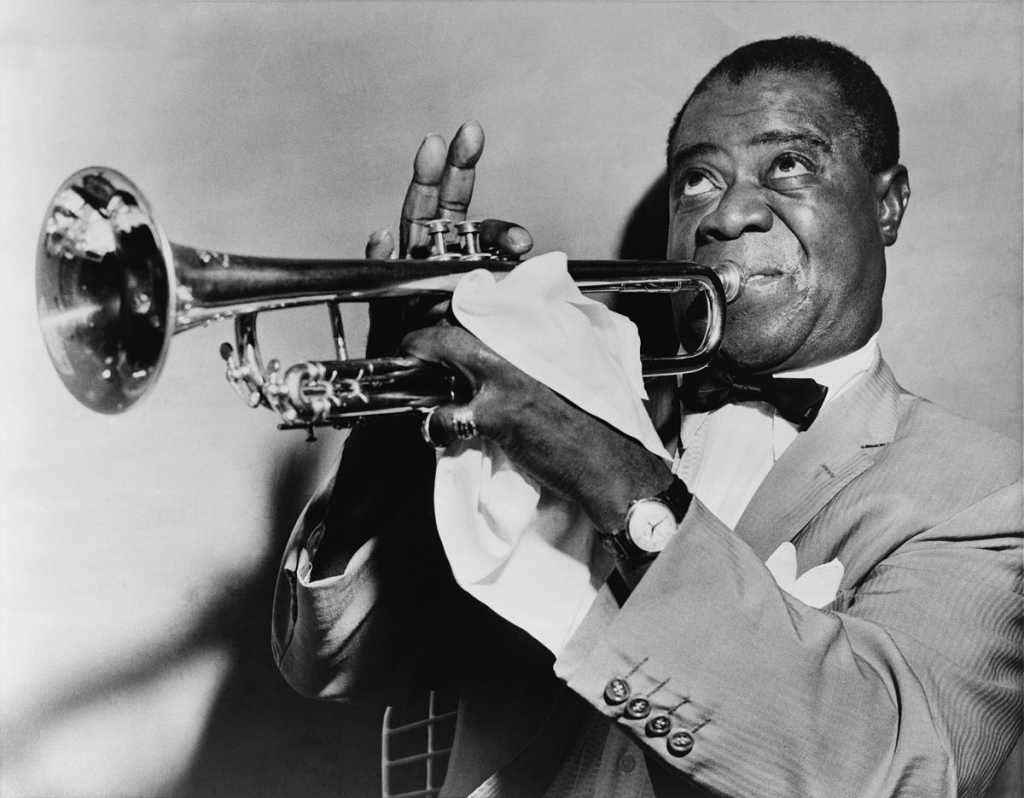
Despite his claims that he was born on the Fourth of July, New Orleans legend Louis Armstrong was actually born today in 1901. Armstrong was born into a poor family in New Orleans and was the grandson of slaves. He spent his youth in poverty, in a rough neighborhood known as the Battlefield, part of the Storyville legal prostitution district. He attended the Fisk School for Boys, where he most likely had early exposure to music. For extra money he also hauled coal to Storyville, and listened to the bands playing in the brothels and dance halls, especially Pete Lala’s, where Joe “King” Oliver would drop in to jam.

August 4, 1939
Today in 1939, Mrs. Josephine Gonzalez of 1123 Thalia Street in New Orleans, went to the beauty parlor and got a perm. (But wait! There’s more!) Mrs. Gonzalez, age 104, was making her first visit to such an establishment. The permanent was a combination croquignole and spiral, the hairdresser, Mrs. Edna Kappes, said the next day in a front page article in the Times-Picayune (photo). When Mrs. Kappes had worked her magic, Mrs. Gonzalez’s daughter cried, “Well, I declare, Ma. You look chipper as all get out!” In response, Mrs. Gonzalez replied that she hadn’t been this happy since her “husband turned up safe and sound from a Yankee prison camp 75 years ago.”

August 5, 1901
This week in 1901, Charles P. Adams arrived in Louisiana to open the school that would become Grambling State University. In the late 1890’s, the North Louisiana Colored Agricultural Relief Association was organized and purchased twenty-three acres of land for a two-story school building. The association wrote to Booker T. Washington for assistance in organizing an industrial school. The answer to their appeal arrived in the person of Charles P. Adams. Early in September, he took over the construction of the building that had been started by the association, and on November 1st, the Colored Industrial and Agricultural School opened with three teachers and 125 students.

August 5, 1862
Baton Rouge had been the first Southern state capital to fall when General Thomas Williams unloaded his army at the town at the end of May. By the morning of August 5th, the Confederates under General John C. Pemberton had marched from Camp Moore in Tangipahoa Parish to the outskirts of the city which were at the time in the area around 22nd Street. Each side had fought with about fifteen hundred soldiers and each side lost about four hundred killed and wounded, including General Williams, who was shot off his horse near Florida and Fourth Street. It was called a draw, but the Confederates were compelled to withdraw.

August 6, 1948
Today at the London Olympics of 1948, 22-year-old New Orleans native Audrey “Mickey” Patterson won an Olympic bronze medal, covering the 200 meters in 25.2 seconds, the same time as Shirley Strickland of Australia. It took officials 45 minutes to decide that Miss Patterson would get the bronze medal; Strickland was placed fourth. Fanny Blankers-Koen of the Netherlands, considered the greatest female Olympian of her time, won the race, earning her third gold medal of the 1948 games. In receiving the bronze medal, Patterson is distinguished as the United States’ first African-American woman to win an Olympic medal. She is seen in the photo at the White House where President Harry Truman congratulated her after returning from London.

August 6, 1926
Today in 1926, Louisiana’s second 50,000-watt radio station (after WWL-AM in New Orleans), WKWH, signed on to the air for the first time. The station was founded by W. K. Henderson (hence the call letters), a native of Bastrop and owner of Henderson Iron Works and Supply Company. Henderson signed KWKH on the air from his country estate at Kennonwood, north of Shreveport, and quickly developed a celebrated on-air persona amongst the station’s listenership and a notorious reputation with government regulators. He often ran afoul of the Federal Radio Commission with profanity-laced rants against chain stores and the government. He initially enjoyed the patronage of Governor Huey P. Long Jr., but ultimately, the outspoken Henderson lost Long’s support and his radio license as well. On May 28, 1935, the Federal Communications Commission approved transfer of ownership of KWKH to the Times Publishing Company Ltd. of Shreveport.

August 7, 1943
Today in 1943, Delta Airlines filed an application to fly from New Orleans to Meridian, Mississippi (via Hattiesburg). Delta had begun in __, operating a route that connected Charleston, South Carolina, to Dallas and Fort Worth, via Savannah, Augusta, Atlanta, Birmingham, Meridian, Jackson, Monroe, Shreveport, and Tyler, Texas. At the request of the Department of Defense earlier in 1943, Delta had connected to the route with a flight from New Orleans to Shreveport, via Baton Rouge and Alexandria. Founded by C.E. Woolman, Delta had begun passenger flights in 1929, connecting Dallas to Jackson, MS, with stops in Shreveport and Monroe.

August 7, 1927
Governor Edwin Edwards, the fiftieth man to serve as Louisiana’s governor was born in Marksville today in 1927. His four terms in office (1972-1980, 1984-1988, 1992-1996) would be twice as many elected terms as any other Louisiana chief executive, and his 5,784 days in office would make him the sixth longest serving state governor in American history. A colorful, powerful and legendary figure, Edwards would wield power in a way not seen in the state since the 1930’s. While he had been longed been accused of corruption, it would be 2001, five years after leaving office for the last time, that he would be found guilty of racketeering charges.

August 8, 2008
According to Lighthouse Digest, “Just after dusk on August 8, 2008, cannon fire and fireworks reawakened the Town of Madisonville to a wonderful chapter in its maritime history. On that balmy summer night a community celebrated a 171-year connection to a long and dynamic history and over two hundred years of navigation, commerce, and culture….In belated celebration of National Lighthouse Day, the 140th anniversary of the tower, Fenner’s Battery of Slidell, Louisiana, a group of Civil War reenactors, brought two artillery pieces with which they helped start the fireworks display in honor of the Union” gunboats that had brought the old tower down in 1864. The lighthouse had been built in 1837 to guide vessels from New Orleans and elsewhere into the Tchfuncte River. After the war, the lighthouse was rebuilt. The station was reached by a road for the first time in the 1920s and was electrified in 1935. The first telephone was installed in 1927, with keeper Schrieber agreeing to pay the costs for monthly service so that his family-including eight children — could have better communications with town.

August 8, 1956
Records of the federal bureau of internal revenue were released today in 1956 demonstrating that more gambling stamps have been issued to residents of Jefferson Parish than to those of the state’s other sixty-three parishes combined. Of the 112 gambling stamps issued in the state, 58 were issued to individuals with mailing addresses in Jefferson Parish. In addition to legal stamp-holders, Jefferson Parish had been the epicenter of gambling in the state since the days of the Lafitte brothers at Grand Isle. Parish history featured ornate but illegal casinos like the Southport Club in Old Jefferson and the Beverly (pictured), which opened in the 1940s and welcomed customers wearing coats and ties.

August 9, 1940
The Huey Long Bridge at Baton Rouge opened to traffic this week in 1940. Pictured here under construction, the bridge was the second bridge across the river to be completed in Louisiana, after the Huey Long Bridge in Jefferson Parish in 1935. Due to the low height of the bridge, Baton Rouge is the furthest inland port on the Mississippi River that can accommodate ocean-going tankers and cargo carriers. The bridge has been repainted several times since its construction, including in the mid-1960s when the bridge was repainted orange; this was done to match the color of dust being emitted by the Kaiser Aluminum plant on the southeast bank of the river, which continually coated the bridge with aluminum oxide (bauxite) dust.[5It was the only span across the river at Baton Rouge until the completion of the Horace Wilkinson I-10 Bridge in 1968.

August 9, 1944
They called it “R-Day”. Seriously. The Young Men’s Business Club (YMBC) of New Orleans had started planning Rat Eradication Day long before the Normandy Invasion in June, but as the big day, August 9th, approached, they were inspired by the success of the landings. Mrs. Alidore Terrebonne, age 74 of 1122 Jackson Avenue, was the first of 100,000 New Orleans housewives to sign the pledge to clean up sidewalks, keep garbage cans covered, save scrap paper and report unsanitary conditions. The pledges would be circulated by the War Block Service of the Office of Civilian Defense, and “block leaders” would be responsible for contacting the housewives in their neighborhoods.

August 10, 1856
They danced, carefree, in the resort hotel’s ballroom, hundreds of men and women from New Orleans and across Louisiana, stepping through a quadrille contredanse to the music of an old German fiddler. Now and then, they felt a tremor in the floor, as wind and rain battered the hotel in ever-stronger gusts. The memory of the fiddler’s music would be tinged with melancholy for one of the ball-goers—by the next night, half of the dancers would be dead. – Smithsonian Magazine. The Isle Derniere devastated the Terrebonne Parish barrier island today in 1856. Wealthy Louisianans had built more than 100 summer homes on the island, and visitors to Muggah’s Hotel, the largest structure on the island, could partake in dancing, bowling, and billiards. About 200 perished and a similar number survived the storm. Isle Derniere (Last Island) was never inhabited again.

August 10, 1936
The highest temperature in Louisiana was recorded in Plain Dealing today in 1936, when the mercury hit 114°. On the same day, Shreveport would record 109°; Baton Rouge, 94°, and New Orleans, 94°. The Summer 1936 North American heat wave was one of the most severe heat waves in modern history. In the middle of the Great Depression and the Dust Bowl, the nationwide death toll would eventually exceed 5,000, and huge numbers of crops would be destroyed. In addition to Louisiana, Texas, Oklahoma, Kansas, Arkansas, Minnesota, Michigan, North Dakota, South Dakota, Pennsylvania, Nebraska, Wisconsin, West Virginia, and New Jersey would also experience record high temperatures.

August 11, 2008
Fort Proctor near Shell Beach in St. Bernard Parish was added to the National Register of Historic Places in 2008. Also known as Fort Beauregard or Beauregard’s Castle, the fort stands on the shore of Lake Borgne just north of the mouth of Bayou Yscloskey. When it was built in the 1850s, it was intended to be part of the fortifications protecting water routes towards New Orleans. Due to delays caused by hurricane damage and then the outbreak of the Civil War, the fort was never garrisoned. By the end of war, improvements in artillery had made the design of the fort obsolete.

August 11, 1862
This week in 1862, the U.S. gunboat Essex shelled the West Feliciana town of Bayou Sara while a small landing party set it ablaze. It could be said that Bayou Sara never had much of a chance. The French had established settlement there, Riviere a la Chaude pissie, or “river of hot urine” perhaps due to its color and flow. Also colloquial for gonorrhea, Chaudepissie became Clap Creek under the British in the 1760s. The Spanish laid out a town they would call New Valencia, but those plans never materialized. Things wee looking up when the West Feliciana Railroad, Louisiana’s first, established its terminusin the town in 1842. After the Civil War burning, the town languished until it was finally washed away for good in the Great 1927 flood. The few buildings were left were incorporated into St. Francisville.

August 12, 1975
Today in 1975, Catholic Church officials in New Orleans complained that funerals were being disrupted by striking gravediggers in the city and appealed to them to end their ten-day-old strike in the city. “It is sad that a bereaved family should have their grief intensified by such an experience,” said Rev. Raymond Weggman, cemeteries director for the Catholic diocese. Striking workers had delayed funerals in the city’s above-ground cemeteries, protesting unbearable working conditions and low pay that they wanted increased to $6.00 per hour from $2.30. The strike would be a bust, and all nineteen striking gravediggers would be replaced by All Saints Day.

August 12, 2016
It didn’t have a name, but it felt like a hurricane. Today in 2016, a flash flood emergency was issued for areas along the Amite and Comite rivers near Baton Rouge. By August 15, those rivers and others had reached a moderate, major, or record flood stage. The Amite River at Denham Springs crested at nearly five feet above its previous record, and nearly one-third of all homes—approximately 15,000 structures—in Ascension Parish were flooded after a levee along the Amite River was overtopped. 75 percent of the homes in Livingston Parish were a “total loss,” and over 146,000 homes in the Baton Rouge area were damaged.

August 13, 2016
There’s not a lot about sno-balls thare isn’t contentious. According to a lawsuit filed this week in 2016, it was acknowledged that snow cones “originated in Texas and are the invention of Samuel “King Sammie” Bert who first sold the treats at the 1919 Texas State Fair. Sno-balls, although often associated with New Orleans, were first made in Baltimore from the shavings left over on ice shipments moving from New England to the American South. (As Baltimore sno-balls were usually drenched in egg cream or marshmallows, it’s hard to take the seriously, but I digress.) In 1934, Ernest Hansen built the first-ever “Sno-Bliz,” a block-ice shaving machine that modernized the growing industry of corner sno-ball stands. Two years later, New Orleans grocer George Ortolano (photo) developed and patented the SnoWizard, a product that also produced delicate, snow-like flakes of ice. Over the years, there have been lots of contentious claims about “who-did-what-when,” but on a hot day in August, we can just be thankful that we have them.

August 13, 1968
Today in 1968, The Times-Picayune reported that the first day of Community Bargain Days had been a rousing success despite persistent showers across the city. The paper had reported that a “multitude” of shoppers had taken advantage of “bargains galore” on the first day of the annual event. Sponsored by the Retail Merchants Bureau of the Chamber of Commerce of the New Orleans Region, featured slashed prices on clothing, school and home. To handle shopping throngs, stores added extra sales personnel, New Orleans Public Service, Inc., added more streetcars and busses, and parking lots geared themselves for the maximum.

August 14, 1865
The first weekly issue of the Thibodaux Sentinel after the Civil War appeared this week in 1865. The paper had been founded in 1861 but was put out of business during the war. In August 1865, the journal was revived by former Confederate soldier Pierre Ernest Lorio and François Sancan, a native of France who had emigrated to Louisiana and worked as a portrait painter and photographer. Issued weekly in four pages with two in French and two in English, the Sentinel’s motto was “Independent in all things—neutral in none” / Independant en tout. Neutre en rien. The paper would struggle and eventually succumb in 1912.

August 14, 1789
Today in 1789,The signal to begin the Haitian revolution was given by Dutty Boukman, a leader of the Maroon slaves on the island. That bloody revolution brought hundreds of French refugees and thousands of their slaves to Louisiana. They in turn are said to have brought red beans and rice to the colony. Red beans and rice is one of the few New Orleans dishes to be commonly served both in people’s homes and in restaurants. Restaurants and schools routinely serve it as a Monday lunch or dinner special. While Monday washdays are largely historical, red beans remain a staple for large gatherings. New Orleanian musician Louis Armstrong’s favorite food was red beans and rice, and he would sign letters “Red Beans and Ricely Yours, Louis Armstrong”.

August 15, 1988
It was a grand old party at the Superdome today in 1988 as the Republican National Convention kicked off its four-day run in New Orleans. Much of the credit for bringing the convention to Louisiana was given to Louisiana Republican National Committeewoman Virginia Martinez of New Orleans, who lobbied on behalf of her adopted home city as a member of the RNC Executive Committee. The convention would nominate George H. W. Bush for President and Dan Quayle for Vice President, but the highlight of the festivities would be the farewell address of outgoing President Ronald Reagan. Other speakers included Joe Paterno, Pat Robertson and a New Jersey Governor Thomas Kean.

August 15, 1945
Today was VJ Day in Louisiana and throughout the Free World in 1945. While some were celebrating memorably in Tokyo Bay (photo), thousands of Louisianians were also celebrating with horns and confetti in towns and cities throughout the state. Many others celebrated by going to the service stations. Gasoline rationing had finally come to an end and motorists were at last free to shout, “Fill ‘er up!” And they did. Herbert Wimberly, owner of the Auto Hotel on Convention Street in Baton Rouge, said that he sold six thousand gallons that day after averaging about one thousand gallons per day during the war.