
August 16, 1963
Nobody paid much attention at the time, but the image of Lee Harvey Oswald distributing leaflets urging “Fair Play for Cuba” on Magazine Street in New Orleans today in 1963 would challenge investigators for the next fifty years. On May 26, 1963, Oswald wrote to the Fair Play for Cuba Committee and proposed “renting a small office at my own expense for the purpose of forming a FPCC branch here in New Orleans.” Three months later, Oswald would be filmed distributing a thousand copies of a handbill from a local printer. Neither Oswald’s motives or why anyone
would think to film him was ever fully explained.

August 16, 1931
When today was declared to be Louis Armstrong Day in New Orleans in 1931, one of the day’s highlights would be a baseball game between the “Armstrong Secret Nine” and the “Melpomine White Sox at St. Raymond Park. During the Jazz Age, the popularity of baseball made for an attractive medium used by American entertainers and public figures for self promotion. Both softball and baseball teams were formed by big name bands led by Benny Goodman, Count Basie, Harry James, Tommy Dorsey, and Louis Armstrong. Armstrong, an avid baseball fan and New Orleans native, sponsored a New Orleans–based team called the Raggedy 9. The name was inspired by the poor quality of their uniforms. Under his sponsorship, they would become the Armstrong Secret 9. While more than 1500 fans had turned out for Louis Armstrong Day, the Secret 9 kept their secret too well and only played one season. In this photo, a member of the team is conducting a workshop for youths.

August 17, 1885
There would still be a Lafayette without Maurice Heymann, but you probably wouldn’t recognize it. Born today in New Orleans today in 1885, the namesake of the Heymann Oil Center, Heymann Performing Arts Center, Heymann Recreation Center, and other community resources, left his mark on the city and the state. He moved to Lafayette in 1916 and was credited with opening the city’s first department store. When the store started selling food, it was considered the city’s first grocery store. Even though he was Jewish, he is considered to be the Father on Mardi Gras in Lafayette because he thought it would be good for the city. When he needed a home for his family, he hired an unknown named Hays Town–and started a architectural movement that is prominent throughout the state to this day. Recently, a conversation in Lafayatte was begun about how the future of the city, the underlying question was, “What would Maurice Heymann do?”

August 17, 1769
In 1768, Spanish Governor Antonio de Ulloa had tried to take the reins of power in New Orleans following the Treaty of Paris, but French settlers had refused to recognize him and expelled him from the colony. Today in August 1769, his replacement, Don Alejandro O’Reilly (pictured) arrived in New Orleans to show the French settlers who was boss. The Irish-born don would quickly earn the name “Bloody O’Reilly,” executing six prominent rebel French colonists in the first two months and exiling others to life imprisonment in the Morro Castle in Havana. Having crushed the rebellion, he concentrated on organizing Louisiana’s administration and on stabilizing the food supply

August 18, 1894
Coozan Dudley LeBlanc was born in Youngsville this week in 1894. He was a four-term state senator, the “father of the old age pension” in Louisiana, a French culture warrior and a Cajun Renaissance man, but he would be remembered forever as the entrepreneur of the patent medicine he called “HADACOL” because he “had to call” it something. Le Blanc devised never-before-seen marketing techniques to sell the medicine techniques never before seen in America, and HADACOL became a best-selling patent medicine throughout the United States. As a candidate for office, LeBlanc often campaigned in French, attacking opponents in a language that most of them could not understand.

August 18, 1920
Today in 1920, the Tennessee legislature adopted the 19th Amendment to the U. S. Constitution, the 36th state to do so, and women’s suffrage became law and women became voters. (No thanks to Louisiana, where the 19th amendment would not be adopted until June 11, 1970–fifty years later!) Louisianians celebrated the way Louisianians always celebrate something big—by driving around town and honking horns. In Baton Rouge, a large rally was held in front of City Hall, and the effects of the amendment were almost immediately evident in Baton Rouge, where women were instrumental in the success of the first female candidate for sheriff, Eudora S. Day, in 1928.

August 19, 1873
Ernest John (E. J.) Bellocq, who chronicled the prositutes of Storyville in the early 1900’s,was born in New Orleans today in 1873. In early life, he made his living mostly by taking photographic records of landmarks and of ships and machinery for local companies. However, he also took personal photographs of the hidden side of local life, notably the opium dens in Chinatown and the prostitutes of Storyville. (See picture.) His photographs have inspired novels, poems, and films, including 1977’s Pretty Baby, which was the film debut of a teen-age Brook Shields.

August 19, 1888
The Association of Northern Settlers held its first convention in New Orleans this month in 1888. When Sylvester L. Cary came south in the early 1880s to escape the frozen Iowa winter, he knew he was home when the train reached Jennings. Almost immediately, “Father Cary” was staking a land claim. He soon became the station agent for Southern Pacific Railroad and began writing letters home to Iowa promoting settlement around Jennings. Cary produced a booklet titled “Southwest Louisiana,” and Southern Pacific distributed 30,000 copies throughout the country. Eventually, hundreds of Iowans would heed his call and move south, mostly to the area around the community of “Iowa.”

August 20, 1890
Happy birthday, West Monroe! The town that was charted today in 1890 has a long history, going back to the Ouachita people, part of the Caddo Confederacy, who were living along the Ouachita River where West Monroe and Monroe are today. West Monroe was originally laid out in 1837 as Byron by John Campbell at the foot of the ferry landing to Monroe. The town floundered and Campbell went bankrupt. The area was then bought by Christopher Dabbs, a doctor from Virginia who submitted the plans for the town of Cotton Port, which was officially recognized in 1859. It too languished until the arrival of the Vicksburg, Shreveport, & Texas Railroad and the construction of the bridge over the Ouachita. Cotton Port boomed as a river port and rail depot. West Monroe received its name in 1880 from railroad workers and was incorporated ten years later. Trenton Street is seen here in the 1890’s.

August 20, 1912
This week in 1912, Bobby Dunbar, the four-year-old son born to Lessie and Percy Dunbar of Opelousas, disappeared on a fishing trip. The boy’s supposed kidnapping was sensationalized by newspapers across the country, and hundreds of rumors and leads in the case were widely reported in 1912 and 1913. After an eight-month nationwide search, investigators believed that they had found the child in Mississippi, in the hands of William Cantwell Walters of North Carolina. Dunbar’s parents claimed the boy as their missing son, and he would live out his life as Bobby Dunbar. However, in 2004, DNA profiling established that “Bobby” was not a blood relative of the Dunbar family.

August 21, 1755
The French called it the “Le Grand Dérangement,” and others named it “Great Expulsion”-and it began this month in 1755. The British had taken possession of the French Canadian provinces of Nova Scotia, New Brunswick, Prince Edward Island — an area also known as Acadia. But the Seven Years War was still raging, and the British wanted the potentially dangerous French settlers out of the region. The first wave of the expulsion began in August 1755, with the Bay of Fundy Campaign.
Although as many as half of those who would be forced out would die in the expulsion, approximately four thousand Acadians had made their way to Louisiana by 1764.

August 21, 1926
Happy Birthday, James Martial (J.M.) Lapeyre (1926-1989), who–depending on your point of view–was maybe the most useful Louisianian who ever lived. Challenged by some who said “it couldn’t be done” in 1952, he developed an elegantly simple shrimp peeling machine which silenced the skeptics. The significance of this invention was enormous. It revolutionized the shrimp processing industry along the Gulf and South Atlantic coasts and created what is now the Laitram Corporation to manufacture the needed machinery. Ten years later, another J.M. invention resulted in machines for peeling the tiny shrimp found in Scandinavia. This invention literally created the processing industry now found in Greenland, Iceland, Alaska, Canada, and the Northwest U.S. At his death, J.M. had been issued 139 U.S. patents and over 100 foreign patents.

August 22, 2010
“Choot ‘em!” The American Alligator (Alligator mississippiensis) may be Louisiana’s Official State Reptile, but the debut of The History Channel’s Swamp People today in 2010 was not a point of pride for the giant lizards as they were usually shown being shot, strung up or gutted. Swamp People follows the day-to-day activities of Lillooet native Glen Ferguson, AKA Troy Landry, living in the swamps of the Atchafalaya River Basin and huntin’ ‘gators with his old pal Eustace. Alligator season in Louisiana begins on the first Wednesday in September and lasts for thirty days.

August 22, 1969
The proposed Riverfront Expressway in New Orleans was finally abandoned today in 1969. Since 1946, the Louisiana Highway Department had been searching for a route for what would become I-10 through New Orleans. Consultant Robert Moses proposed a 40-foot high, 108-foot wide freeway running 3.5 miles from I-10 near Elysian Fields Ave, following Elysian Fields at ground level to the riverfront, and continuing south, elevated to the BR US 90 bridge approach, and it was officially added to the Interstate Highway System as Interstate 310. After years of intense local opposition by French Quarter residents and other preservationists, the freeway was finally removed from the Interstate System on August 22, 1969.

August 23, 2003
Today was a big day at the House that Ruth Built in 2003. At Yankee Stadium in the Bronx, it was Ron Guidry Day, and the Yanks retired Number 49, worn by the legendary pitcher Ron Guidry during his fourteen-year career with the team. Guidry had been born in Lafayette in 1950 and attended the University of Southwestern Louisiana, where his two-year combined record was 12–5 with a 2.03 earned run average in 1969 and 1970. He was selected in the third round by the Yankees in the 1971 draft, and from 1977 to 1985, he recorded 154 victories, more than any other pitcher in the majors.

August 23, 1787
Let’s talk about James Wilkinson. Was he a patriot or a spy? Some of both, probably. During the Revolutionary War, he had witnessed both the pivotal Battle of Saratoga and Washington crossing the Delaware. After the war, as a resident of Kentucky, he advocated for an independent Kentucky and traveled to New Orleans to engage in talks with the Spanish in Spanish-controlled New Orleans. This week in 1787, he became a paid agent of the Spain, and was referred to as “Agent 13″ in communications. His efforts to join the Kentucky Territory to Spain ultimately failed, but no one would know of Wilkinson’s involvement for another fifty years. In 1805 he was named governor of the Louisiana Territory, where he would be present at the handing over of Louisiana to the United States in New Orleans in 1812.

August 24, 1806
Two of Louisiana’s most iconic buildings were designed by architect James Harrison Dakin, who was born in New York today in 1806. He moved to New Orleans in November 1835, and joined his brother, Charles, in forming the firm of Dakin & Dakin. He was the architect of the New Orleans Custom House and the Louisiana State Capitol in Baton Rouge, which gave him the reputation of being one of the more original Romantic-era architects. During his career, he would also design St. Patrick’s Church, State Arsenal and the Medical College of Louisiana in New Orleans. He died a week after completing his work on the Old State Capitol.

August 24, 2020
Things a Man Oughta Know, Lainie Wilson’s breakout hit was released today in 2020. Wilson was raised in Baskin, population 170, in Franklin Parish. At age nine, she attended a performance of the Grand Ole Opry and was drawn to the music. “I just remember looking up there, being like, ‘Man, I wanna do that’,” she recalled. Ten years later, she moved to Nashville in 2011 to pursue her career in country music. At age 19, she famously lived in a 20-foot camper trailer parked at a recording studio in Nashville for three years. To date, she has received nine Country Music Association Awards, including the top honor Entertainer of the Year in 2023, 2025, and 2026. She has also received a Grammy Award and sixteen Academy of Country Music Awards.

August 25, 1946
This week in 1946, John, Anthony and Paul Schwegmann opened the first
Schwegmann Brothers Giant Super Market on St. Claude Avenue Elysian Fields in New Orleans. By 1957, there were Schwegmann stores all over New Orleans, and in time, the brothers’ empire would grow to eighteen stores with 5,000 employees. The Schwegmann’s revolutionized grocery shopping in New Orleans, and the stores sold everything from gourmet food to garden supplies. The largest store was the one on Old Gentilly Road, which at the time was the biggest supermarket in the world, which was a staggering 155,000 square feet and attracted customers and curious tourists who came by bus to see it.

August 25, 2025
Today in 2025, “The 3-1-8” became “The 318/457” as Louisiana’s sixth area code was designated. It is the first “overlaid” area code in the state. The other five are used exclusively in specific areas. The original North American area codes were established by the American Telephone and Telegraph Company (AT&T) in 1947. Today the North American Numbering Plan Administrator (NANPA) determines and assigns area codes in the United States, and in Louisiana, the Public Service Commission makes the decision on the implementation method.

August 26, 1884
Today in 1884, The Shreveport Times announced, ”On and after September 1st, Lawrence Station on the Vicksburg, Shreveport and Pacific Railroad will be known as Haughton. In 1881 Mary Jane Haughton Lawrence sold land to the railroad. At the time of the purchase, the town was known as Lawrenceville, but in 1884 it would be changed to Haughton because the railroad already had a Lawrenceville on its route. The railroad brought life to Haughton which at the time boasted three saloons and a box car used as a railroad station. In 1885, Mrs. Lawrence began selling lots and Haughton soon became a town and businesses started to prosper.

August 26, 1917
This week in in 1917, the Lake Charles Chamber of Commerce was notified that the U. S. Army would build a fighter pilot training base, later named Gerstner Field, on 1,200 acres of land southeast of Lake Charles near Holmwood. About 3,000 workers built the base in three months. The 45th and 143rd Aero Squadrons of the U. S. Air Service from Chandler Field at Essington, Pennsylvania, became the first units to occupy the new Gerstner Field. Destroyed in 1918 hurricane. February 25, 1921 The U. S. government sold all the remaining hangars, barracks, and other buildings (about 100) and many tons of equipment at Gerstner Field, valued at $2 million, to Harris Brothers, a New York wrecking firm, for $50,000.

August 27, 2012
This week in 2012, Drew Ramsey, operations manager at Hubig’s Pies bakery asked people wanting to use the company’s trademark featuring “Savory Simon” to contact the company for permission. The Marigny Street factory of New Orleans producer of fried pies stuffed with chocolate, lemon and other fruits had burned down on July 27th, and Ramsey said that “our brand is of the utmost importance to the future of
the company.” Several entities had reached out to Hubig’s to offer support, including Lauren Thom, owner of Fleurty Girl which sold Hubig’s themed T-shirts and donated more than $9,000 in profits to Hubig’s to help it recover.
August 27, 1995
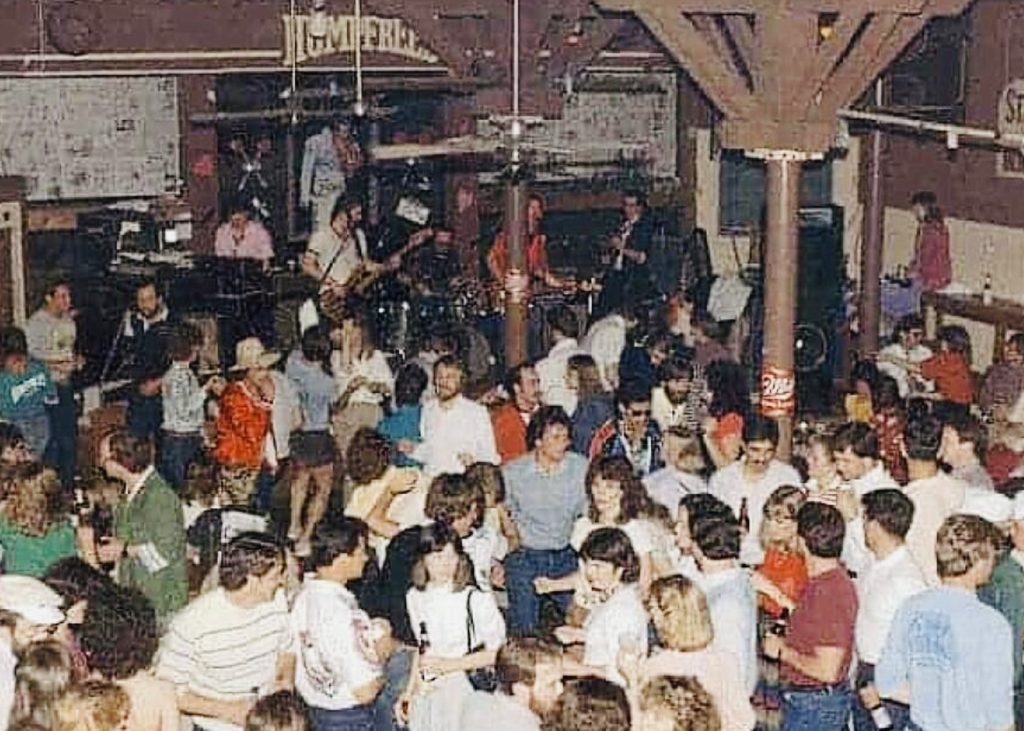
This week in 1995, legislation was enacted to close the eleven-year-old loophole in Louisiana law that permitted eighteen-year-olds to drink despite the National Minimum Age Drinking Age Act of 1984. It might not have been “The Day the Music Died,” but in Shreveport, it was widely recognized as the last nail in the coffin for Shreve Square. The Shreve Square entertainment district in downtown had sprung up the late ’70’s and early 80’s with the opening of waterholes like Cowboy’s, Steamboat Annie’s, Circle in the Square, Humpfee’s (photo), Denim & Diamonds, Drummers Inn and others. It was the place to be, but by the early 90’s, riverboat casinos, crime (and the law enforcement that accompanied it), changing tastes and other factors had reduced the district considerably. The law that changed the drinking age was widely considered to be the final blow.

August 28, 1956
The Pontchartrain Causeway, the “World’s Longest Bridge Over Water”, opened to the public today in 1956. The original Causeway was a single span containing two lanes and measuring 23.86 miles. The second two-lane span was added in 1969 and is 1/100 of a mile longer than the original span. The twin spans are constructed of prestressed panels supported by 9,000 concrete pilings. The causeway also was the first to employ assembly line techniques in fabricating and assembling a bridge. Since its completion—and especially since the completion of the second bridge, the causeway has been a primary driver in the Northshore boom in St. Tammany Parish.

August 28, 1963
Martin Luther King delivered his famous “I Have a Dream” speech today in 1963 at the March on Washington for Jobs and Freedom.Also on the program was Louisiana’s Mahalia Jackson, who had been born in New Orleans in 1911. Nationwide recognition came for Jackson in 1947 with the release of Move On Up a Little Higher, selling two million copies and hitting the number-two spot on Billboard charts, both firsts for gospel music. Jackson’s recordings captured the attention of jazz fans in the U.S. and France, and she became the first gospel recording artist to tour Europe. She regularly appeared on television and radio, and performed for many presidents and heads of state, including singing the national anthem at John F. Kennedy’s Inaugural Ball in 1961. Motivated by her experiences living and touring in the South and integrating a Chicago neighborhood, she participated in the civil rights movement. At the March on Washington for Jobs and Freedom on August 28, 1963, she sang, “I’ve Been ‘Buked, and I’ve Been Scorned, and How I Got Over.

August 29, 2005
It was the storm that changed everything. Hurricane Katrina came ashore today in 2005, killing more than 1500 people, leaving more than two million homeless and causing damage that may never be repaired. Over fifty breaches in New Orleans’s hurricane surge protection were the cause of most of Katrina’s death and destruction. Eventually 80 percent of the city and large tracts of neighboring parishes became flooded, and the floodwaters lingered for weeks. According to a modeling exercise conducted by the U.S. Army Corps of Engineers, two-thirds of the deaths in Greater New Orleans were due to levee and floodwall failure.

August 29, 2021
As this had been the date in 2005 when Katrina had come ashore, Louisianians sat in dread of what might happen today in 2021, when Ida, a Category 4 monster, was poised to come ashore near Port Fourchon in Lafourche Parish. In terms of maximum sustained winds of 150 mph at landfall, Ida tied with 2020’s Hurricane Laura and the 1856 Last Island hurricane as the strongest on record to hit Louisiana. Thirty people in Loiusiana perished as the storm caused approximately $55 billion in damages across the state, which was alreay suffering the effects of the Covid pandemic. Grand Isle was completely devastated, and heavy flooding and wind damage were recorded from Morgan City to Gulfport.

August 30, 1974
Today in 1974 Fort Livingston near Grand isle was was listed on the National Register of Historic Places. In the early 19th century, Grand Terre Island was the home to pirates under the command of Jean Lafitte. These pirates were forced to leave the island after the War of 1812 so the U.S. government could build a coastal defense fort. The fort was named after Edward Livingston who had held positions as Mayor of New York City, U.S. Senator from Louisiana, and U.S. Secretary of State under President Andrew Jackson. Plans for the fort by Lieutenant H. G. Wright called a trapeziform stronghold surrounded by a wet ditch and by outworks on the land side. The walls were constructed of cemented shell, faced with brick, and trimmed with granite. The fort was never complete. Today, the remains of the fort are only accessible by boat.

August 30, 1874
A year after the Colfax Massacre in neighboring Grant Parish, Thomas Floyd, an African American state senator was murdered in Brownsville. Members of the White League arrested several white Republicans and twenty freedmen, accusing them of plotting a rebellion. Within two days, hundreds of armed whites arrived in Coushatta, and Republican officeholders including the sheriff, parish attorney and tax collector were taken hostage. The officeholders were forced to sign statements promising to leave Louisiana immediately. As they left, six of the captives were murdered by a band of armed whites. At the same time, at least four African Americans in the parish were attacked and killed in what would be known as the Coushatta Massacre.

August 31, 2005
Two days after much of New Orleans and Southeast Louisiana were devastated by Hurricane Katrina and its aftermath, state senator Nick Gautreaux of Abbeville contacted Lafayette TV stations asking them to broadcast a public service announcement: Every able-bodied citizen with a boat is invited to show up at the Acadiana Mall on Johnston Street in Lafayette by 5 o’clock tomorrow morning and drive to New Orleans to help rescue stranded flood victims.” Gautreaux expected 30 to 40 boats and hopefully 100 people to come and form this citizen flotilla. But, incredibly, 300 to 500 boats showed up along with 600 to 800 people – from Lafayette, Abbeville, Lake Charles, Opelousas and other Acadiana communities. In other communities men and women with good hearts–and boats–were doing likewise, inclduding Todd Terrell of Baton Rouge, who would later become the founder and president of the United Cajun Navy. Overall, the Cajun Navy would be credited with rescuing over 10,000 storm victims in Southeast Louisian. “What we did was typical Louisiana,” Gautreaux would say later. “We had doctors, lawyers, college students, nurses, working class people…. It’s part of our Cajun heritage to help our neighbor.”

August 31, 1927
Geoffrey Beene was born in Haynesville this week in 1927. He was born into a family of doctors as Samuel Albert Bozeman, Jr., and he was encouraged to follow in his father’s and uncles’ footsteps. After three years of studying medicine at Tulane, he realized that he was the only one of his classmates drawing clothes on anatomical figures. He dropped out and moved to Los Angeles, where he studied fashion design at USC and worked in the display department of the I. Magnin before moving to New York in 1947. He would become one of New York’s most famous fashion designers, creating simple, comfortable and dressy women’s wear.